Korean Food Delivery: What Does My Family Order, and When?
I enjoy cooking for my family at home. That does not mean I prepare every meal myself, however. When I am short on time or craving something a little more flavorful than usual, I open a food delivery app on my phone.
With just a few taps, I can have fried chicken, pizza, jajangmyeon, sashimi, jokbal, or even chicken baeksuk delivered to my home. On weekend mornings, we sometimes order sandwiches to enjoy with coffee. Korean food delivery is no longer something we use only when we cannot prepare dinner. It has become another way to choose a meal based on what we want to eat and the situation that day.
The food my family orders most often is Korean fried chicken. Our second most common choice is a set with jajangmyeon and tangsuyuk. Looking back through the photos I have taken, however, I realized that the range of delivery food we have ordered is much wider than I expected.
Delivery Food Is Not Always a Simple Meal
People encountering Korean food delivery for the first time may initially think of familiar choices such as fried chicken or pizza. My family also orders both fairly often. In Korea, however, it is also possible to have large dishes made for sharing and meals with many different components delivered to your home.
One evening, we ordered a spicy seafood dish that came with a savory pancake, fried rice, kimchi, and side dishes. Once I had taken all the containers out and set out plates and chopsticks, the meal covered much more of the table than an ordinary dinner.
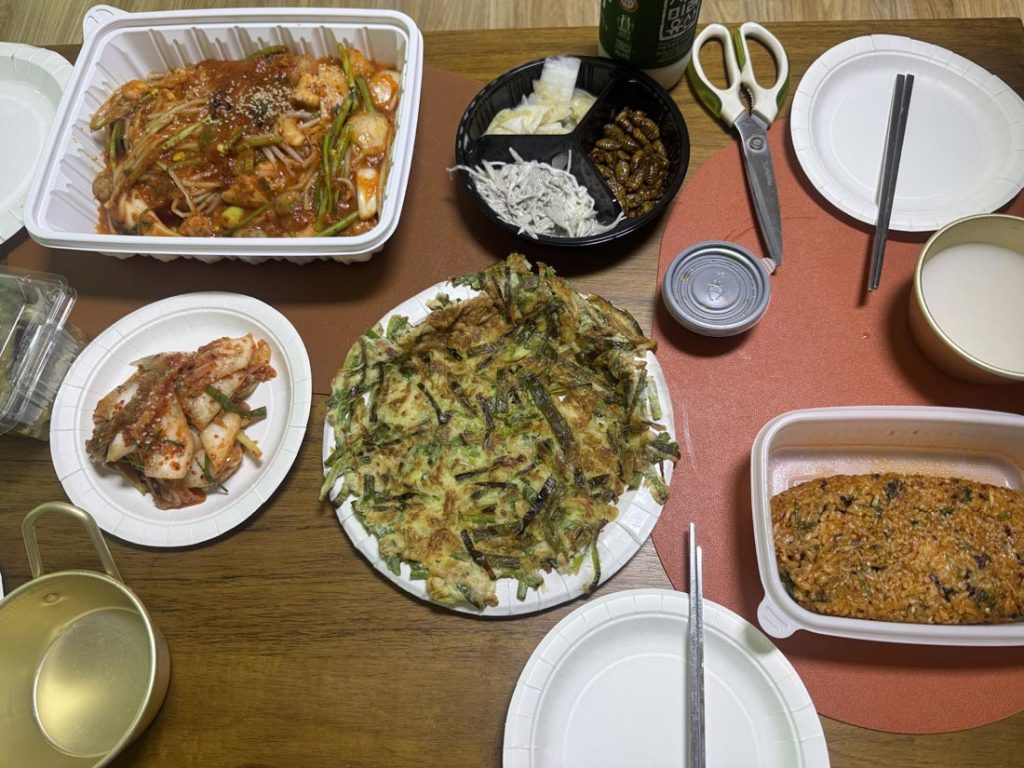
This type of meal is good for families who want to place several dishes in the middle of the table and share them rather than eat just one dish each. We sometimes eat directly from the delivery containers, but transferring the pancake and kimchi onto plates can make the meal look more like something prepared at home.
More food does not necessarily make a delivery meal more convenient, though. All the containers need to be opened and cleared away, and leftovers have to be stored separately. Ordering delivery saves us from cooking, but the amount of packaging left afterward is one drawback.
The Fried Chicken and Korean Chinese Food My Family Orders Most Often
Korean fried chicken is the delivery food I order most frequently. I prefer a half-and-half order with one half seasoned chicken and the other half plain fried chicken. It means I do not have to choose only one flavor, and everyone in the family can eat the kind they prefer. I enjoy the combination of plain fried chicken and beer, while my children like the sweetness of seasoned chicken.
Some days, we order pizza and chicken together. In the photo, there is a whole pizza, pieces of fried chicken, chicken wings, salad, pickles, and chicken-mu, or Korean pickled radish, on the table. With drinks and dipping sauces added, it feels quite different from a meal cooked at home.
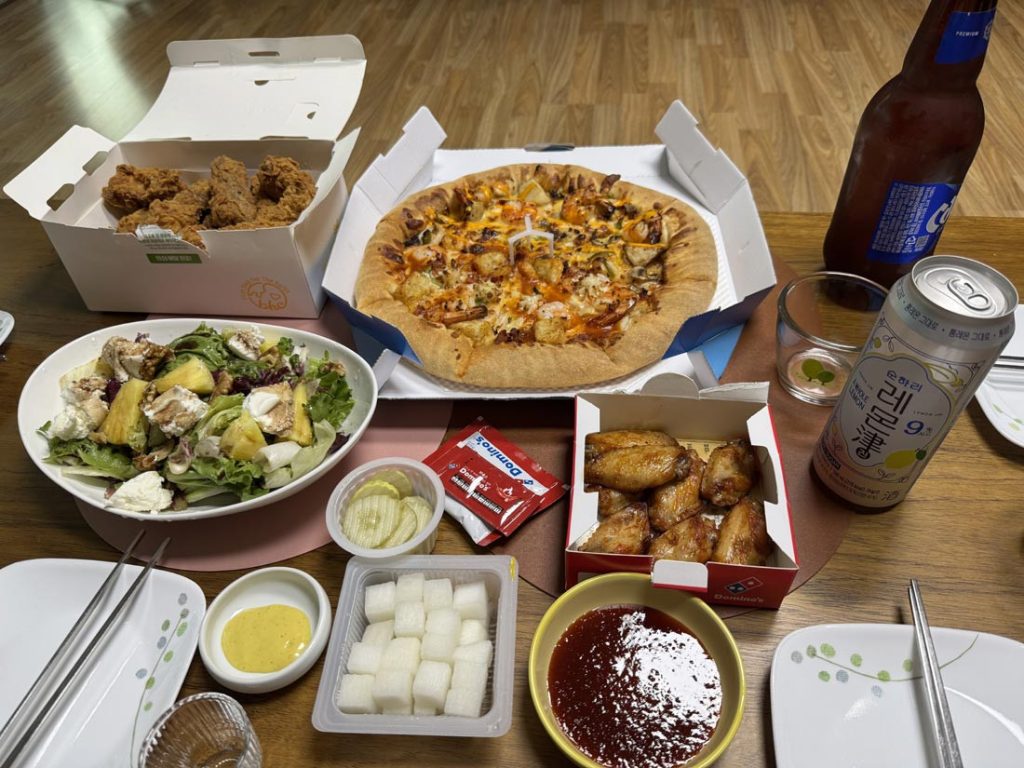
Chicken and pizza are easy to share, with everyone taking as much as they want. On the other hand, ordering both can easily leave us with too much food. I dislike running out in the middle of a meal, so I tend to order a little more than we need. As a result, we sometimes cannot finish everything.
This is one of my habits that my wife dislikes. I would rather have food left over than not have enough, but from her perspective, I order more than necessary and create extra work because the leftovers have to be stored. In our home, deciding how much to order can sometimes be more difficult than choosing what to eat.
After chicken, the meal we order most frequently is a jajangmyeon and tangsuyuk set. Jajangmyeon is a Korean Chinese noodle dish mixed with a dark chunjang sauce. Tangsuyuk consists of fried pork served with a sweet-and-sour sauce.
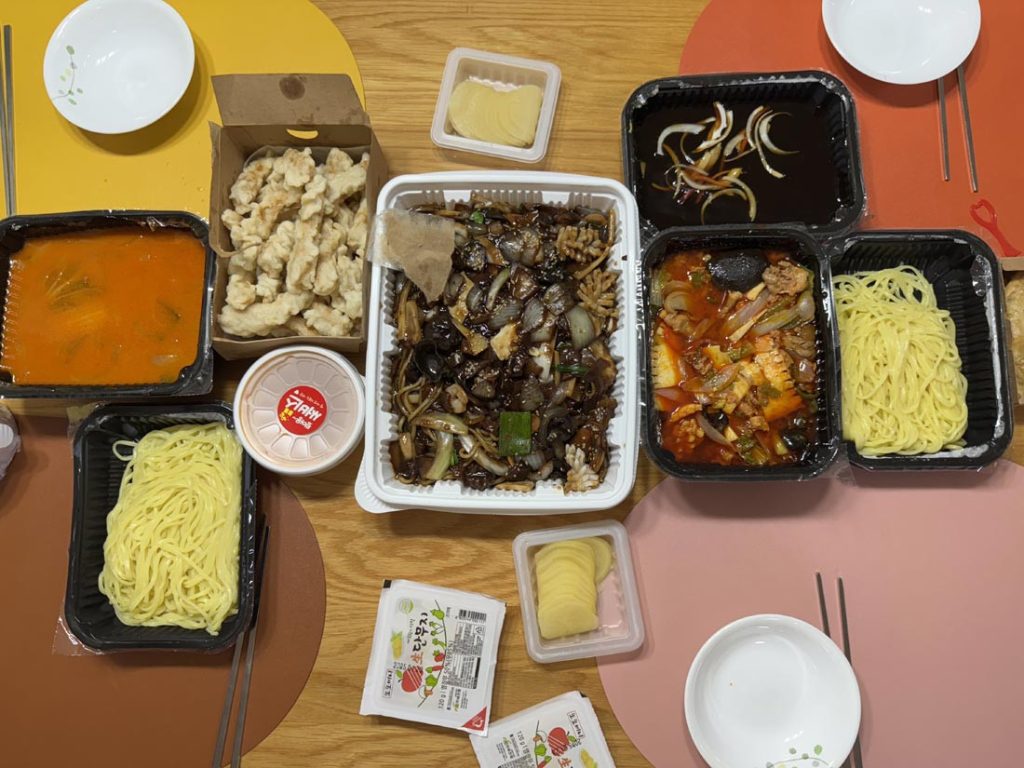
Personally, I think jajangmyeon and tangsuyuk taste better when eaten immediately at a restaurant. The noodles can soften over time, and the texture of the tangsuyuk may change while it is being delivered.
Even so, we order this meal frequently because it is convenient. I can select the dishes on a delivery app, tap the screen a few times, and have the food brought to our home. We do not have to get ready to go out or travel to a restaurant. A restaurant meal may sometimes taste better, but when convenience is part of the decision, we often end up ordering it again.
Delivery Choices Range From Full Meals to Food Served With Drinks
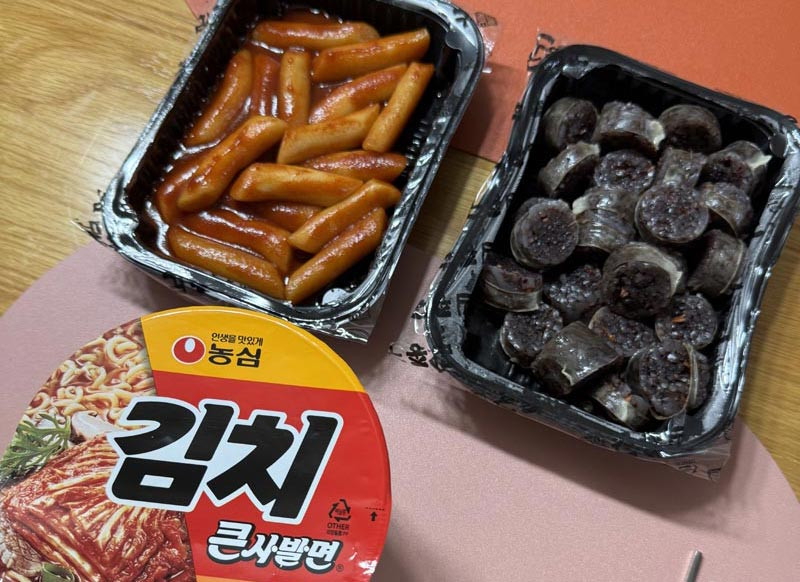
Tteokbokki and sundae are commonly eaten together in Korea. Tteokbokki consists of rice cakes cooked in a spicy and sweet sauce. Sundae is a type of Korean sausage typically filled with ingredients such as glass noodles. In the photo, there is also a cup of instant noodles next to the tteokbokki and sundae.
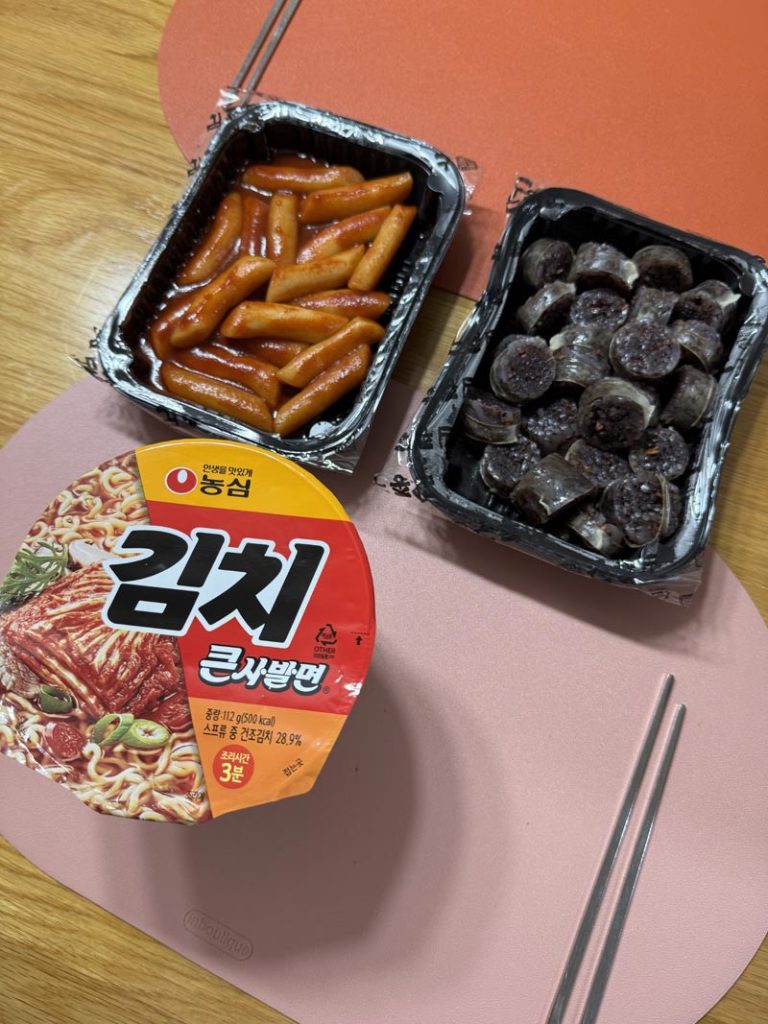
These foods can work well when we want something relatively simple, but the flavor and heat level of tteokbokki can vary from one restaurant to another. Someone who is not accustomed to spicy food should check whether the menu lists different spice levels rather than choosing based only on the name of the dish.
Korean food delivery is not limited to familiar bunsik dishes such as tteokbokki. Sashimi and yukhoe can also be delivered. The photo shows salmon sashimi, salmon topped with sauce, yukhoe, and rice in separate containers. Soy sauce, wasabi, vegetables, and other dipping sauces were delivered with them.
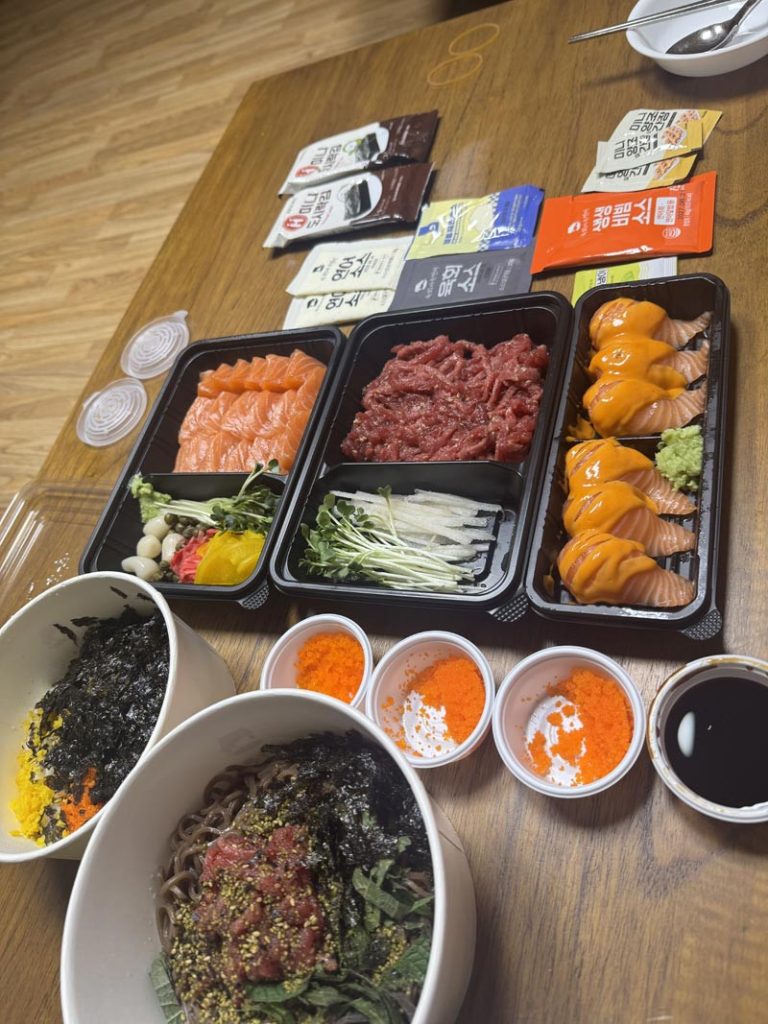
This photo shows that Korean delivery food is not limited to hot, cooked dishes. Raw foods such as sashimi and yukhoe, however, require more attention to delivery time and storage conditions than ordinary fried foods or noodle dishes. If you cannot eat them soon after they arrive, it is best to check the storage instructions before ordering.
When we crave several spicy foods at once, the table can become even more crowded. In the photo, tteokbokki, a spicy chicken dish, seafood, and fried food are packed in separate containers. A combination of several spicy dishes may taste satisfying at first but can become overwhelming as the meal continues.
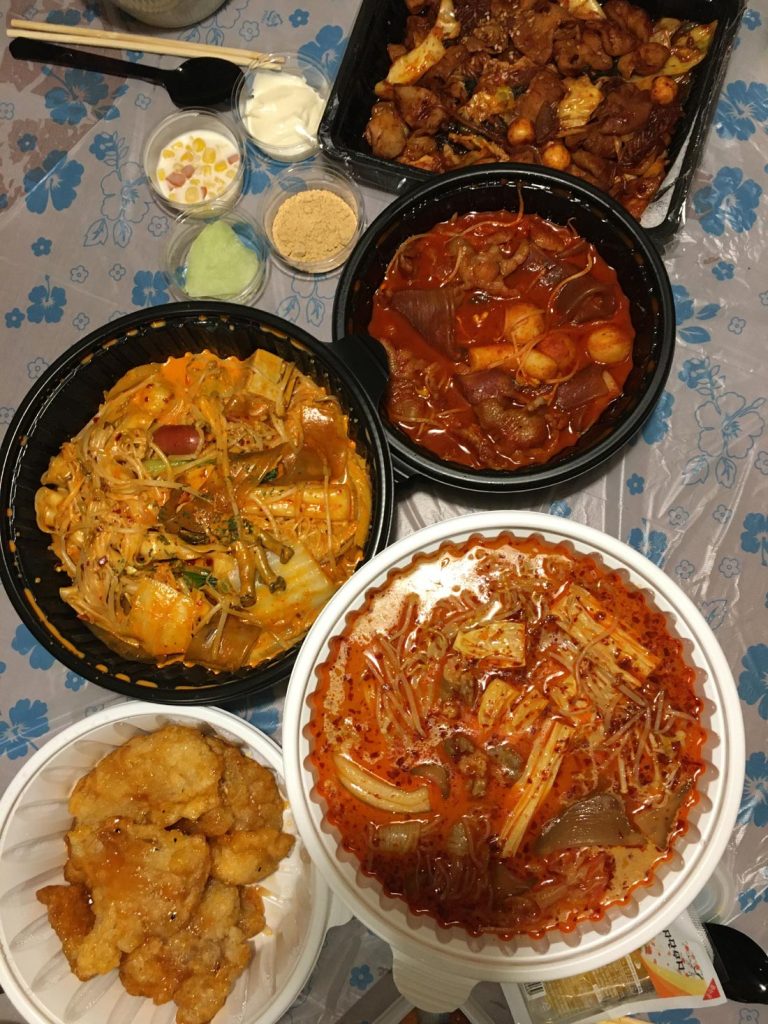
In this situation, it can be helpful to prepare a non-spicy dish or a drink rather than choosing only spicy foods. The name of an unfamiliar dish may not tell you exactly how hot it will be. Even the same type of food can vary in heat depending on the restaurant and the spice level selected.
We Also Order Dishes That Are Inconvenient to Make at Home
One day, we ordered a whole chicken served with broth and a side of makguksu. The chicken and broth arrived in large containers, along with makguksu, kimchi, and several side dishes.
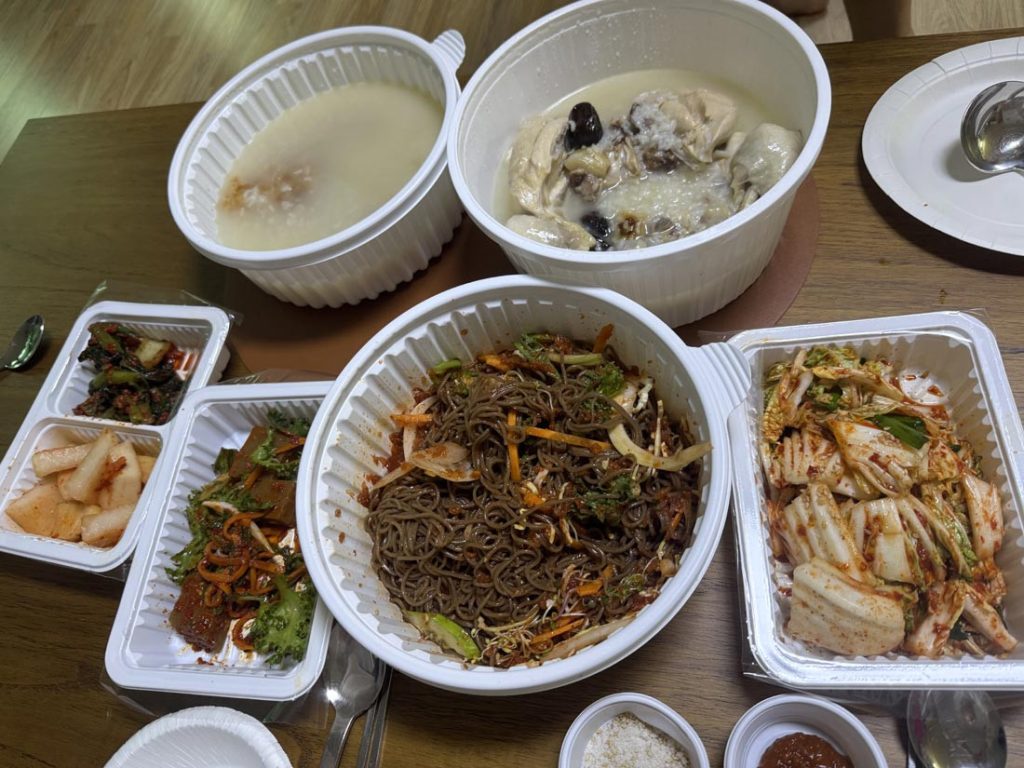
Compared with chicken or pizza, this meal looks a little closer to Korean home cooking. The warm broth, chicken, and kimchi create a Korean-style table setting even though everything was delivered. Makguksu can be eaten between bites of chicken or shared as a separate noodle dish.
Jokbal and bossam are also suitable for sharing with the family. Jokbal is made from pig’s trotters simmered in a seasoned soy sauce mixture and sliced before serving. Bossam is boiled pork typically eaten with kimchi or vegetables. The photo includes jokbal, bossam, spicy makguksu, kimchi, garlic, dipping sauces, and soup.
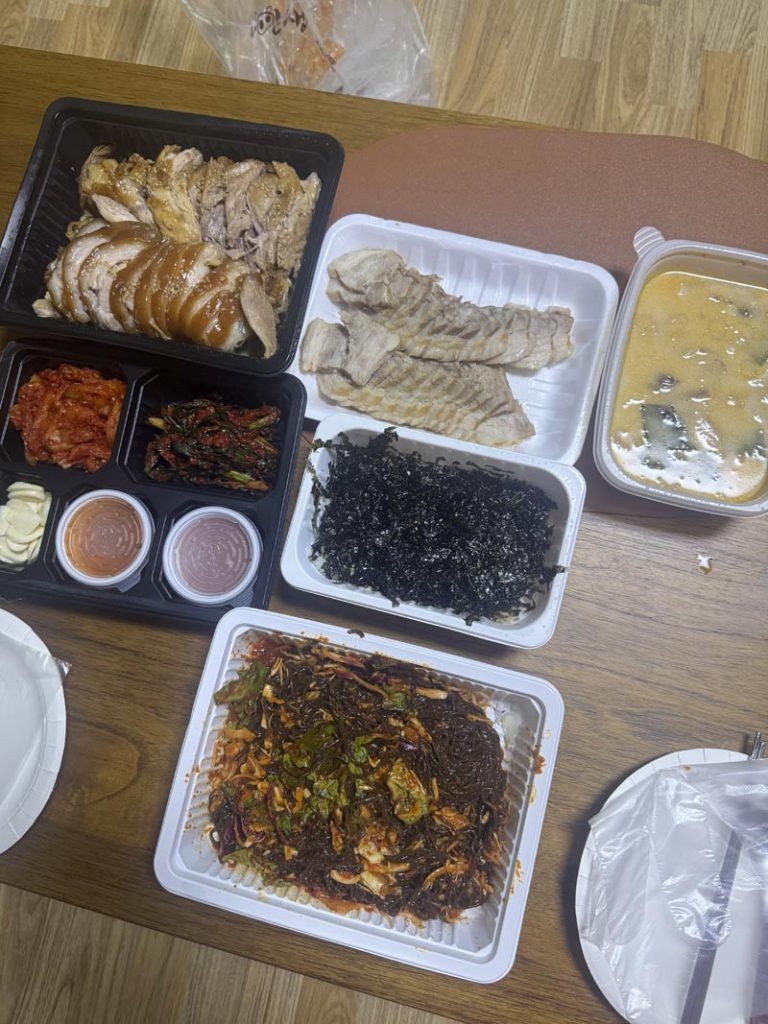
Jokbal and bossam delivery sets may include several accompaniments in addition to the meat. Once all the containers are opened, they can quickly fill the table. Wrapping the meat in vegetables or kimchi and eating makguksu between bites provides more variety than eating the meat by itself.
These sets are also among the meals for which I can easily misjudge the amount of food. I may place an order while thinking only about the meat and makguksu, but once the side dishes and accompaniments are unpacked, there can be much more food than expected. If your family disagrees about leftovers as mine sometimes does, it is a good idea to check the set contents and recommended number of servings before ordering.
What International Visitors Should Know About Ordering Food Delivery in Korea
Ordering food delivery in Korea does not mean you have to choose only Korean dishes. The range of options includes fried chicken, pizza, sandwiches, Korean Chinese food, bunsik, sashimi, and meat dishes. My family orders chicken or jajangmyeon for dinner, while on some weekend mornings, we have sandwiches and coffee delivered.
If you are ordering for the first time, there are several things worth checking in addition to the menu photos.
First, check the portion size and the recommended number of diners. Some Korean delivery meals are intended for one person, while other sets are designed to be shared by two or more people. A meal that includes many side dishes and sauces may contain more food overall than you would expect from looking only at the main dish.
Second, check the spice level. The description “spicy” does not mean the same thing to everyone. If you do not tolerate spicy food well, look for selectable spice levels, chili pepper symbols, and explanations in the menu description.
Third, consider whether the food’s texture changes easily. Noodles can soften during delivery, while steam trapped inside a container can make fried food less crisp. These dishes are usually best eaten soon after they arrive.
Finally, do not rely only on a dish’s name if you have food allergies or dietary restrictions. Sauces and broths may contain ingredients that are not immediately visible. A dish that appears to contain no meat may still use a meat- or seafood-based broth. Contact the restaurant before ordering when confirmation is necessary.
Food Delivery Is Convenient, but the Person Ordering Still Has Choices to Make
For me, delivery food is not something I order only because I do not want to cook. I also choose it when I crave a dish that is inconvenient to make at home, when I do not have enough time, or when I want stronger flavors than usual. On weekend mornings, I sometimes use delivery when I want a simple sandwich and coffee.
The convenience of a delivery app does not make every task disappear after the food arrives, however. Ordering too many dishes creates leftovers, and multiple containers have to be cleared away. Fried foods and noodles can also change in taste and texture as time passes.
I will probably continue choosing half seasoned and half plain fried chicken, and I will order jajangmyeon and tangsuyuk again even while remembering how they taste at a restaurant. Still, knowing how much my wife dislikes having too many leftovers, I may need to check the quantity one more time before tapping the order button.
If you are trying Korean food delivery for the first time, it is better to begin with one or two dishes suited to the size and preferences of your group rather than ordering many famous foods at once. You can start with familiar choices such as fried chicken or jajangmyeon, or try a more distinctly Korean combination such as jokbal and makguksu. What matters most is not how many dishes you order, but ordering an amount you can enjoy while the food is still at its best.