CLAYMORE Selene Review: Is This Mood Lantern Worth the Extra Space?
The CLAYMORE Selene Review comes down to one practical question: does its unusually warm, atmospheric light justify carrying a 660-gram lantern that occupies considerably more space than a compact LED model?
I’m K-papa, a creator living in South Korea. This is a research-based review, not a hands-on test. I compared CLAYMORE’s Korean specifications with four Korean owner reports, paying particular attention to where their experiences overlap—and where attractive campsite photos can hide the product’s limitations.
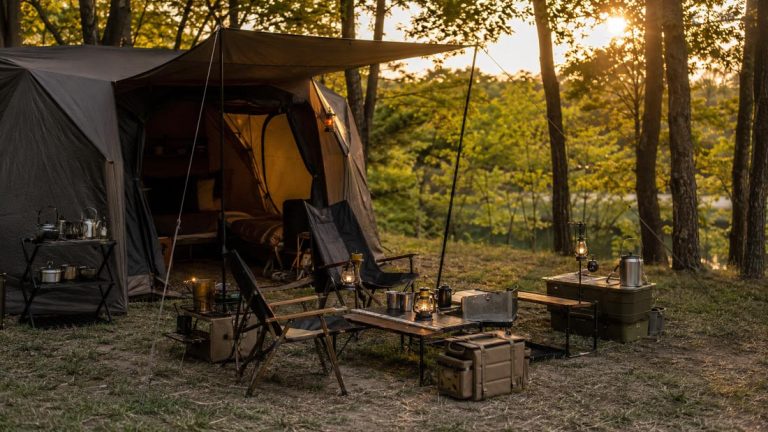
The Selene is not simply a utility lantern dressed in vintage styling. Its four lighting modes, continuously adjustable brightness, detachable shade, and 660-lumen maximum give it a genuine dual role: campsite mood light and functional table lantern.
That combination works. But it makes the most sense for car campers, families, and people who care about how their campsite feels after sunset. Minimalists and solo campers can solve the basic lighting problem with something smaller and less elaborate.
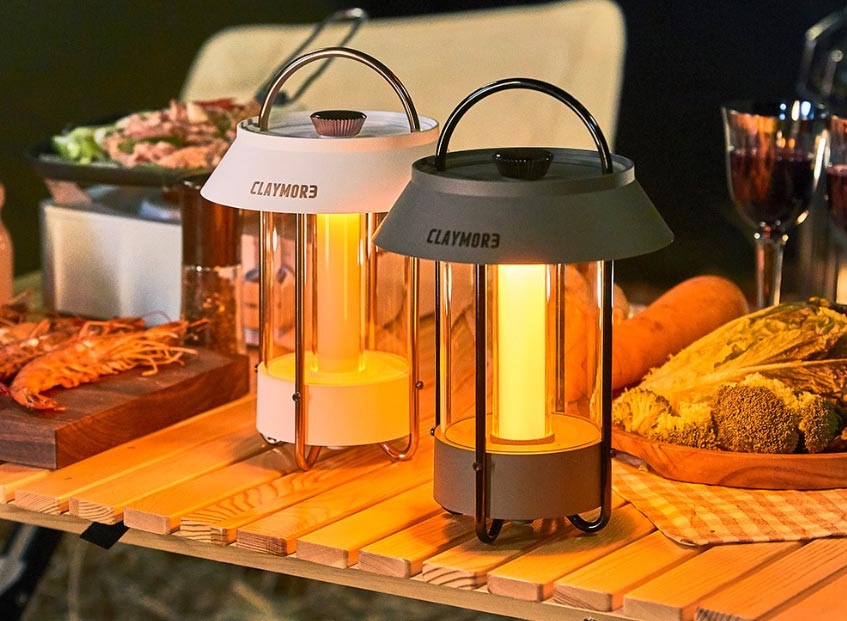
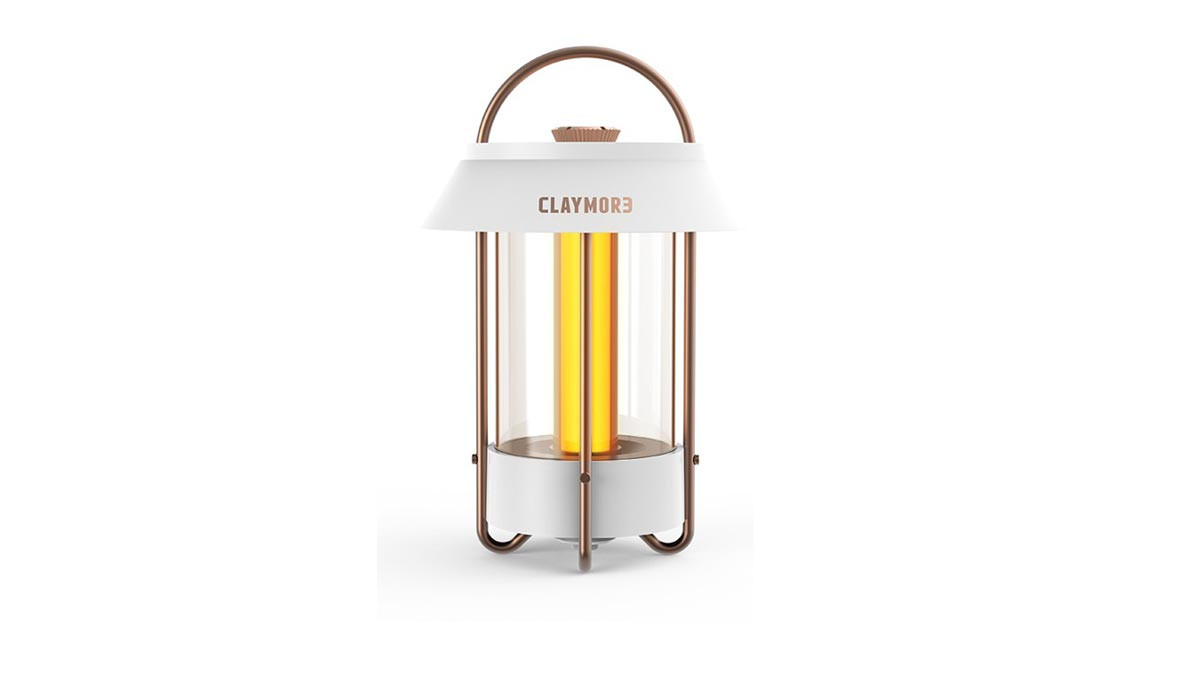
Product images courtesy of CLAYMORE official website.
The Short Answer: Buy It for the Light, Not Just the Design
The CLAYMORE Selene is worth considering if you want one rechargeable lantern that can move from a soft, flame-like glow to useful table lighting without changing diffusers or carrying a second mood light.
Its strongest qualities are closely connected:
- Four genuinely different warm-light modes
- Fine brightness control through a rotary dial
- Up to 660 lumens for practical campsite use
- A broad, diffused light that feels softer than a directional work lamp
- A detachable shade that changes both the appearance and light distribution
- USB-C charging and power-bank output
- A bottom tripod socket for elevated placement
The compromises are just as connected. Its traditional lantern shape creates the atmosphere, but that shape also makes it bulky. The fixed handle and loosely seated shade can be inconvenient during transport, while the long charging time demands more preparation than a small backup lantern.
Buy: for car camping, family camping, glamping-style setups, or a lantern that will also be used at home.
Consider carefully: if this needs to be your only main lantern for a large campsite.
Skip: for backpacking, highly compact solo camping, or situations where maximum light per gram matters more than atmosphere.
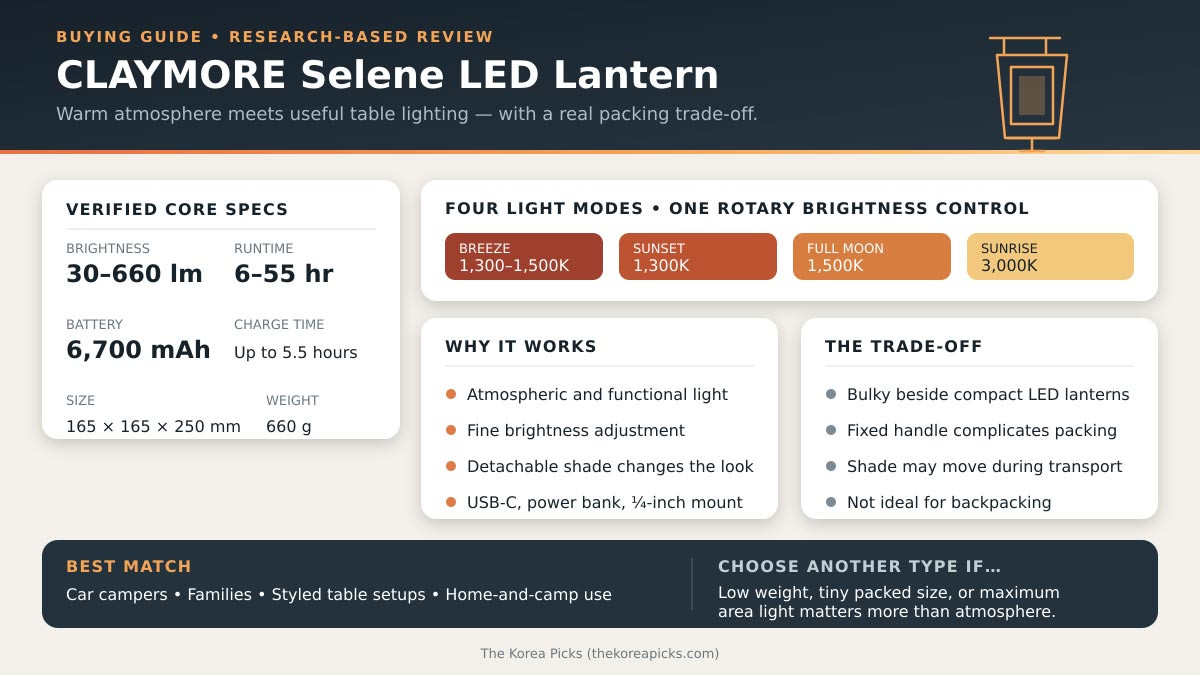
A quick buying guide to the CLAYMORE Selene’s lighting modes, core specifications, practical strengths, and packing trade-offs.
Four Light Modes That Change More Than the Color
Many rechargeable lanterns advertise several color temperatures, but the differences can feel cosmetic. The Selene’s range is more purposeful because it extends from extremely warm orange light to a more practical 3,000K setting.
| Mode | Approximate color temperature | Best suited to |
|---|---|---|
| Breeze | 1,300–1,500K | Flame-like ambience and quiet evenings |
| Sunset | 1,300K | Deep orange table lighting |
| Full Moon | 1,500K | Warm dining or bedside light |
| Sunrise | 3,000K | General illumination, reading, and campsite tasks |
Breeze mode adds a flickering effect intended to resemble a candle or small fire. It is the least practical choice when preparing food or searching through gear, but it gives the Selene a character that an ordinary warm-white lantern cannot reproduce.
Sunset and Full Moon sit close together on paper. Korean owners generally describe the distinction as subtle rather than dramatic: Sunset appears redder, while Full Moon moves toward a softer yellow. That is an important expectation to set. Buyers hoping for four radically different colors may be disappointed; buyers who notice small changes in warm light are more likely to appreciate them.
Sunrise is the practical counterweight. At 3,000K, it remains warmer than cool-white work lighting but makes objects easier to see than the orange modes. This is the setting that prevents the Selene from becoming an expensive decorative lamp with limited camping value.
One Korean owner described using the warmer modes around the table and the brighter mode for indoor reading. Another considered the differences between the orange settings minor at first, then more noticeable when comparing them directly. Together, those observations suggest that the modes matter most after dark and in a space without competing artificial light.
At an already illuminated glamping site or urban campground, much of the effect can disappear.
Is 660 Lumens Enough for Real Camping?
CLAYMORE rates the Selene from 30 to 660 lumens. Brightness is adjusted by turning the top control rather than being restricted to only a few fixed levels.
One Korean review refers to “three-stage brightness,” but the manufacturer’s documentation and other owner descriptions show rotary, fine-level adjustment. The most reasonable interpretation is that the reviewer was simplifying how they used the lantern rather than documenting its complete control system.
At the upper end, 660 lumens should be useful over a camping table, inside a modest shelter, or as part of a layered lighting setup. Korean owners repeatedly describe it as brighter and more functional than its mood-lantern appearance suggests.
It should not automatically be treated as a complete replacement for a high-output area light, though.
Lantern performance depends on more than the lumen number. Placement, shade position, tent fabric, table height, and competing lights all change how bright a campsite feels. The Selene’s diffused design favors comfortable nearby illumination rather than throwing a concentrated beam across a large site.
That makes the Selene most convincing in one of these roles:
- The main table lantern at a small campsite
- A warm secondary lantern beside a brighter area light
- A tent or shelter light when positioned carefully
- A home mood light between camping trips
For a large family shelter, a wide outdoor kitchen, or a site where one lamp must illuminate everything, a higher-output utility lantern would be the safer primary choice. The Selene can then handle the table and seating area, where its softer light has more value.
From my perspective as a Korean product editor, this is the key distinction: 660 lumens makes the Selene practical, but the quality and character of its light are still the real reasons to pay for it. If brightness is the only goal, simpler lanterns can deliver more output for less money and less packed volume.
Battery Life Is Strong, but the Maximum Figure Needs Context
The Selene uses a 6,700mAh lithium-ion battery rated at 24.12Wh. CLAYMORE specifies an operating range of approximately 6 to 55 hours, depending on mode and brightness.
That wide range deserves more attention than the headline “up to 55 hours.”
The maximum figure applies to low-output use. At the opposite end, full brightness shortens the stated runtime to around six hours. A camper alternating between moderate table light and low mood lighting should land somewhere between those extremes, but the available Korean reviews do not provide controlled runtime measurements.
One owner reported that it comfortably covered a one-night camping trip without recharging. Other reviews simply described the battery as lasting a long time. Those are useful signals for ordinary weekend use, but they are not substitutes for a timed battery test.
Charging is through USB-C with a specified 5V/2A input, and the listed maximum charging time is approximately 5.5 hours. That is manageable when the lantern is charged at home before departure. It becomes less convenient if you arrive with an empty battery and expect a quick top-up at camp.
The USB output also allows the Selene to serve as an emergency power bank at 5V/2A. It is a helpful backup feature, not free energy: charging a phone reduces the remaining lantern runtime.
Battery capacity will also decline with age. CLAYMORE’s Korean support information explains that the lithium-ion battery is a consumable component affected by charging cycles, temperature, storage conditions, and repeated full discharge. Anyone buying older inventory or a used Selene should therefore ask about purchase date and battery condition rather than judging the lantern by its exterior alone.
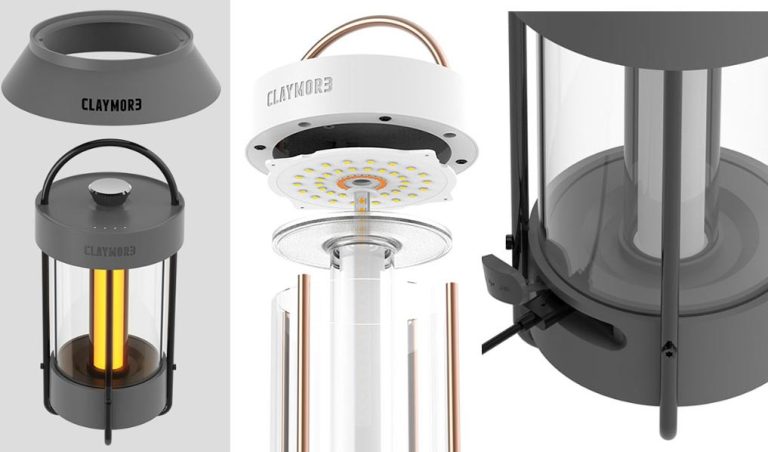
The Detachable Shade Creates the Look—and a Packing Problem
The Selene measures approximately 165 × 165 × 250 mm and weighs 660 grams. Those numbers do not sound extreme beside large camping equipment, but its cylindrical body and wide shade consume more usable storage space than a flat panel light or compact hanging lantern.
This is the clearest pattern across the Korean owner material.
Owners praise the classic profile, especially with the shade attached. They also mention that the case and assembled shape are larger than expected. One owner comparing the Selene with CLAYMORE’s Cabin lantern considered the Selene’s storage volume a meaningful disadvantage.
Another owner pointed out two design details that are easy to miss online:
- The carrying handle is fixed rather than folding completely out of the way.
- The detachable shade rests in position and may move or rattle when the lantern is carried.
These are not major faults once the lamp is placed on a table or stand. They matter while packing, unloading, and moving it around a campsite.
The shade can be removed for a different appearance and potentially broader light exposure. Even so, this is not a lantern designed around minimum volume.
That trade-off is reasonable for car camping. A 660-gram lamp is unlikely to decide whether a vehicle can carry the load, and the visual benefit may justify reserving space in a storage box. For backpacking or compact solo setups, the same calculation changes completely.
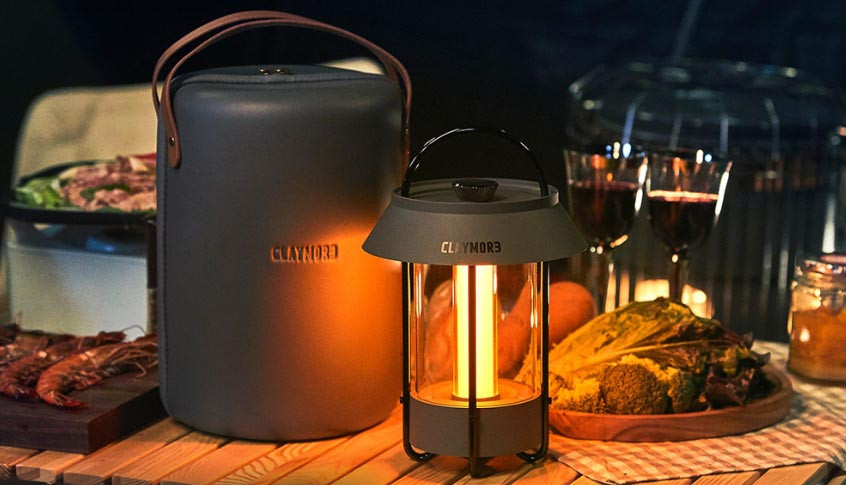
Korean camping culture often treats the table and seating area as a temporary outdoor living room. In that setting, lighting is both equipment and part of the campsite design. The Selene fits that style particularly well. An ultralight lantern does the job of making darkness go away; the Selene is meant to shape what the evening space feels like.
Video source: This Korean-language owner review is included for additional visual context. The opinions expressed in the video belong to its creator and do not necessarily reflect the views of The Korea Picks.
Table, Stand, or Tent: Placement Changes Its Value
The built-in handle lets the Selene sit or hang like a traditional lantern. A standard 1/4-inch socket on the bottom also allows it to connect to compatible tripods, lantern stands, clamps, and related accessories.
That mounting option is more than a decorative extra.
Placed directly on a table, a lantern can create glare at eye level or leave gear casting hard shadows. Raising the Selene above the table spreads the light over food, cookware, and seating more evenly. Several Korean users favor stand-mounted setups partly for this reason and partly because the elevated lantern resembles a small streetlamp.
Before buying an accessory, check its load capacity, screw compatibility, and stability. One Korean owner found a separate tripod surprisingly bulky and heavy. A large stand can undermine the Selene’s portability advantage if it is purchased without considering the complete packed setup.
The lantern also works indoors as a bedside or living-room mood light. This is not merely a fallback use invented for marketing. Its warmer settings, diffused glow, and familiar lamp shape make more sense inside a home than the exposed LEDs and rugged housings of many camping lights.
That extra use can strengthen the value argument. A product taken out only a few weekends per year has to work hard to justify its space and cost. A lantern used at home between trips is easier to defend.
Who Should Choose the Selene—and Who Should Choose Another Light?
The Selene is best for buyers who recognize themselves in several of these conditions:
- You usually camp by car rather than carrying everything on foot.
- The table or seating area is the visual center of your campsite.
- Very warm light is preferable to cool, clinical illumination.
- You want mood lighting without a flame or fuel canister.
- You appreciate continuous brightness adjustment.
- You will use the lantern at home as well as outdoors.
- A 660-gram lantern and its protective storage space are acceptable.
A less expensive compact rechargeable lantern is the better decision when:
- Packed size matters more than appearance.
- You need a lightweight light for backpacking or solo camping.
- Your campsite already has strong ambient lighting.
- You mainly need a tent light or emergency backup.
- You rarely use low, warm mood settings.
- A fixed handle and separate shade would complicate packing.
A high-output panel or area lantern is more appropriate if the first priority is illuminating a large shelter, cooking station, or family campsite. It may not create the same atmosphere, but it will spend less of its design budget on styling.
There is also another option within CLAYMORE’s mood-lantern range. Buyers interested in a different form and mosquito-mat heating function can read the CLAYMORE Lamp Athena Review: Mood Lighting and Mosquito Mat Heating in One Lantern. The better choice depends on whether the Selene’s brighter, streetlamp-like presence or the Athena’s additional warm-weather function matters more.
The Buying Decision
Buy the CLAYMORE Selene if warm light is part of how you enjoy camping, you have room in the car, and you want one lantern that can handle both relaxed table ambience and moderately bright practical lighting.
Consider it with a second main light if you camp on a large site. The Selene is most persuasive near people, food, and furniture—not as a distant floodlight trying to cover the entire campsite.
Skip it if you are attracted mainly by the photos but normally prioritize compact packing. The wide shade, fixed handle, 660-gram weight, and approximately 25-centimeter height are not minor details. A smaller rechargeable lantern will be easier to carry and can still provide warm light.
K-papa’s editorial judgment is that the Selene earns its premium through range rather than raw performance. Breeze mode, three warm color profiles, fine brightness adjustment, and stand compatibility create several believable uses from dinner through late-night conversation. That is more meaningful than adding decorative modes that owners rarely select.
Still, the best buyer is not simply someone who thinks the Selene looks beautiful. It is someone whose camping routine gives that beauty a job to do.
Product images courtesy of CLAYMORE official website.
How I Researched This Review
This review is based on CLAYMORE’s official Korean product documentation, the brand’s published specifications and support information, and four Korean owner articles supplied for comparison. I separated manufacturer-rated figures from individual observations and looked for repeated patterns involving light modes, controls, battery use, mounting, storage size, and design limitations.
I have not personally purchased, measured, charged, or used the CLAYMORE Selene. Runtime and brightness figures in this article are manufacturer specifications unless clearly described as an owner’s experience. Overseas availability, current pricing, included case, warranty coverage, and package contents should be confirmed with the seller before purchase.
Frequently Asked Questions
Can the CLAYMORE Selene serve as a campsite’s main lantern?
It may be sufficient for a table, smaller shelter, or compact campsite at up to 660 lumens. A large family setup will usually benefit from a separate high-output area light.
Does the Selene have fixed brightness levels?
CLAYMORE’s documentation shows that brightness is adjusted by rotating the top control, allowing finer adjustment than a simple low-medium-high system. Pressing the control cycles through the four lighting modes.
How long does its battery last?
The official operating range is approximately 6 to 55 hours, depending on brightness and mode. The 55-hour figure represents low-output use, not continuous operation at 660 lumens.
Is the shade permanently attached?
No. The shade is detachable, allowing two visual and lighting arrangements. Because it rests on the lantern rather than locking tightly into place, it should be secured carefully during transport.
Is the Selene a good backpacking lantern?
Not for most backpackers. It weighs about 660 grams and measures roughly 165 × 165 × 250 mm. Compact rechargeable or ultralight hanging lanterns offer a more efficient weight-to-light ratio.
DID YOU KNOW? Korea
At many Korean car-camping sites, lighting is treated as part of the campsite layout rather than as a single piece of emergency equipment. Campers may combine a bright task light around the cooking area with warmer lanterns near the table and chairs.
This helps explain why lanterns such as the Selene are designed to do more than produce the highest possible lumen number. The color and spread of the light matter because the campsite often functions like an outdoor living room after sunset.
K-papa’s Quick Korean Lesson!
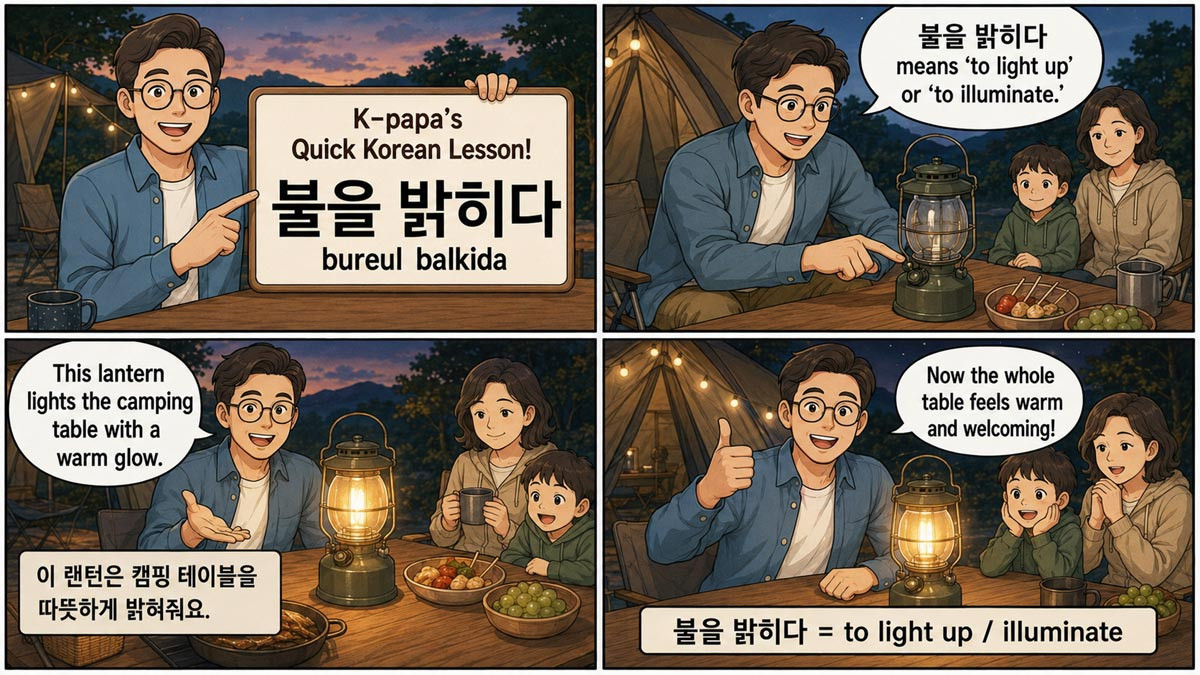
Korean phrase: 불을 밝히다
Romanization: Bureul balkida
Pronunciation: boo-reul bal-gee-da
Meaning: To light up or illuminate
Example:
이 랜턴은 캠핑 테이블을 따뜻하게 밝혀줘요.
I raenteoneun kaemping teibeureul ttatteuthage balkyeojwoyo.
This lantern lights the camping table with a warm glow.
About the Author
K-papa is a creator living in South Korea who examines Korean products and everyday culture for international readers. His reviews separate verified specifications, recurring user experiences, and editorial judgment so readers can make a practical buying decision. Learn more about K-papa and The Korea Picks.