KOVEA Container Stove Review: A Palm-Size Korean Burner Built for Serious Camp Cooking
Quick Verdict: This KOVEA Container Stove review is based on KOVEA’s official specifications and four Korean user reviews.
Best for: Car campers and van campers who want a compact single-burner stove that supports small-to-medium camp cookware.
Biggest strength: It folds to just 83 × 124 × 85 mm, yet opens into a broad pot-support platform rated for cookware up to 22 cm and loads up to 10 kg.
Know before buying: Its 739 g packed weight is reasonable for car camping but heavy for backpacking. Low-heat control also appears less convincing than high-output cooking, based on one owner’s experience.
Skip it if: You need an ultralight stove, routinely cook in exposed wind, or cannot reliably obtain the specified 220 g nozzle-type butane canisters.
Bottom line: The Container Stove is not simply a design piece. Its compact folding mechanism, wide supports and strong burner make it a credible car-camping cooker. International buyers should confirm fuel availability and local canister compatibility before paying an import premium.

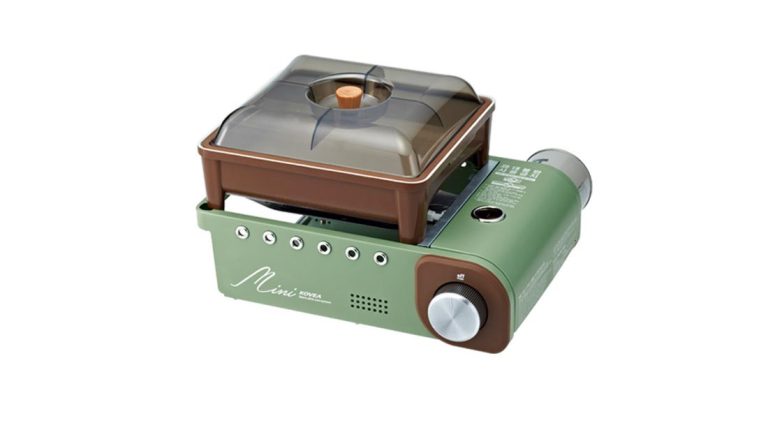
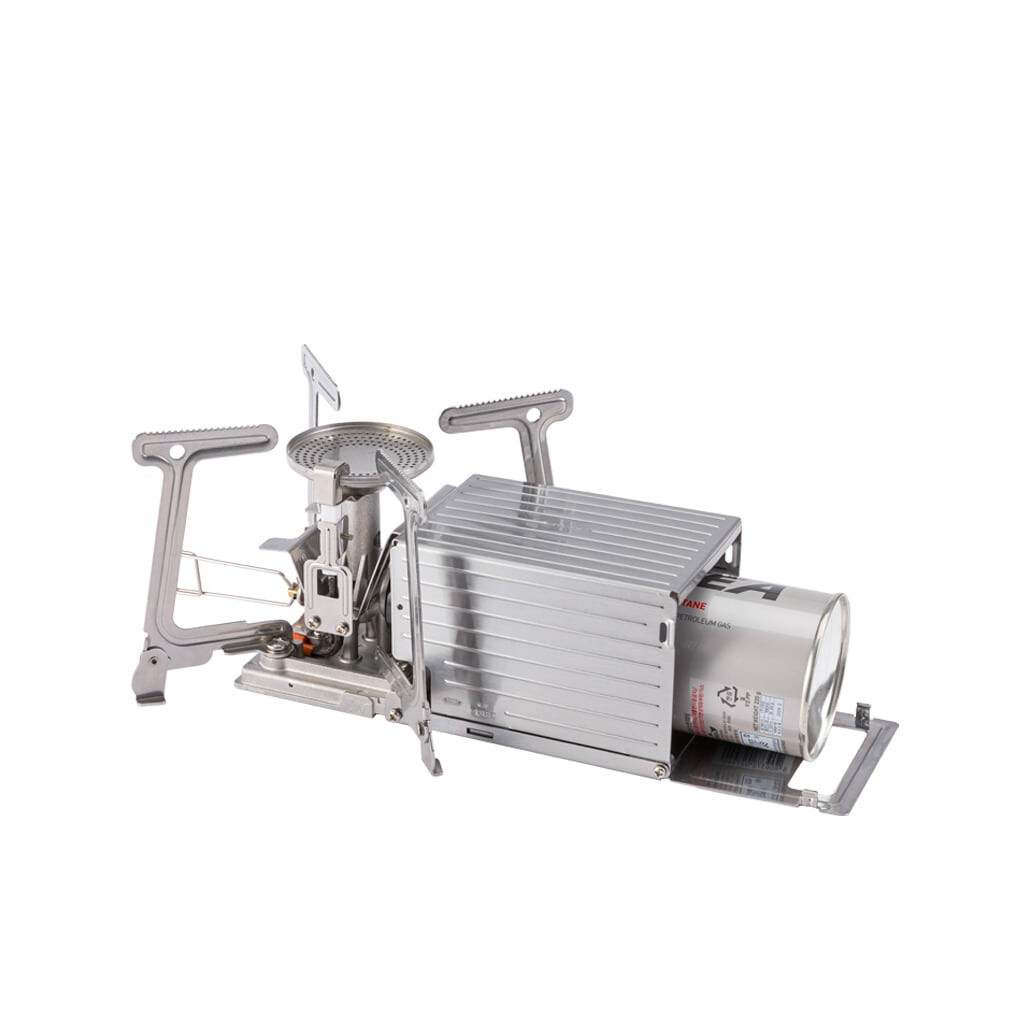
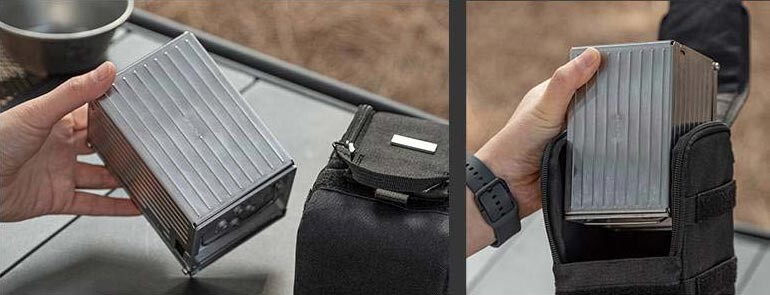
The KOVEA Container Stove is an unusual Korean camping burner. Closed, it resembles a ribbed metal cargo box small enough to sit on one hand. Open the cover and unfold the supports, however, and it becomes a table-top stove designed for real pots rather than minimalist mugs.
That transformation is the product’s main appeal, but it is not the only reason Korean campers notice it. KOVEA specifies a gas consumption rate of 186 g/h, a 60 mm burner head, and a 3-minute-03-second boil time for one liter of water under stated test conditions. Those figures suggest a stove optimized for fast boiling and general camp meals rather than delicate simmering.
How I Researched This KOVEA Container Stove Review
I compared KOVEA’s official product specifications with four Korean-language owner and product-review posts. I focused on recurring observations about heat output, boiling speed, storage, cookware stability, wind performance, and low-flame control. When a review conflicted with KOVEA’s official fuel or safety guidance, I followed the manufacturer’s instructions and identified the discrepancy rather than repeating it as fact. I have not personally tested this stove.
KOVEA Container Stove Review: What the official specifications mean
| Specification | KOVEA’s official figure | What it means in use |
|---|---|---|
| Model | KGB-2401CP | Useful when checking listings and regional availability |
| Open dimensions | 120 × 315 × 146 mm | The long footprint includes the burner and side-mounted canister housing |
| Packed dimensions | 83 × 124 × 85 mm | Very compact for a stove with broad, integrated pot supports |
| Total weight | 739 g | Stove 630 g; carry bag 109 g |
| Fuel | 220 g nozzle-type butane canister | Not the same connection as a threaded backpacking isobutane canister |
| Gas consumption | 186 g/h | At the stated rate, a 220 g canister represents roughly 71 minutes at maximum consumption in theory; actual use varies |
| Ignition | Lever-linked automatic ignition | Turning the control lever fully engages ignition without a separate button |
| Maximum cookware diameter | 22 cm | Suitable for many small-to-medium camp pots and pans |
| Maximum supported load | 10 kg or less | A static rating, not permission to use oversized cookware |
| Official boil test | 3 min 03 sec for 1 L | KOVEA states 20°C water and a 20°C ambient temperature; real results will vary |
| Country of origin | South Korea | Manufactured by KOVEA |
The theoretical runtime above is a calculation, not a KOVEA endurance claim: 220 g divided by 186 g/h equals about 1.18 hours. Wind, temperature, valve setting, canister pressure and remaining fuel can all change practical runtime.
The stove is therefore compact in volume, not especially light in weight. At 739 g including its bag, it makes more sense in a car, camper van or organized picnic kit than in a pack where every gram matters.
What the folding container design changes in daily use
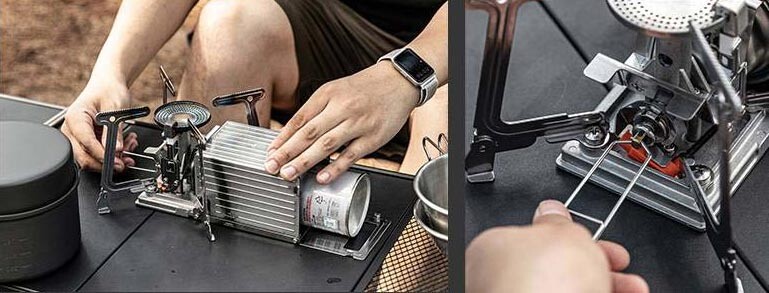
KOVEA has reduced the stored shape to a clean rectangular block by folding the burner frame and pot supports around the main body. Once opened, four supports spread around the 60 mm burner and create a much wider cooking platform.
That difference matters. Tiny backpacking burners concentrate a pot’s weight above a narrow canister or small stand. The Container Stove instead creates a low table-top platform and places its center of gravity beneath the cookware. KOVEA rates it for pots and pans up to 22 cm in diameter and no more than 10 kg.
Two reviews specifically praised the ease of storage, and another emphasized how orderly the stove looks on a camping table. Those are subjective observations, but they align with the folding geometry shown in KOVEA’s official material.

There is still a trade-off. A hard-sided metal mechanism protects the packed stove better than an exposed burner, but it also contributes to the 630 g stove weight. Buyers attracted by the word “compact” should not confuse it with a pocket backpacking stove.
What Korean owners repeatedly noticed about cooking performance
The clearest recurring theme across the supplied Korean reviews is strong heat.
- Reviewer A said water for ramen boiled faster than on the reviewer’s previous portable tabletop burner.
- Reviewer B also perceived faster boiling and described the pot support as steady under common camping cookware.
- Reviewer C highlighted the high output but warned that the flame could be excessive for small vessels and low-heat cooking.
These are personal observations, not controlled tests. None of the reviewers provided matching water volumes, vessel materials, starting temperatures, wind speeds or fuel-canister conditions. It would therefore be misleading to turn their comments into a universal speed advantage over every conventional butane stove.
KOVEA’s own test is more specific: one liter of water at 20°C boiled in 3 minutes 03 seconds at an ambient temperature of 20°C. Even this should be read as a reference result rather than a guarantee. A wide pan, cold fuel, low remaining canister pressure or moving air can extend the time.
KOVEA also places a 20 mm gap between the large burner head and cookware. The company says this reduces heat loss, while the 60 mm burner distributes flame over a broader area than a small point burner. In practical terms, that layout should favor rapid boiling and pan cooking.
High heat appears more convincing than fine simmer control
One Korean reviewer reported difficulty setting a very low flame and recommended using a roomier pot for foods likely to boil over. The same reviewer said the strong heat damaged a separate accessory plate.
That is a single user’s experience, so it should not be presented as a confirmed defect. It is still useful purchasing information because it fits the stove’s broader design priorities: a large burner, high gas-consumption ceiling and fast official boil time.
If your camping menu is dominated by ramen, stew, water boiling and pan-frying, the output is likely to be an advantage. If you frequently cook rice in a small Sierra cup, melt chocolate or hold sauces just below a simmer, the stove deserves more caution. A heat diffuser may change performance, but only use accessories that do not trap heat around the canister or conflict with KOVEA’s instructions.
Wind performance depends on conditions, despite the large burner
The supplied reviews do not agree about wind.
Reviewer A felt that the flame remained stable outdoors, while Reviewer B reported flame disturbance and occasional flameout in stronger wind. Reviewer C described the burner as wind-resistant, broadly echoing KOVEA’s claim for its large burner head.
The responsible conclusion is that the stove may cope with ordinary airflow better than a very small exposed burner, but it is not windproof. The open frame still leaves the flame exposed.
Choose a naturally sheltered, well-ventilated outdoor cooking position. Do not tightly surround the burner and fuel canister with an improvised windscreen: reflected heat can raise canister temperature. KOVEA’s material specifically highlights a cover intended to reduce radiant heat reaching the fuel canister, and that protection should not be undermined by the campsite setup.

Fuel compatibility is the key question for overseas buyers
KOVEA specifies a 220 g nozzle-type butane canister. This is the familiar aerosol-shaped cassette-gas format used by many portable Korean and East Asian tabletop stoves.
One supplied review refers to isobutane and suggests compatibility with ordinary portable-stove gas. That wording is internally inconsistent and should not override the manufacturer’s specification. The Container Stove does not use the common threaded EN417-style connection shown on many backpacking isobutane canisters.
Before importing the stove, check all three of the following:
- The exact canister connection and orientation shown in the current manual.
- Whether compatible 220 g nozzle-type butane canisters are legally sold in your country.
- Whether the stove carries any certification required where you intend to use it.
Do not improvise with an adapter or a visually similar canister. KOVEA warns against fitting the fuel container in a manner different from its instructions because incorrect installation can cause overheating or explosion.
Cold weather is another limitation of this fuel format. One reviewer reported no noticeable seasonal difference, but that personal observation is not a controlled cold-weather test. Butane pressure normally falls as temperature drops, so winter performance will depend heavily on fuel temperature and conditions.
Product images courtesy of KOVEA: KOVEA Official Website
Four limitations worth knowing before you buy
1. It is compact, but too heavy for most weight-focused backpackers
The packed dimensions are excellent; the 739 g carry weight is not ultralight. This is primarily a car-camping and table-cooking stove.
2. The lowest flame may require attention
Only one reviewer raised the issue, but the reported difficulty with fine low-heat adjustment matters if your meals demand careful simmering.
3. Strong wind can still disrupt the exposed flame
Owner reports conflict, which suggests that campsite exposure matters. Shelter the cooking area from wind without enclosing it or reflecting excessive heat toward the canister.
4. Import value depends on fuel and support availability
The official Korean listing supplied for this analysis showed a 120,000-won price, and the matching carry bag was included in that listing. Prices, packages, stock and overseas shipping can change. An imported unit may also be less convenient to service than one purchased through an authorized local channel.
The safety rules matter more than the container-style aesthetics
This is an outdoor gas appliance, not a decorative table accessory. Use it only outdoors in a well-ventilated area and on a flat, stable, nonflammable surface.
KOVEA’s official warnings include the following essentials:
- Lock the folding body securely before transport and fully open it as instructed before use.
- Never move the stove while it is burning.
- Do not use it on an unstable, sloped or heat-sensitive surface.
- Do not attach radiant-heater accessories or use a configuration that directs excessive heat toward the canister.
- Keep combustible materials away from the flame and hot surfaces.
- Stop using the appliance if you smell gas or suspect a leak; extinguish flames and move away from ignition sources.
- Let the stove cool fully before folding, packing or storing it.
One supplied reviewer mentioned briefly running the stove for warmth and using it in a room. That is not a safe use case and is not endorsed here. Carbon monoxide can accumulate in tents, vehicles and rooms even when openings appear to provide some ventilation. Never use the stove as a heater.
Who should buy the KOVEA Container Stove?
The Container Stove is a strong match for:
- car campers who value a tidy, compact packing system;
- campers who cook with medium pots and pans rather than only a mug;
- Korean-camping enthusiasts who appreciate industrial, container-inspired gear;
- buyers who can obtain the correct 220 g butane canisters locally;
- users who prioritize boiling speed and general camp cooking over minimum weight.
Look elsewhere if you need:
- an ultralight backpacking burner;
- reliable high-altitude or deep-winter performance;
- precise low-flame cooking as your top priority;
- a stove certified and supported by a distributor in your own market;
- an integrated windscreen for routinely exposed conditions.
Building a comfortable car-camping setup takes more than a reliable stove. If you also need better airflow during warm-weather trips, read my Claymore Fan V1040 review to see how this Korean wireless camping circulator performs.
Is the KOVEA Container Stove worth buying?
For the right camper, yes. The official specifications support the product’s central promise: it packs into a remarkably small rectangular form, unfolds into a stable cooking platform and delivers a high-output flame. The repeated Korean-owner comments about quick boiling and tidy storage are consistent with that design.
Its weaknesses are equally specific. It is not an ultralight stove, the open flame remains condition-dependent in wind, and one owner’s low-heat experience raises a reasonable question for simmer-focused cooks. Outside Korea, fuel compatibility, certification, warranty access and total import cost may matter more than the stove’s visual appeal.
Buy it for organized car camping and fast, practical meals—not merely because it looks good in a photograph.
Since photos and text have their limits, here is a review video to give you a real sense of the product’s actual size and feel.
Frequently asked questions about the KOVEA Container Stove
What fuel does the KOVEA Container Stove use?
KOVEA specifies a 220 g nozzle-type butane canister. It does not use the threaded backpacking canister connection commonly associated with EN417 isobutane fuel. Confirm the exact compatible canister in the current manual for your market.
How small is the KOVEA Container Stove when packed?
The official packed dimensions are 83 × 124 × 85 mm. Fully opened, it measures 120 × 315 × 146 mm.
How much does it weigh?
The total listed weight is 739 g: 630 g for the stove and 109 g for the carry bag.
How fast does it boil water?
KOVEA reports 3 minutes 03 seconds for one liter of water, with both the starting water and ambient temperature stated as 20°C. Wind, cookware, fuel temperature and canister pressure can change the result.
What size cookware can it hold?
KOVEA permits cookware up to 22 cm in diameter and a load of no more than 10 kg. Both limits should be respected.
Is the KOVEA Container Stove good in wind?
KOVEA describes the large burner as wind-resistant, but the supplied owner reports were mixed. Use it in a naturally sheltered, well-ventilated outdoor location and avoid windscreen arrangements that can overheat the canister.
Can it be used inside a tent, car or home?
No. Treat it as an outdoor cooking appliance. Never use it in a tent, vehicle or enclosed room, and never operate it for warmth.
Is it suitable for backpacking?
Its packed volume is small, but the 739 g total weight makes it better suited to car camping, van camping and picnics than weight-conscious backpacking.
Sources Used for This Review
This analysis used KOVEA’s official product specifications and four independent Korean-language product and owner posts published on Naver Blog. User observations were treated as individual experiences rather than laboratory results.