
KOVEA Ghost Phantom Air Tent Review: Fast Family Setup, Serious Packed Weight
This KOVEA Ghost Phantom Air Tent Review examines whether its built-in pump, five-person interior, and spacious family layout justify its 33 kg weight. A roomy family tent can make rainy weekends far more comfortable, but tents in this class often demand heavy poles, extra accessories, and a long setup after you reach camp. The KOVEA Ghost Phantom Air Tent takes a different approach: a rechargeable built-in pump inflates its air-beam structure while you work on the stakes and the rest of your campsite.
I’m K-papa, a creator currently living in Korea who introduces useful Korean products to international readers. This is a research-based review, not a personal field test. I compared KOVEA’s official product specifications with five Korean-language sources, including three owner reports, to determine where this large air tent delivers real value and where its size may become a burden.
Quick Buying Decision
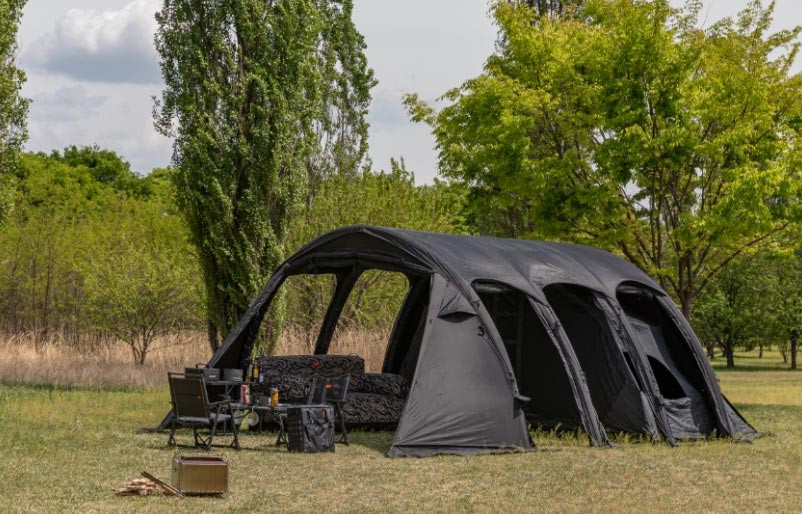
The KOVEA Ghost Phantom Air is worth considering if you want a large family shelter without assembling a complicated set of poles. Its built-in rechargeable pump, 6.4-meter length, five-person inner tent, and generous list of included accessories give it a strong convenience advantage.
The catch is easy to spot in the official specifications: the complete package weighs approximately 33 kg. It is also 4 meters wide, so it needs a genuinely large campsite. Packing it away may require more effort and practice than inflating it.
Best suited to: car-camping families, couples who enjoy spacious long-stay setups, and campers who value easy pitching more than compact storage.
Think twice if: you regularly change campsites, drive a small vehicle, camp on restricted platforms, or want one person to carry and pack every component without help.
KOVEA Ghost Phantom Air Tent Review: Setup and Built-In Pump
The central appeal is not simply that this is an air tent. It is that the inflation system is already integrated into the structure.
According to KOVEA’s official material, the removable pump uses a 7.4V, 2,500mAh battery. A full charge is rated for approximately two inflation cycles. The pump stops automatically after the tent reaches its operating pressure, so you do not have to stand beside it and guess when to switch it off.
This changes the rhythm of arrival at camp. One Korean owner reported that the structure became self-supporting in roughly 10 to 15 minutes while the owner worked on the stakes. Another described the pump as quieter than expected and said there was enough battery power for the first pitch even without charging immediately before the trip.
Those are individual field observations rather than controlled measurements, so they should not be treated as a guaranteed setup time. Still, the same practical benefit appears repeatedly: the tent can inflate in the background instead of demanding continuous pole assembly.
There is one important procedure to understand. The air-beam connectors can isolate individual sections of the frame. During normal inflation, the circulation connectors need to be in the correct open position so air can travel through the system. The isolation function is intended to help manage a leak in one section, not to remain closed during an ordinary pitch.
A manual pump is included as a backup. That is more than a token accessory. One owner found the rechargeable battery empty when trying to add pressure after the second pitch, reinforcing the value of carrying the hand pump even when the electric system appears fully charged.
Official KOVEA Ghost Phantom Air Specifications
The table below uses the specifications shown in the supplied KOVEA product material. Some Korean retail and blog pages mix figures from the earlier pole-supported Ghost Phantom with the newer air model, so check the exact model code before ordering.
| Specification | Official information |
|---|---|
| Model | KOVEA Ghost Phantom Air |
| Model codes | KECZ9T0-03 (Moss), KECZ9T0-04 (Black) |
| Capacity | 5 people |
| Exterior dimensions | 640 × 400 × 210 cm |
| Inner tent dimensions | 250 × 380 (310) × 190 cm |
| Total weight | 33 kg ± 0.5 kg |
| Main tent and component weight | 20.5 kg |
| Fly fabric | 40D nylon ripstop with silicone coating, PU coating and 2,000 mm water resistance |
| Inner tent fabric | 68D polyester taffeta with 450 mm water resistance |
| Groundsheet fabric | 150D polyester Oxford with 1,500 mm water resistance |
| Rechargeable pump battery | 7.4V, 2,500mAh |
| Charging connection | USB-C |
| Rated pump use | Approximately two complete inflations per full charge |
| Colors | Moss and Black |
| Country of manufacture | China |
The package shown in KOVEA’s material includes the inner tent, groundsheet, roof, front TPU window, manual pump, rechargeable pump, aluminum spare pole, stakes, guylines, storage bags, and related setup components.
That bundled kit matters. Large air shelters can become much more expensive once a buyer adds a pump, weather window, groundsheet, and emergency support separately. Here, most of the important pieces appear to be included from the beginning.
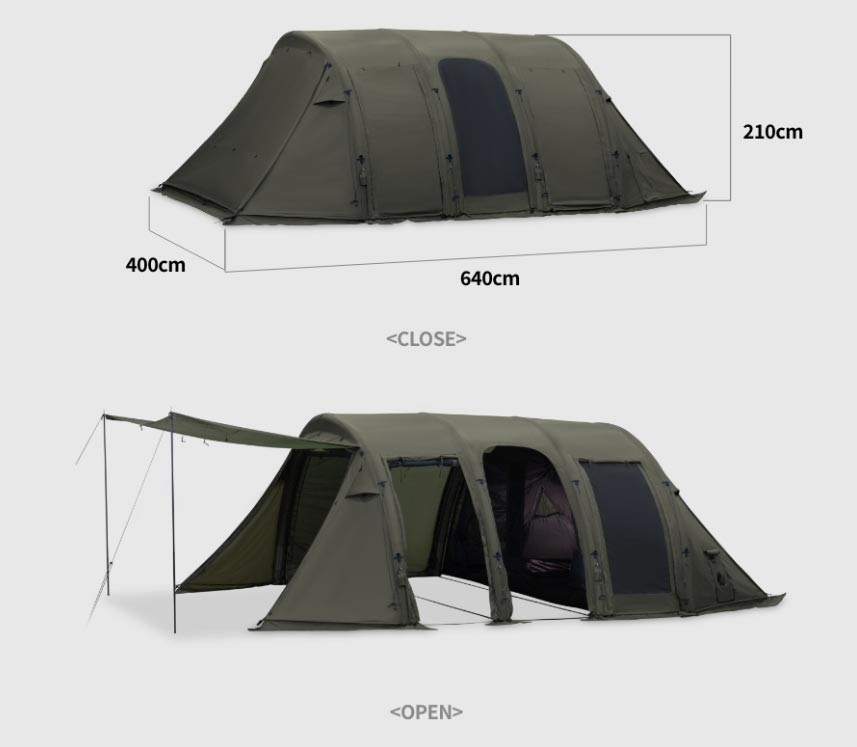
Image credit: KOVEA Official Website
What Korean Owners Repeatedly Liked
The living space remains useful after the bedroom is installed
The 6.4 × 4-meter footprint creates a substantial shared area in front of the inner tent. One owner said that four people had plenty of room and believed the shelter could accommodate a larger group in the living area. That should not be confused with the official sleeping capacity, which is five.
The more useful takeaway is that the inner tent does not consume the entire interior. A family can still arrange tables, chairs, storage, or a projector in the screened living space.
The roof shape also helps. Unlike tunnel shelters that taper sharply at both ends, the Ghost Phantom Air maintains a relatively tall profile across much of its length. That can make furniture placement easier and reduce the feeling that the outer sections are unusable.
Ventilation is available from several directions
The front, rear, and side sections incorporate mesh openings. Owners highlighted the number of doors and windows, while KOVEA’s materials show a removable center-side entrance and several ventilation options.
This flexibility is valuable in warm weather and during bug season. It does not mean the tent will remain cool in direct summer sun, however. One owner found the interior hot when the shelter was exposed to strong sunlight and considered adding a separate dark-coated tarp.
That is a sensible limitation to remember. Mesh improves airflow, but it cannot replace shade.
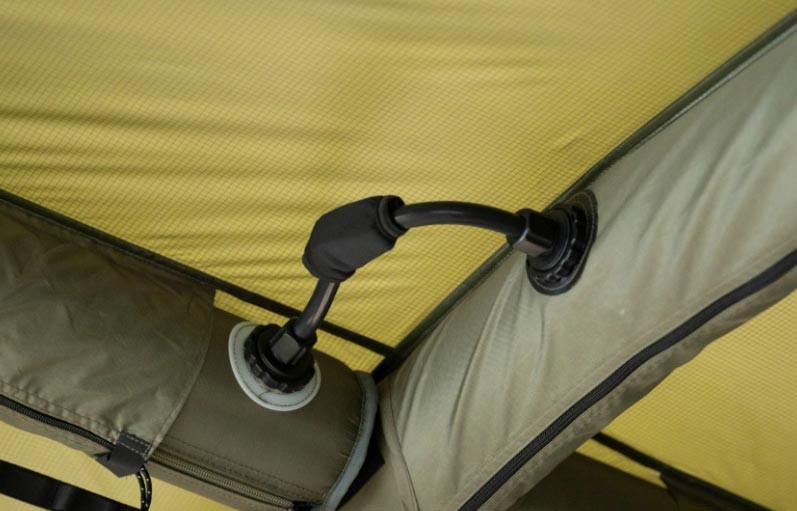
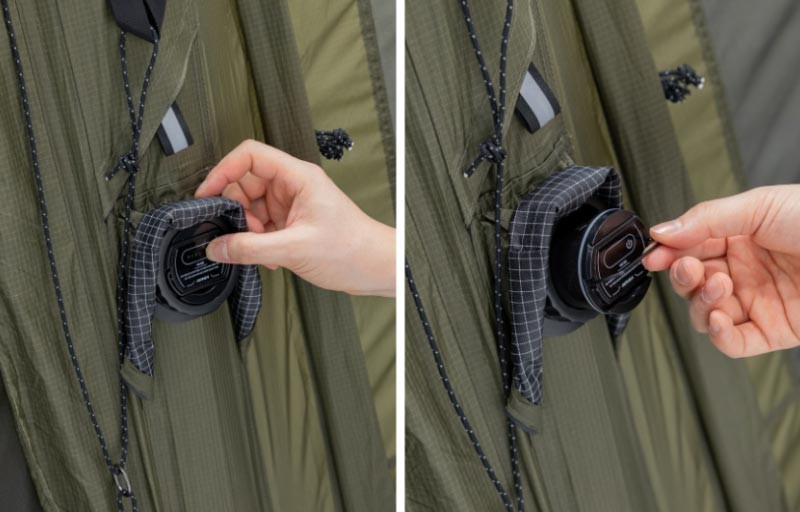
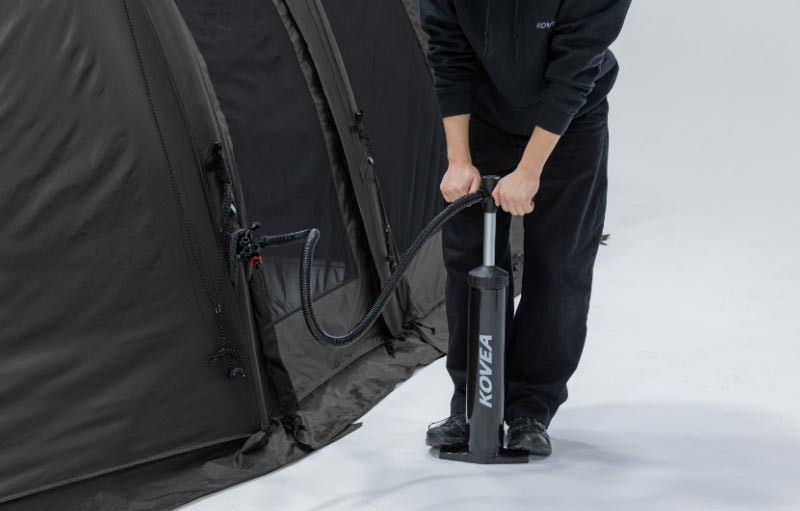

Image credit: KOVEA Official Website
The included TPU window adds cold-weather usability
The front TPU window lets occupants close the entrance against wind or rain without completely losing the outside view. One owner installed it during wet weather and used the enclosed living area for the evening.
KOVEA includes the front TPU panel in the standard package. That is a meaningful advantage for campers who would otherwise need to buy a weather panel separately.
A TPU window can still require careful storage and maintenance. It should be packed clean and dry, and buyers should inspect the supplied panel after delivery for clarity, creasing, or surface defects. One owner specifically noted receiving a clear panel after hearing about cloudiness in some earlier examples, but a single report cannot establish that every current unit has the same finish.
Emergency options are better than relying on one continuous air frame
The air connectors can isolate individual beams if pressure is lost in one part of the structure. KOVEA also supplies an aluminum emergency pole.
That does not make punctures irrelevant, but it gives campers a way to respond without automatically losing the entire shelter. For families camping far from home, this is one of the more reassuring design choices.
Where Its Size Works Best
This is a car-camping shelter, not a portable tent in the usual backpacking sense.
A family staying for several nights can benefit from the large interior, especially during poor weather. The living area can hold furniture and lighting while the inner tent remains dedicated to sleeping. The air-conditioner inlet also gives Korean-style summer campers a cleaner route for compatible cooling equipment, although overseas buyers must determine whether their own equipment fits the opening.
A longer stay makes the 33 kg weight easier to justify because the setup effort is spread across several days. For a one-night trip, the same package may feel excessive once loading, unloading, drying, and repacking are included.
The tent also needs a suitable pitch. One owner used a 6 × 8-meter site and reported that the shelter fit, while another discovered that the 6.4-meter length prevented the preferred orientation on a particular platform. Before booking a campsite, check the usable area rather than relying only on the operator’s general site category.
Inside a shelter this large, lighting placement matters too. A broad area light such as the CLAYMORE 3FACE NEO 30 may be more practical than filling the ceiling with several small lanterns.
The Harder Part Comes After the Trip
Inflation is the easy headline. Packing the tent is the more revealing test.
Two owner reports described the first takedown as less straightforward than pitching. Air must be removed thoroughly, the large body has to be folded into a manageable shape, and the final bundle needs to fit back into its bag.
One first-time owner succeeded partly because the storage bag provided extra room, although the packed tent had expanded considerably. Another owner described folding the structure inward, releasing air from the upper beams, compressing the body, and pushing out additional air after placing it in the bag.
This sounds manageable with experience, but buyers should not expect the tent to fold itself simply because the beams deflate. Wet fabric will make the process less pleasant and creates another problem: a shelter this large needs enough space at home to be opened and dried properly.
The battery also deserves a routine. Charge it before departure, remove and store it according to KOVEA’s instructions, and bring the manual pump. The official two-inflation rating leaves little margin if you need to re-pitch or top up the pressure.
Video source: This official KOVEA product video is embedded to help readers better understand the product’s design, features, and operation.
The Buying Trade-Off at a Glance
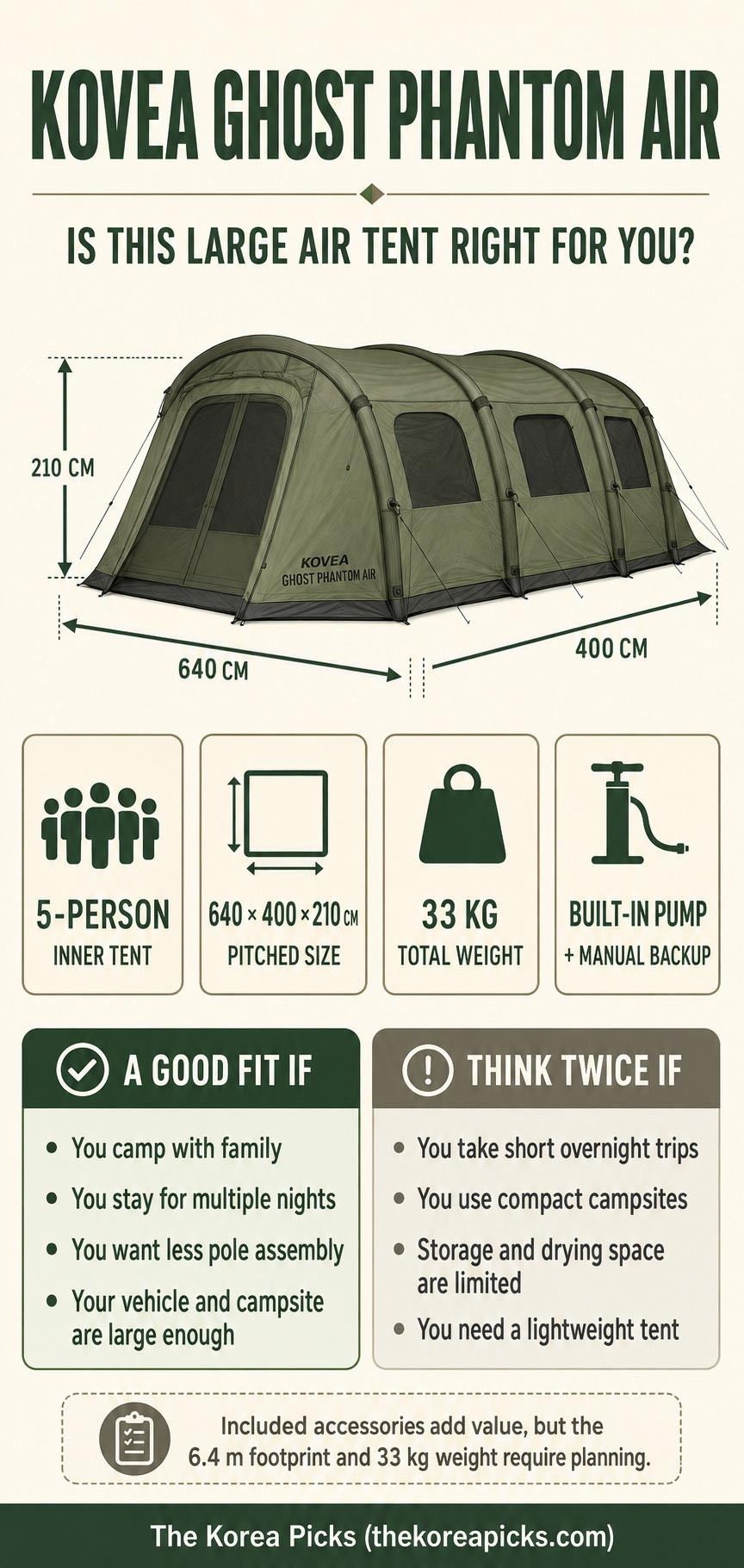
A quick look at the KOVEA Ghost Phantom Air’s size, setup benefits, weight, and ideal users.
| What makes it worth considering | What could make you skip it |
|---|---|
| Rechargeable built-in pump reduces hands-on pole assembly | Complete package weighs approximately 33 kg |
| Large 640 × 400 cm family living space | Requires a large campsite and careful site orientation |
| Five-person inner tent leaves usable communal space | First takedown and repacking may take practice |
| Front TPU window, groundsheet, roof, pumps, and emergency pole are included | Direct summer sun can still make the interior hot |
| Multiple mesh panels support cross-ventilation | Battery should not be treated as the only inflation option |
| Individual air-beam isolation provides an emergency response option | Large wet fabric may be difficult to dry at home |
Value for Money and International Buying
A current, verified retail price was not included in the supplied official material, so it would be misleading to assign the Ghost Phantom Air a fixed value score.
Its value depends heavily on how much you would otherwise spend on accessories. The package already includes components that are often separate purchases, including the rechargeable pump, manual pump, groundsheet, front TPU window, roof, and emergency support pole. Buyers who genuinely need those items may find the complete kit easier to justify than the tent-only price suggests.
Campers who mostly travel in mild, dry weather may not receive the same value. A less expensive pole tent or a smaller basic air tent could provide adequate sleeping space without the same storage and transport demands.
International buyers should confirm all of the following before ordering:
- Whether the listing is specifically for the Ghost Phantom Air, not the pole-supported Ghost Phantom
- Whether every accessory shown in the Korean package is included
- The packed dimensions and shipping weight
- International freight charges, import duties, and return costs
- Pump charging compatibility and the supplied USB-C accessories
- Availability of replacement air-beam parts, pump batteries, and repair service
- Whether KOVEA warranty support applies in the destination country
The pump charges through USB-C, so this is not comparable to importing a large Korean household appliance with a fixed 220V plug. Even so, verify the charger requirements and included accessories with the seller.
KOVEA Ghost Phantom Air vs. More Conventional Alternatives
The most relevant alternative is not necessarily another premium air tent. It may be a smaller pole-supported family shelter.
Choose the Ghost Phantom Air when reducing pole assembly is a priority, you have a large vehicle, and you regularly stay long enough to enjoy the living space. Its bundled weather accessories also make sense for campers who use the shelter across changing seasons.
Choose a conventional tunnel tent if lower purchase cost, smaller packed volume, and simpler long-term parts replacement matter more than automated inflation. Pole construction requires more hands-on setup, but some campers may prefer carrying separate components rather than one very heavy air-tent package.
A smaller air tent is another reasonable option for couples. You keep much of the inflation convenience while avoiding a 6.4-meter shelter that may be difficult to fit on compact pitches.
Sleeping equipment can also change how much interior space you need. If you are planning a raised sleep system, the Helinox Cot One Convertible review explains the trade-off between sleeping comfort, floor area, and packed equipment.
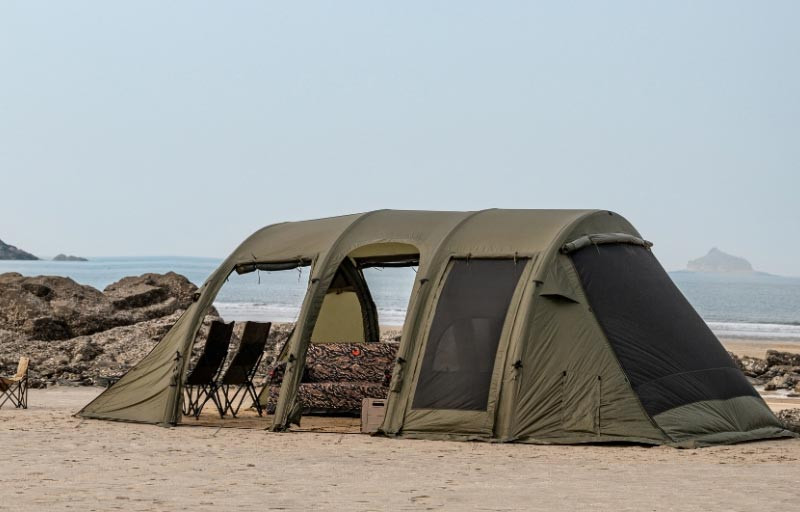
Image credit: KOVEA Official Website
Who Should Buy It and Who Should Skip It
Consider the KOVEA Ghost Phantom Air if you:
- Usually travel by car and have room for a 33 kg tent package
- Camp with a family or want a separate bedroom and living area
- Dislike assembling large pole frameworks
- Take multi-night trips where a spacious shelter earns its place
- Expect to use the included TPU window, groundsheet, and other accessories
- Can reserve campsites large enough for a 640 × 400 cm structure
Consider another tent if you:
- Drive a compact vehicle already filled with camping furniture
- Frequently camp on small decks or tightly divided pitches
- Prefer short overnight trips and fast departures
- Need equipment that one person can easily carry
- Have limited space for drying a large wet tent
- Only require sleeping accommodation and do not need a full living room
A portable fan will not solve direct solar heat, but it can improve circulation during milder warm-weather trips. The CLAYMORE Fan V1040 review may help if airflow and cordless runtime are part of your shelter plan.
Research-Based Verdict
The KOVEA Ghost Phantom Air makes a convincing case for family campers who want the space of a large tunnel shelter without spending arrival time connecting a maze of poles. Its built-in pump is useful, the five-person inner tent leaves a substantial living area, and the standard package includes an unusually complete set of accessories.
Its main weakness is not hidden: this is a 33 kg, 6.4-meter tent. Automated inflation cannot make it compact, and it does not remove the work involved in folding, loading, drying, and storing a large shelter.
For multi-night family car camping, those compromises may be reasonable. The tent offers the most value when its weather protection, living space, and bundled equipment are used regularly. Couples taking short trips, campers with small vehicles, and anyone limited to compact pitches will probably be happier with a smaller air tent or a lighter pole-supported shelter.
Before importing one, verify the exact model, package contents, shipping weight, replacement-part access, and after-sales support. Those details could change an appealing Korean retail package into a much less comfortable overseas purchase.
How I Researched This Review
This review draws on KOVEA’s supplied official product catalog and five Korean-language sources. Three of those sources documented owner use of the Ghost Phantom Air, including pitching, inflation, interior setup, wet-weather use, and takedown. One source was an affiliate-supported product overview rather than a first-hand field report, and another was written from a retailer-oriented perspective.
I treated KOVEA’s catalog as the primary source for dimensions, capacity, weight, materials, pump specifications, and included components. Owner reports were used only for practical observations. When an experience appeared in one review, I presented it as an individual report rather than a general owner consensus.
Frequently Asked Questions
How many people can sleep in the KOVEA Ghost Phantom Air?
The KOVEA Ghost Phantom Air is officially rated for five people. Its inner tent measures approximately 250 × 380 (310) × 190 cm. The outer living area can hold additional furniture or occupants during the day, but that does not increase the manufacturer’s stated sleeping capacity.
How large is the KOVEA Ghost Phantom Air?
The tent measures 640 × 400 × 210 cm when pitched. Its 6.4-meter length requires a large campsite, and the usable pitch should also provide room for stakes and guylines. Check the exact dimensions of a campsite or platform before making a reservation.
How much does the KOVEA Ghost Phantom Air weigh?
The official total weight is approximately 33 kg, with a tolerance of 0.5 kg. KOVEA lists the tent body and related components at 20.5 kg, while the remaining packed accessories contribute to the full transport weight.
Does the tent include an electric air pump?
Yes. It includes a removable rechargeable pump with a 7.4V, 2,500mAh battery, along with a manual backup pump. KOVEA states that a fully charged battery can provide approximately two complete inflation cycles, although conditions and battery health may affect real-world performance.
Is the KOVEA Ghost Phantom Air easy for one person to pitch?
The inflation stage can be managed by one person because the integrated pump operates automatically while other setup tasks are completed. Owners still needed to position and stake the large body correctly. Folding and packing the 33 kg shelter may be considerably easier with a second person.
Is the KOVEA Ghost Phantom Air suitable for summer?
It can work in summer thanks to multiple mesh openings and ventilation points, but it may become hot in direct sunlight. One Korean owner specifically reported noticeable heat inside the shelter under strong sun. Choosing a shaded pitch or adding an appropriate overhead tarp may improve comfort.
What happens if one of the air beams loses pressure?
The air system includes connectors that can isolate individual beam sections, and KOVEA supplies an aluminum emergency pole. These features provide a temporary response option, but owners should still carry the manual pump and confirm how replacement beams or professional repairs are handled in their country.
Is the KOVEA Ghost Phantom Air worth importing?
It may be worth importing for family campers who specifically need its large space, built-in pump, and bundled accessories. The decision becomes less attractive if freight, duties, difficult returns, or limited replacement-part access add substantially to the cost. Confirm those conditions with the seller before purchasing.
📬 A Slice of Korea (K-papa’s Daily Walk)
After spending so much time talking about modern camping equipment, let me take you somewhere that feels much older.
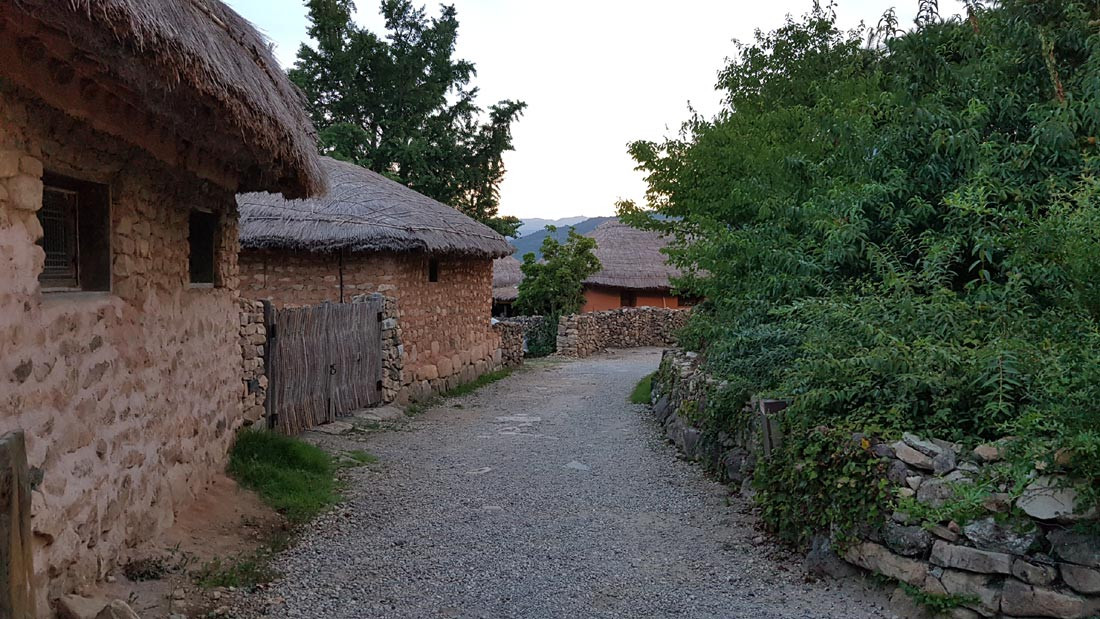

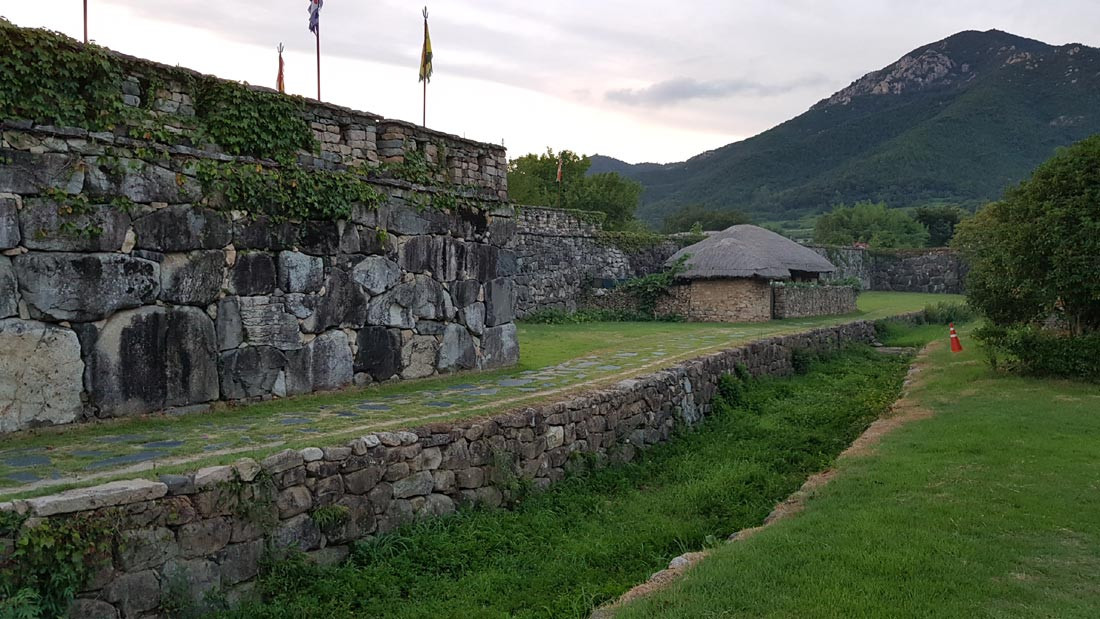

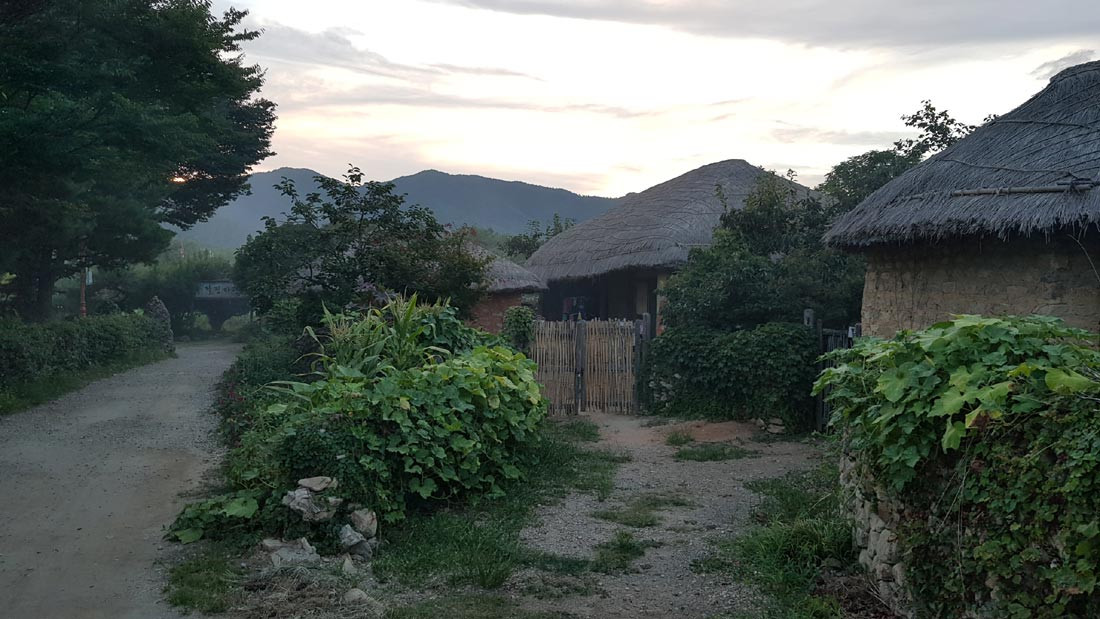
Last year, I photographed Naganeupseong Folk Village in Suncheon, a city in southern Korea. For an international visitor, the easiest way to understand this place is to imagine walking into a small piece of Korea’s past that has never been completely separated from everyday life.
Naganeupseong is a historic village surrounded by a stone fortress wall. Inside, you can see traditional thatched-roof houses, narrow paths, courtyards, and buildings that show how Korean communities once lived and worked. Unlike a display contained inside one museum building, the village spreads out around you. You walk through gates, follow the old lanes, and look across rows of low roofs toward the surrounding hills.
The fortress walls are especially memorable. From the elevated path, the village below looks very different from Korea’s familiar image of high-rise apartments, busy roads, and glowing city signs. The low houses sit close together, and the natural colors of earth, straw, stone, and wood create a calm landscape.
It is an easy place for foreign visitors to understand visually, even without knowing much Korean history. The village shows that Korea is not only Seoul, technology, and modern pop culture. Older ways of building homes and organizing communities are also part of the country’s story.
The photos accompanying this section were taken by me during my visit last year. Next time, I’ll show you another small view of life and travel in Korea.
🗣️ K-papa’s Quick Korean Lesson!

Korean phrase: 천천히 둘러보세요
Romanization: Cheoncheonhi dulleoboseyo
Pronunciation: Chun-chun-hee dool-luh-bo-seh-yo
Meaning: “Take your time and look around.”
Example: When welcoming a friend to a traditional Korean village, you can say, “시간이 많으니까 천천히 둘러보세요.”
“We have plenty of time, so take your time and look around.”
About the Author
K-papa is a creator living in Korea who researches Korean camping gear and kitchen and living products for international readers. Learn more about K-papa and how The Korea Picks researches its reviews on the About page.