Why Korean Campgrounds Look So Different From Western Ones
A first visit to a Korean campground can challenge almost every assumption an international traveler has about camping.
The sites are often clearly divided, reservations may depend on exact pitch dimensions, and campers can spend as much time organizing their temporary living space as they do exploring the surrounding landscape. Even the relationship between neighboring sites can feel different from what visitors may have experienced in North America or Europe.
I’m K-papa, currently living in Korea, and I think the most interesting part of Korean camping is not the amount of equipment people bring. It is the reason this particular style of camping developed.
Korean campgrounds reflect the country’s urban housing, limited land, four distinct seasons, family-centered leisure culture, and highly organized reservation systems. Once you understand those influences, the appearance of a Korean campground begins to make much more sense.
This article focuses on the cultural and structural reasons behind those differences. For a closer look at the objects and scenes you may encounter, read 15 Things That Make Korean Campsites So Unique.
“Western Camping” Is Not One Single Experience
Before comparing Korean campgrounds with Western ones, it is important to recognize that Western camping is incredibly diverse.
A spacious national park campground in the United States has little in common with a holiday park in the United Kingdom, a remote Nordic shelter, or a European caravan resort. Western campers may travel in large recreational vehicles, carry ultralight backpacks, sleep in family tents, or stay in fully furnished cabins.
Korean camping is just as varied. South Korea has backpackers, solo campers, caravan owners, long-distance hikers, glamping guests, and families who build comfortable weekend camps.
The most useful comparison is therefore not “Korea versus the entire West.” It is between mainstream Korean car camping and the simpler, more spacious campground experience many international travelers imagine when they hear the word camping.
The differences begin with the environment in which Korean campers live.
Korean Campgrounds Offer the Outdoor Space Many Homes Do Not Have
South Korea is highly urbanized, and apartment living is a normal part of everyday life for a large share of the population. Apartments can be modern and comfortable, but they usually do not include a private garden, large garage, or backyard where a family can spend an entire afternoon outdoors.
Camping provides temporary access to that missing space.
After reserving a site, a family gains a small private area where children can play, adults can cook outside, and everyone can sit under the open sky. For one or two nights, the campsite functions as a personal yard as much as a place to sleep.
This helps explain why Korean campers often put considerable effort into arranging their assigned space. They are not simply pitching a shelter before beginning another activity. Creating and enjoying the temporary outdoor home is one of the main activities.
The setup process can even be part of the satisfaction. An empty site gradually becomes a dining area, a place to rest, and a private family space surrounded by nature.
Limited Land Produces Clearly Defined Campsites
South Korea has beautiful mountains, rivers, forests, and coastlines, but it also has a large population concentrated in and around major cities. Campgrounds within a manageable drive of Seoul and other urban centers can attract strong weekend demand.
As a result, many Korean campgrounds divide their available land into clearly defined reservable units.
Rather than choosing any open spot in a large field, visitors are usually assigned a specific numbered site. That site may have fixed boundaries, a wooden platform, a gravel surface, or a parking position that determines how the entire camp must be arranged.
The exact dimensions matter.
Before reserving, experienced campers may compare the measurements of the pitch with the footprint of their shelter. They also consider where the entrance will face, whether the car must fit inside the boundary, and how much room remains for movement.
This creates a campground that can look more structured and compact than a loosely organized campground with generous natural separation between visitors.
Privacy Must Be Created Rather Than Assumed
At a spacious rural campground, distance and trees may naturally separate one group from another. At a compact Korean campground, neighboring sites can be close enough that campers hear conversations and see daily activities on both sides.
Privacy is therefore often created through the layout of the site.
Campers think carefully about the direction of their entrance, the position of their vehicle, and which side of the living space faces the neighboring pitch. The arrangement can create a visual boundary even when there is no fence.
This does not necessarily mean that Korean campgrounds lack privacy. Instead, privacy is produced through thoughtful use of a limited area.
The result resembles urban living in a subtle way. People share a relatively compact environment, but each group creates a distinct personal zone within it.
Korean Camping Is Often a Short Weekend Escape
The length of the typical trip also affects how Korean campgrounds look.
Many recreational campers leave a city on Friday evening or Saturday morning and return home on Sunday. The destination must therefore be close enough to reach by car and organized enough for a short stay.
A long journey into a remote wilderness area would consume too much of the available weekend. A developed campground with reserved pitches, toilets, washing facilities, electricity, and nearby parking makes the trip more predictable.
Families know where they will stay and which facilities will be available before they leave home. They can arrive, establish their space, enjoy an evening together, and pack the following morning.
This short-stay pattern favors convenience and efficient site management. It also encourages campers to recreate familiar comforts quickly rather than gradually adapting to primitive conditions.
Car Camping Shapes the Entire Experience
Most of the distinctive features associated with mainstream Korean camping become possible because people travel by car.
A backpacker must justify every additional item because the weight will be carried for several kilometers. A car camper faces a very different calculation. If something fits safely in the vehicle and makes the weekend more comfortable, bringing it may feel worthwhile.
The car also connects apartment life with the campground. Equipment can be stored at home or in a rented storage unit, loaded for the weekend, and transported directly to the reserved pitch.
This creates an equipment system built around packing efficiency rather than hiking weight alone. Folding size, storage shape, and the order in which items are loaded can become important purchasing considerations.
The Korean campground consequently develops around the vehicle, even when cars must remain in a separate parking area after unloading.
Four Distinct Seasons Demand Flexible Campgrounds
Korea’s weather changes dramatically throughout the year.
Summer can be hot and humid, and the monsoon season can bring sustained rain. Winter temperatures can fall well below freezing in many regions. Spring and autumn are popular for camping, but daytime and nighttime temperatures may differ significantly.
A campground that operates across several seasons must accommodate very different needs.
Shade and airflow are important during summer. Drainage becomes essential during heavy rain. In colder weather, campers look for wind protection and safe access to electricity. Ground conditions also affect comfort, particularly after rain or during a winter freeze.
Wooden platforms and prepared gravel pitches are partly responses to these practical challenges. They provide a relatively predictable surface in weather that might turn an ordinary field into mud.
The climate also explains why Korean camping tends to prioritize enclosed living space. Campers want to continue eating and spending time together even when rain, wind, heat, or cold makes an exposed site uncomfortable.
The Campground Is Often the Destination
In some camping traditions, the campsite primarily serves as a base. Travelers sleep there before hiking, fishing, climbing, paddling, or moving to another destination.
In mainstream Korean family camping, the campground itself can be the main destination.
A family may take a short walk or visit a nearby attraction, but much of the weekend is spent at the site. Setting up, preparing meals, talking, drinking coffee, and relaxing together are not pauses between adventures. They are the central activities.
This changes how people evaluate campgrounds.
A dramatic hiking trail may be less important to one family than clean facilities, generous site dimensions, reliable hot water, a safe area for children, and a convenient distance from home. Other campers may prioritize a river view, quiet surroundings, shade, or pet-friendly rules.
The quality of the stay is determined by how comfortably people can inhabit the site, not only by what they can do outside it.
Shared Meals Influence the Layout of Korean Campgrounds
Food appears in both Korean and Western camping, but Korean group dining has a particular influence on how a site is organized.
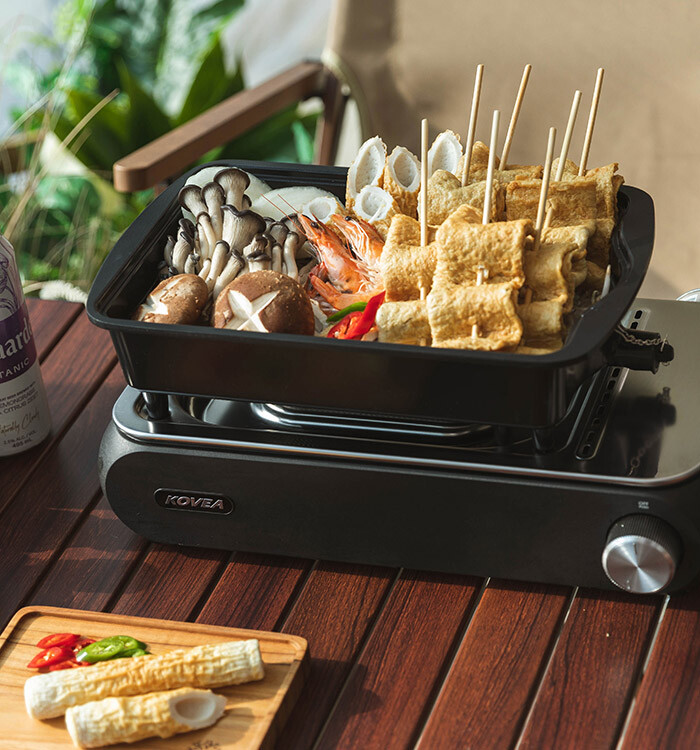
Many Korean meals are designed to be shared from the center of the table. Several dishes may remain available at the same time, and cooking can continue after everyone sits down.
This encourages a layout in which people can face one another and reach a common dining area. The social arrangement matters as much as the cooking equipment.
Rather than one person preparing a meal away from the group, cooking, eating, and conversation frequently happen in the same space. The dining area becomes the heart of the campsite.
This reflects Korean social life beyond camping. Eating together is an important way for families, friends, and coworkers to strengthen relationships. Moving the meal outdoors does not remove that cultural role.
Apartment Etiquette Travels Into the Tent
Some of the most interesting differences at Korean campgrounds come from habits that feel completely ordinary inside a Korean home.
Shoes are removed before entering a clean indoor area. The floor may be treated as a place to sit, relax, or sleep rather than merely a surface to walk across. Belongings are organized carefully because the available space must support several activities.
These habits continue when a family moves outdoors.
A tent or shelter can have an informal boundary between an outside zone and a clean interior. The direction of movement through the space matters, particularly when the ground is wet.
The goal is not to reproduce a house perfectly. It is to apply familiar ideas about cleanliness and shared living to a temporary environment.
An international guest who understands this connection will find Korean campsite etiquette much easier to follow.
Developed Facilities Make Comfort-Oriented Camping Possible
The appearance of Korean campgrounds is also influenced by the services they provide.
Many developed locations include centralized toilets, showers, washing areas, waste stations, electrical access, and designated parking. The quality and availability of these facilities differ, so travelers must check the details of each campground.
These services reduce the need for complete self-sufficiency. Campers can stay in nature without carrying all their water, managing waste independently, or relying solely on batteries.
This is particularly important for families with children and people who are new to outdoor travel. A clean and organized campground provides a more approachable introduction to camping.
Official tourism information for Korea also presents glamping as an accessible option for travelers without their own equipment. Some facilities provide nearly everything needed for an overnight stay, further expanding the idea that camping can combine nature with convenience.
Reservation Culture Creates Predictable Expectations
Korean leisure activities are often planned through online platforms, and camping is no exception.
Campers may study site maps, photographs, facility lists, and detailed reviews before choosing a pitch. Popular weekends can sell out quickly, particularly during pleasant spring weather or the autumn foliage season.
This reservation culture changes the way people think about camping.
Instead of arriving and searching for an open area, visitors often know their exact site number in advance. They may already understand its dimensions, surface type, nearby facilities, and relationship to surrounding sites.
Planning begins long before arrival.
The structured process can feel closer to selecting a hotel room than choosing an informal place to pitch a tent. The difference is that the “room” is an empty outdoor space that each camper must transform.
Online Reviews Standardize What Campers Expect
Korean campers frequently share detailed reviews through blogs, online communities, video platforms, and social media.
A useful campground review may show the road leading to the entrance, the distance from the parking lot, the size of each pitch, the condition of the toilets, the availability of hot water, and how much shade reaches a specific site.
This level of information affects both visitors and campground owners.
Campers arrive with clear expectations based on what they have already seen online. Owners know that small problems may appear in photographs and reviews. Well-maintained facilities and carefully designed sites therefore become part of the campground’s reputation.
Online content also spreads certain setup styles rapidly. When one layout works well in a compact site, other campers can study and adapt it.
The physical appearance of Korean campgrounds is partly shaped by this digital exchange of information.
Equipment Design Responds to Limited Space
Korean camping products often need to solve a specific problem: how to create a comfortable living area without wasting space in the car or at the campground.
This encourages folding, stacking, modularity, and compatibility.
A product that serves one purpose but occupies too much storage space may be less attractive than something that integrates with the rest of a system. Campers consider not only how an item works when open but also how efficiently it packs.
The same logic can be seen in Korean apartment furniture and household storage. Limited space rewards products that can change shape, fit together, or disappear when not in use.
Korean campground design and Korean camping equipment have developed together. Compact sites encourage modular equipment, while modular equipment allows campers to make compact sites feel more complete.
Visual Order Helps a Small Site Feel Comfortable
The coordinated appearance of some Korean campsites is not purely decorative.
When many objects must fit inside a limited area, visual disorder can make the site feel smaller and more stressful. Matching storage, repeated colors, and clearly defined zones create a sense of calm.
A well-organized site also helps campers find what they need without repeatedly opening containers or moving furniture.
Style and function are therefore closely connected. The campsite may look carefully curated, but the visual consistency also makes a compact temporary home easier to use.
This is one reason Korean camping can appear highly designed even when the campers are not creating content for social media.
Public and Private Campgrounds Can Feel Different
International visitors should also understand that there is no single standard Korean campground.
Public facilities operated by local governments, national recreation forests, private campgrounds, riverside locations, caravan parks, and glamping resorts can offer very different experiences.
A public facility may emphasize affordability, clear regulations, and access to natural attractions. A private campground may compete through larger sites, family facilities, themed landscaping, or upgraded amenities.
Some places are highly developed, while others remain simple and close to nature.
This variety is another reason travelers should avoid judging all Korean camping from one location. A campground near Seoul on a holiday weekend may feel compact and busy, while a mountain site in a less populated region can be quiet and spacious.
Korean Campgrounds Reflect a Different Definition of Escape
For some travelers, escaping everyday life means carrying as little as possible and moving far away from roads, buildings, and other people.
For many Korean car campers, escape can mean something different.
It may mean leaving an apartment, putting the phone aside, preparing a long meal, and giving the family an outdoor space that belongs to them for the weekend. Comfort does not necessarily weaken that escape. It can make the family willing to stay outside longer.
This is why judging Korean camping only by the amount of equipment misses the larger story.
The site is designed to support time together. The structure, facilities, reservation system, and temporary living space all serve that purpose.
What Foreign Visitors Should Check Before Booking
The organized nature of Korean campgrounds can make them convenient, but visitors should not assume that every location provides the same services.
Before making a reservation, check:
- The exact dimensions and surface of the pitch
- Whether the site includes parking
- Whether electricity is available and subject to a usage limit
- The opening hours of showers and washing areas
- Check-in and check-out times
- Rules for cooking and individual fires
- Quiet hours
- Waste separation requirements
- Restrictions on visitors, children, or pets
- Whether English-language assistance is available
Travelers without equipment can consider a glamping site or a campground offering rental packages. The Korea Tourism Organization notes that glamping facilities can provide equipment for visitors who want to enjoy nature without owning a full camping setup.
Why Korean Campgrounds Look the Way They Do
Korean campgrounds did not become compact, structured, and comfort-oriented by accident.
They developed within a country where many people live in apartments, urban families have limited access to private outdoor space, popular destinations face strong weekend demand, and the weather can change dramatically with the season.
The reserved pitch becomes a temporary yard. The enclosed shelter responds to the climate. The shared dining space reflects Korean food culture. Modular organization makes a limited site more usable. Developed facilities allow families to spend time in nature without abandoning every familiar comfort.
Seen from the outside, a Korean campground may appear unusually organized or even excessive.
Seen within the context of Korean life, it is a logical response to the country’s geography, housing, climate, and social habits.
Korean campers are not simply bringing their homes into nature. They are creating a kind of outdoor space that many of them cannot enjoy at home—and making the most of it for one carefully planned weekend.
Frequently Asked Questions About Korean Campgrounds
Are Korean campgrounds smaller than Western campgrounds?
Some Korean campgrounds, particularly popular locations near major cities, have compact and clearly divided sites. However, size varies significantly. Rural, mountain, and coastal campgrounds may offer larger pitches and greater separation.
Why do Korean campers reserve exact sites?
Reservations help campground owners manage limited space and allow campers to select a pitch suited to their tent, vehicle, and preferred facilities. Popular sites can be booked quickly during peak seasons.
Is Korean camping mostly about equipment?
No. Equipment is highly visible, but the underlying purpose is often to create a comfortable social space where family or friends can eat, talk, and relax outdoors.
Are Korean campgrounds suitable for travelers without a car?
Some are accessible by public transportation, but many rural campgrounds are easier to reach by car, especially when carrying equipment. Travelers without a vehicle may find urban campgrounds or glamping facilities more convenient.
Can foreigners book Korean campgrounds online?
It depends on the booking platform. Some reservations are straightforward, while others may require Korean-language navigation, a local phone number, or a Korean payment method. Contacting the campground directly can help clarify the available options.