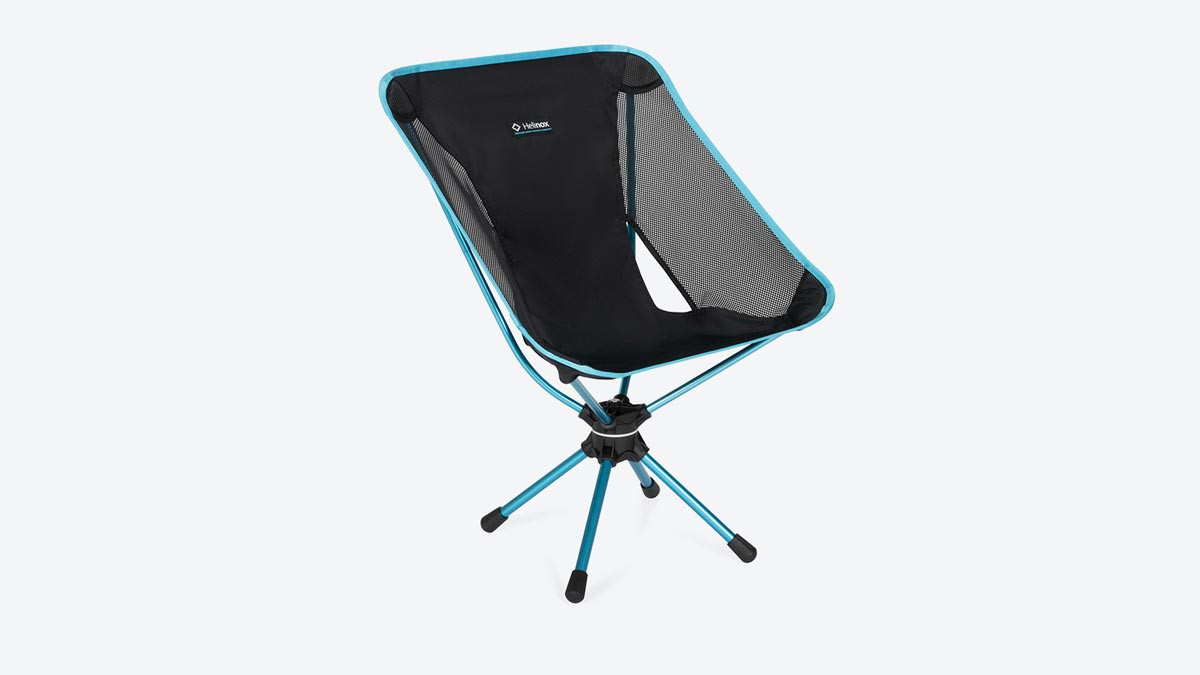
Helinox Swivel Chair Review: Is 360-Degree Rotation Worth the Extra Weight?
The Helinox Swivel Chair looks like a familiar compact camping chair until you notice the pivot beneath the seat. That single mechanism changes how the chair works around a camp kitchen, fire pit, or crowded table—but it also introduces a trade-off that matters more than the novelty: Is easier movement worth carrying a heavier, more mechanically complex chair with limited upper-body support?
I’m K-papa, a creator living in South Korea. This Helinox Swivel Chair review is research-based rather than a record of my own field use. I compared Helinox’s specifications with Korean owner reports, paying particular attention to where their experiences agreed, where they differed, and what those patterns mean for an actual purchase.
The short version is that this is not the best Helinox chair for every camper. It makes the most sense for someone who remains seated while cooking, organizing gear, talking around a fire, or supervising a compact campsite. If your priority is deep relaxation, head support, the lowest possible trail weight, or simple value, the swivel mechanism may solve the wrong problem.
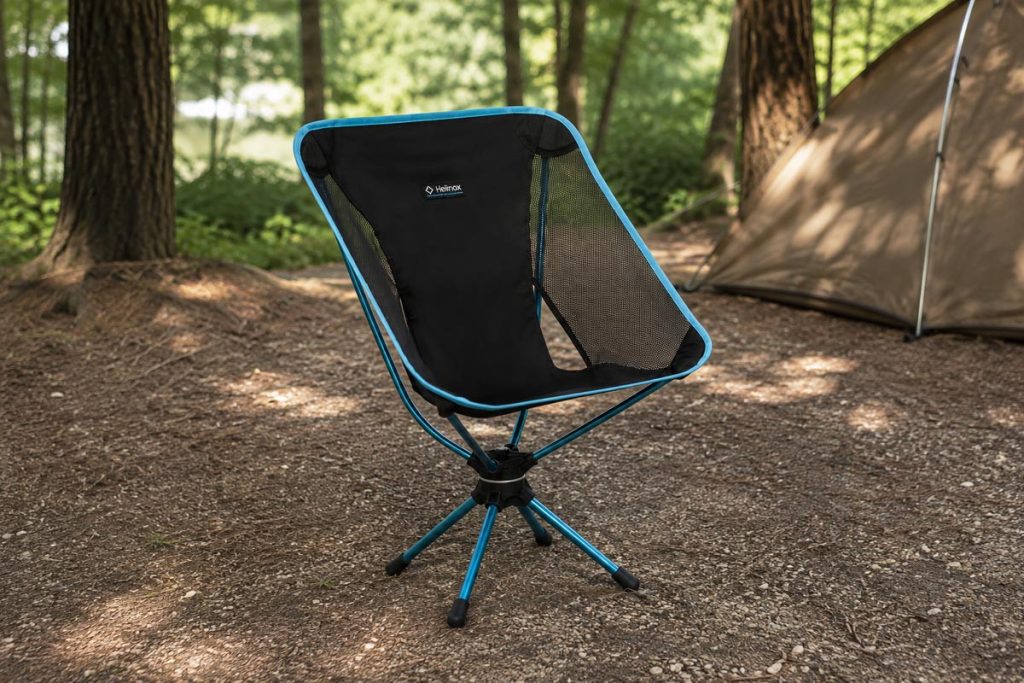
What the Helinox Swivel Chair Actually Changes at Camp
A standard low camping chair usually asks you to do one of three things when reaching sideways: twist your upper body, drag the chair, or stand up.
The Swivel Chair adds a fourth option. Its seat rotates through 360 degrees on a central pivot, allowing the user to turn toward a cooler, cooking station, storage box, or another person without repositioning the legs.
That sounds minor until the chair is placed in a busy campsite.
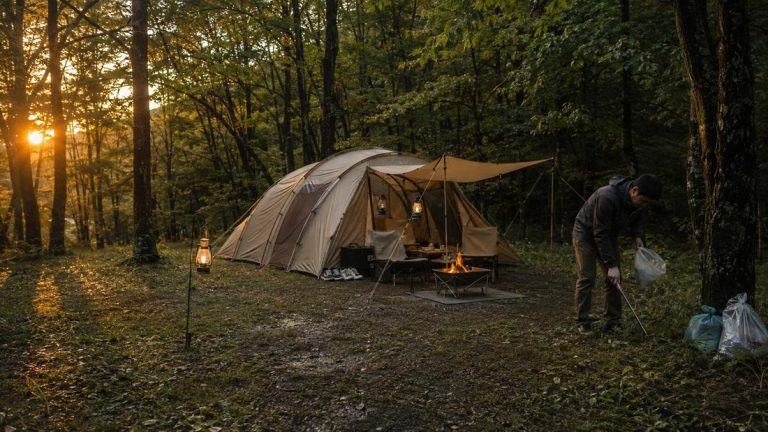
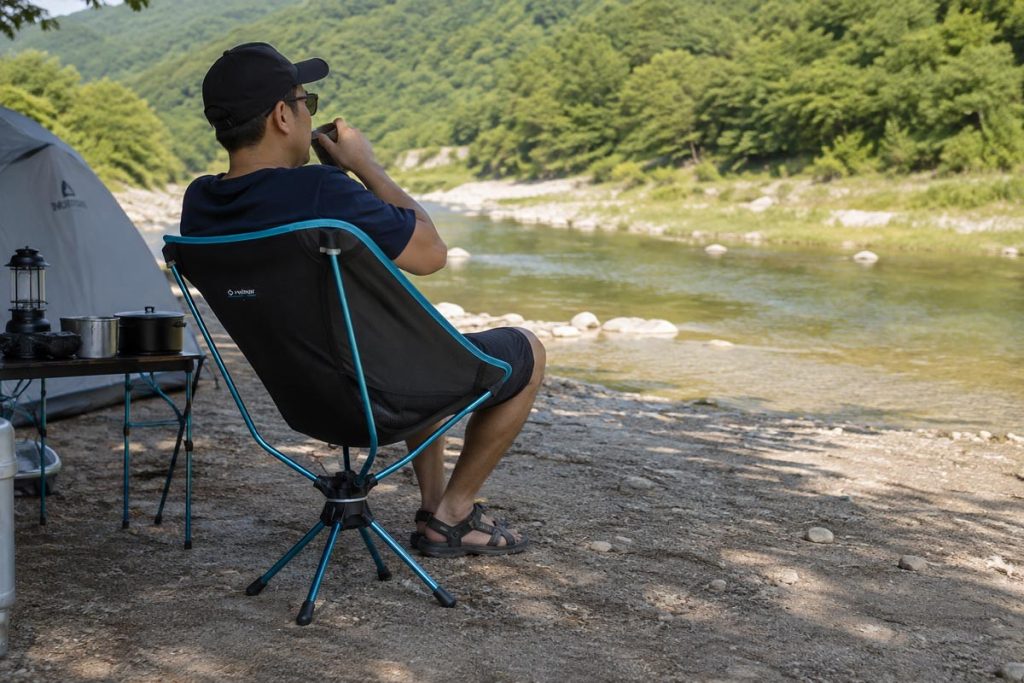
Around a compact camp kitchen, equipment is often distributed across several directions. A stove may be in front, ingredients to one side, and a cooler behind the chair. Korean owners repeatedly described the rotating seat as useful when cooking, grilling meat, retrieving items, or shifting attention between people and equipment.
The common pattern is important: owners did not praise rotation simply because spinning was entertaining. They valued it when the campsite required frequent, short changes in direction.
That makes the chair particularly relevant for:
- Campers who prepare food while seated
- Parents turning between a child, table, and cooking area
- Anglers or photographers working with equipment placed nearby
- Campers using a small shelter where dragging a chair is awkward
- Anyone who often reaches into coolers and storage boxes during a meal
The benefit becomes less meaningful when the user mainly sits facing one direction. If your normal evening involves reclining toward a fire and barely moving for an hour, a conventional high-back chair may provide more value.
There is another subtle advantage. Rotating the seat can reduce the temptation to scrape or lift the entire chair every time the conversation moves. That is convenient on a groundsheet or inside a shelter where space is restricted.
Still, it should not be treated like an office chair. The Swivel Chair has no wheeled base, armrests, height adjustment, or broad flat seat. It remains a compact outdoor chair whose main distinction is directional freedom.
The Real Trade-Off: Mobility Versus Resting Comfort
The Swivel Chair’s biggest strength is movement while seated. Its main limitation is that it is not designed for full-body lounging.
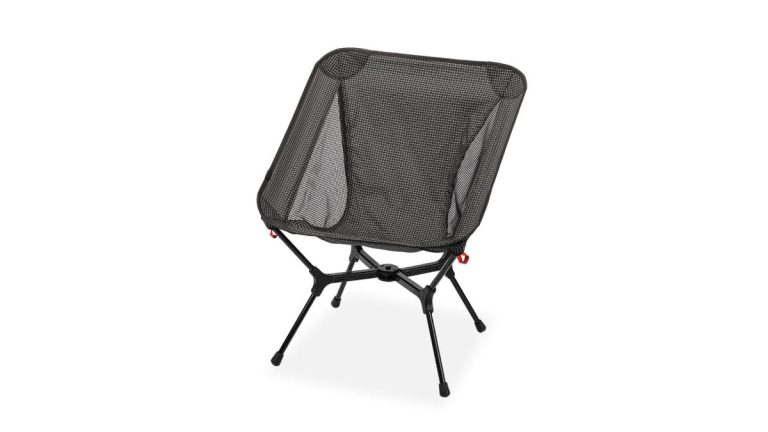
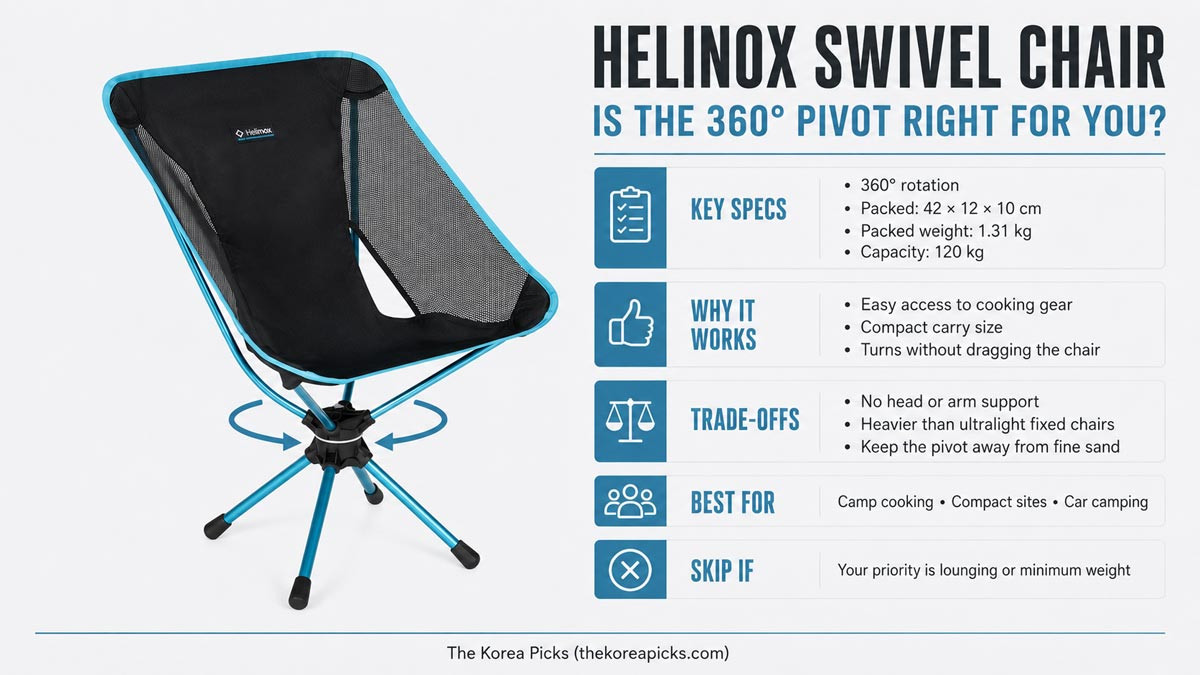
Helinox lists an assembled size of 73 × 52 × 52 cm and a seat weight of 1,218 grams. The structure is compact and relatively low, with a backrest that supports the lower and middle back rather than extending behind the head.
One Korean owner specifically wished the back were longer, even though the chair was not considered uncomfortable. That distinction matters. A short backrest does not automatically mean poor comfort; it means the chair supports a different posture from a long reclining chair.
Think of the intended posture as alert and mobile rather than deeply reclined.
That works well for preparing food, drinking coffee, talking, or frequently turning toward nearby gear. It is less suitable for campers who want to lean their head back during a long evening. Someone accustomed to a lounge chair may find the Swivel Chair supportive enough for active sitting but incomplete as a dedicated relaxation chair.
There is also a more specific comfort concern around the front edge of the seat. One experienced Korean camper discussed the frame or seat edge contacting the thighs when body weight shifted forward or after remaining in one position for a long time. The owner also described the chair as comfortable during most ordinary use.
This is not enough evidence to claim that every user will experience thigh pressure. Body proportions, sitting position, and preferred posture can all change the result. It is enough, however, to make a pre-purchase seating test worthwhile.
Pay attention to three things when trying it:
- Whether the front edge presses into your thighs
- Whether the back height suits your usual resting posture
- Whether your knees and hips feel natural at your camping table
The Swivel Chair may feel excellent to someone who changes position frequently and surprisingly restrictive to someone who remains still for long periods. Comfort here is not just a question of padding. It depends on how you expect to behave once seated.
My editorial judgment is that the rotation premium is easier to justify when the chair is treated as an active campsite seat, not as the only relaxation chair you will ever need. Korean campers sometimes carry different chairs for different moments—one for eating or working and another for reclining by the fire. That is not minimalist, but it explains why the Swivel Chair can be loved without replacing a high-back chair.
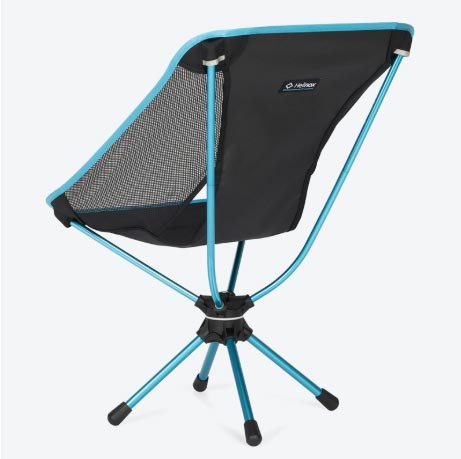
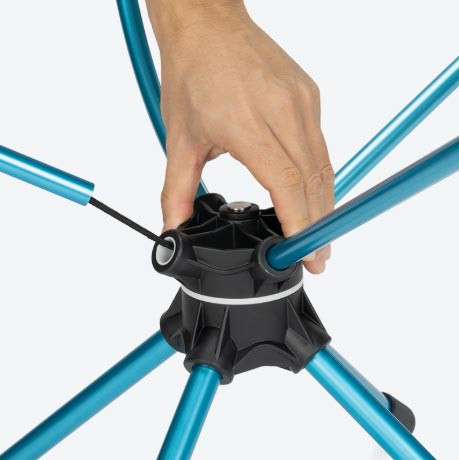
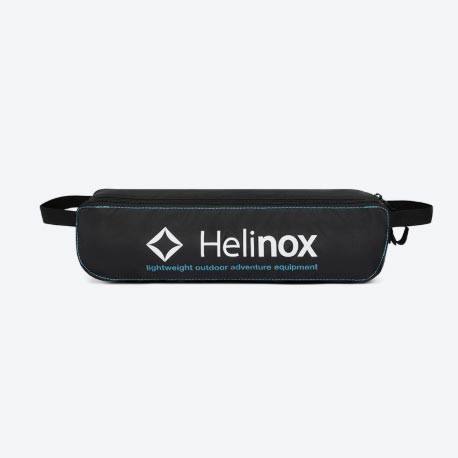
Product images courtesy of the Helinox official website.
Helinox Swivel Chair Specifications That Affect the Decision
According to the current Helinox product specifications, the chair uses a proprietary DAC aluminum-alloy frame, resin hubs, rubber feet, shock-corded poles, and a recycled 600D polyester seat with mesh panels.
| Specification | Helinox Swivel Chair |
|---|---|
| Assembled dimensions | 73 × 52 × 52 cm |
| Packed dimensions | 42 × 12 × 10 cm |
| Chair weight | 1,218 g |
| Packed weight | 1,312 g |
| Weight capacity | 120 kg |
| Rotation | 360 degrees |
| Frame | DAC aluminum alloy with resin hubs |
| Seat material | Recycled 600D polyester and mesh |
| Carry case | Full-zip case with handle and daisy chain |
The packed weight deserves context. At approximately 1.3 kg, the Swivel Chair is light compared with many full-size rotating camping chairs. It is not exceptionally light within Helinox’s own compact-chair range.
This difference becomes clearer beside the standard Helinox Chair One (re). The Swivel Chair asks you to carry additional weight and a specialized pivot in exchange for rotation. Whether that is a good exchange depends on how often you will actually turn while seated.
For car camping, festivals, picnics, or short walks from a parking area, 1.3 kg is unlikely to be the deciding issue. For backpacking, kayak camping, or any trip where every gram is examined, the swivel feature must earn its place.
Its packed shape remains one of the stronger practical points. A 42 cm case can fit into gaps that rigid folding chairs cannot use efficiently. Multiple chairs are easier to stack in a vehicle, and the full-zip opening should make the frame and fabric less frustrating to remove than a narrow drawstring sleeve.
The shock-corded frame also follows a familiar Helinox approach: pole sections naturally move toward their intended connections. Korean owners commonly described assembly as simple and fast. Even so, a rotating chair adds one area that deserves attention—the central mechanism should be correctly positioned, and the seat fabric should be fully secured before anyone sits down.
The 120 kg capacity is an official limit, not a target to challenge. Buyers close to that figure should also consider dynamic movement. Rotating abruptly, dropping into the seat, or leaning far beyond the base can create forces that differ from sitting calmly.
Stable Enough for Turning—But the Ground Still Matters
A rotating chair changes the way force moves through its legs. Instead of always facing forward, the user may reach sideways or turn toward something behind the seat. The chair’s stability therefore depends on more than its published weight capacity.
On hard, level ground, the four-leg base should provide the most predictable experience. Uneven gravel, soft soil, or sand can make one foot sink and alter the chair’s angle as the user turns.
This does not make the Swivel Chair unsuitable for normal campsites. It means that rotation should not encourage careless reaching. A chair can rotate smoothly while the overall base remains limited by the ground underneath it.
One Korean owner added Helinox Ball Feet to reduce sinking on sand and to protect the original feet on rough gravel. Accessories like these may help on soft surfaces, but they add cost, packed volume, and setup steps. They should be viewed as surface-specific tools rather than mandatory upgrades for every buyer.
The pivot itself raises another question: what happens when dirt reaches the mechanism?
An owner who had used the chair expressed particular caution around fine sand and dusty ground because of the possibility of debris entering the rotating section. That report should not be turned into a claim that the mechanism commonly fails. The available reviews do not establish a recurring failure pattern.
But the concern is reasonable enough to influence care.
Avoid placing the disassembled central section directly in sand. Shake or brush loose dirt from the frame before packing it, and follow Helinox’s care instructions rather than forcing the pivot or applying an unapproved lubricant. At a beach campsite, a simple groundsheet may be a sensible precaution.
This is the basic mechanical trade-off: the pivot creates useful movement, but it is also a component that a fixed chair does not need. Buyers who value simplicity above everything else may reasonably prefer fewer moving parts—even without evidence of a widespread durability problem.
Video source: This Korean-language owner review is included for additional visual context. The opinions expressed in the video belong to its creator and do not necessarily reflect the views of The Korea Picks.
What Korean Owners Reveal Beyond the Feature List
The Korean reports reviewed for this article do not represent a controlled test, and each owner used the chair differently. Together, however, they reveal several useful patterns.
First, rotation was most appreciated during tasks.
Cooking, grilling, reaching for supplies, turning toward a cooler, and moving between conversation partners appeared repeatedly. That supports the idea that the Swivel Chair’s advantage is functional rather than decorative.
Second, compact packing and low weight remained important even among car campers. A chair does not need to be used for backpacking before small packed dimensions matter. Korean camping setups often include shelters, tables, storage boxes, kitchen equipment, and multiple chairs, so reducing the volume of each item can make vehicle organization easier.
Third, comfort opinions were positive but qualified.
Owners generally described the chair as comfortable, while also mentioning the absence of head support or possible pressure near the thighs. These are not contradictory findings. They suggest that the chair succeeds within a compact, upright seating category but should not be judged by the standards of a long reclining chair.
Fourth, the swivel feature may encourage family sharing. One owner described the lower seat as useful for a growing child who was not well matched to a taller café-style chair, while the parent used the rotation during cooking. That does not make the Swivel Chair a children’s chair; it shows that its usefulness can change throughout the day.
Finally, enthusiastic ownership does not erase the price issue. The Swivel Chair combines a premium brand, a DAC frame, compact construction, and a specialized pivot. A buyer who only needs a place to sit can accomplish that for much less.
This is where K-papa’s perspective as a Korean product editor becomes relevant. Korean camping culture often places several activities—cooking, eating, organizing, and socializing—within a carefully arranged but crowded site. In that setting, a chair that turns without being dragged can feel more useful than its specification sheet suggests.
For a minimalist overseas buyer with one stove, one bag, and an open campsite, the same mechanism may feel like an expensive answer to a problem that barely exists.
Buy It for Movement, Skip It for Lounging
Buy the Helinox Swivel Chair if you regularly cook or organize equipment while seated, camp in compact layouts, and want a rotating chair that still packs into a relatively small case. It is especially compelling for car campers who value low storage volume more than the lowest possible weight.
Consider it carefully if you backpack. The packed size is attractive, but the 1,312-gram packed weight is significant beside lighter fixed chairs. Bring it only when rotation has a clear role in your trip rather than because the mechanism is interesting.
Skip it if you want head support, armrests, a deep reclining position, or maximum comfort during long, motionless evenings. A high-back chair is more closely aligned with that job.
You should also skip it if price efficiency is the priority. A basic fixed chair will provide seating with fewer moving parts, while a conventional Helinox model may preserve the brand’s compact construction without asking you to pay for rotation.
The clearest buying test is simple: How many times during a normal camping meal do you stand up or drag your chair solely to reach something nearby?
If the answer is “constantly,” the Swivel Chair addresses a real habit. If the answer is “almost never,” spend the money on better back support, lower weight, or another piece of equipment.
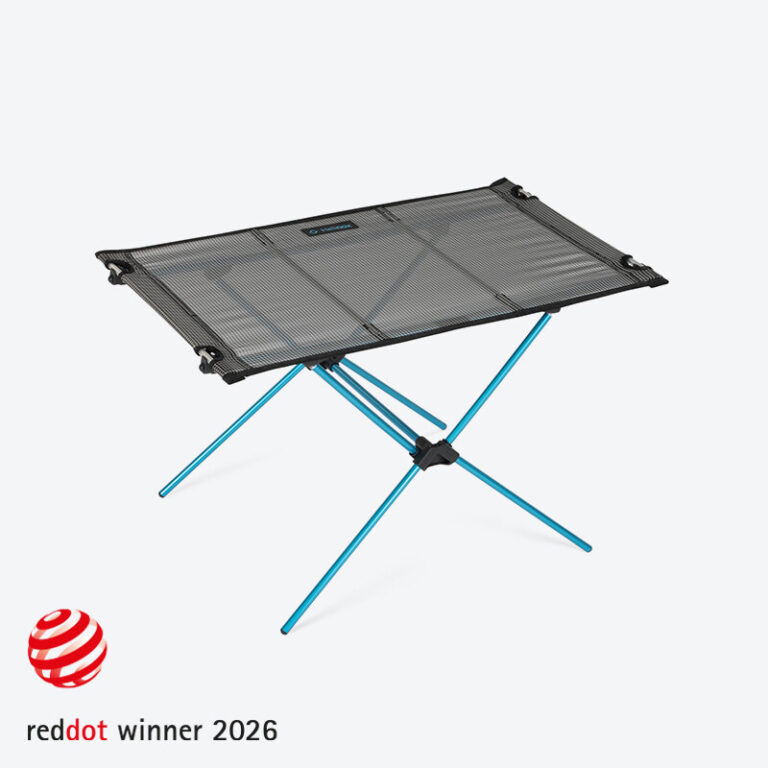
For campers building a coordinated lightweight setup, the compact chair also pairs naturally with a small table such as the one covered in my Helinox Table Zero LT review. Just remember that a very low, light table and a rotating chair still need to match your preferred eating posture.
How I Researched This Review
This is a research-based review; I have not personally purchased or field-tested the Helinox Swivel Chair.
I checked Helinox’s published dimensions, materials, packed weight, capacity, and construction, then compared them with four Korean owner reports supplied for this article. I treated official specifications as product facts and owner comments as individual experiences. Repeated use cases—especially cooking, reaching for gear, compact storage, and limited upper-back support—were used to identify patterns, while isolated concerns were kept conditional rather than presented as universal defects.
DID YOU KNOW? Korea
At many Korean campgrounds, the chair is more than a place to rest. It can become the center of a compact outdoor workstation.
A camper may prepare ingredients on a low table, grill meat, reach into a cooler, pass side dishes, and talk with family members without leaving the same small area. Korean meals also tend to place several shared dishes on the table at once, so people frequently turn, reach, serve, and reorganize items as the meal continues.
That helps explain why a rotating chair can attract attention in Korea even when a normal chair is lighter or less expensive. The swivel mechanism fits a campsite where cooking and socializing happen together rather than in separate zones.
There is also a familiar Korean camping tension between minimal camping and a carefully furnished “outdoor living room.” The Helinox Swivel Chair sits somewhere between those ideas: compact enough to pack efficiently, yet specialized enough to add another layer of convenience.
K-papa’s Quick Korean Lesson!
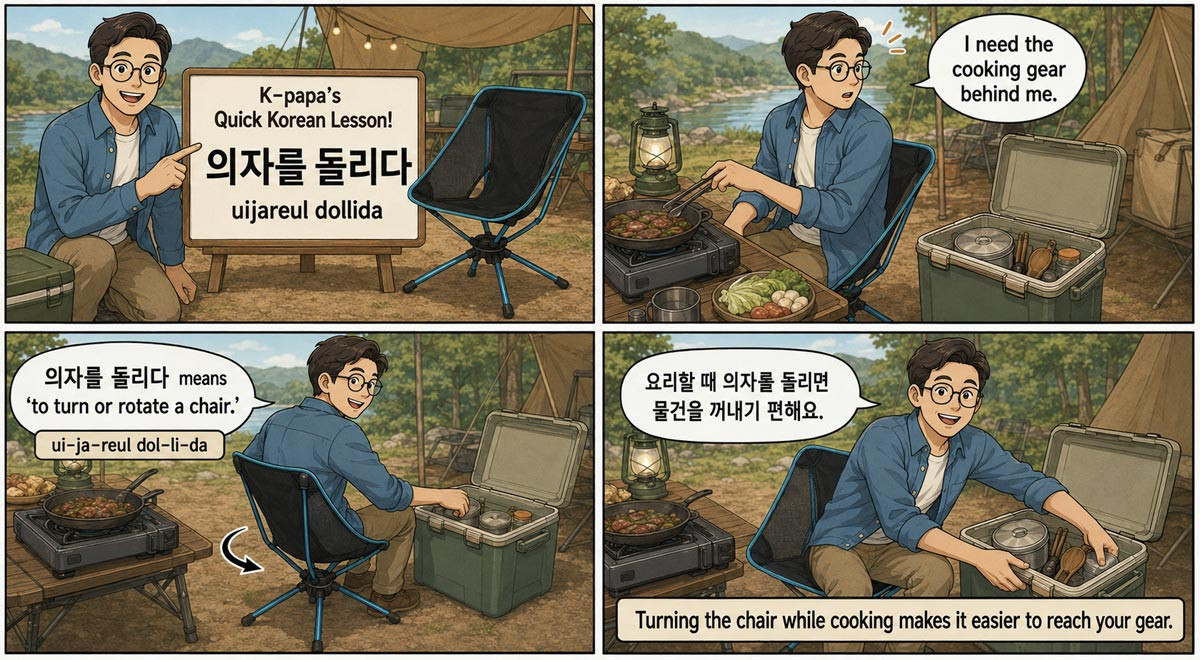
Korean phrase: 의자를 돌리다
Romanization: Uijareul dollida
Pronunciation: ui-ja-reul dol-li-da
Meaning: To turn or rotate a chair
Example: 요리할 때 의자를 돌리면 물건을 꺼내기 편해요.
Turning the chair while cooking makes it easier to reach your gear.
About the Author
K-papa is a creator living in South Korea who examines Korean products and everyday culture for international readers. His reviews separate verified specifications, recurring user experiences, and editorial judgment so readers can make a practical buying decision. Learn more about K-papa and The Korea Picks.