
KOVEA Camp 1 Hose Stove Review: Why This Long-Running Korean Burner Still Makes Sense
This KOVEA Camp 1 Hose Stove Review examines whether its low-profile design, wide burner, and heating pipe make it a practical choice for everyday campsite cooking.
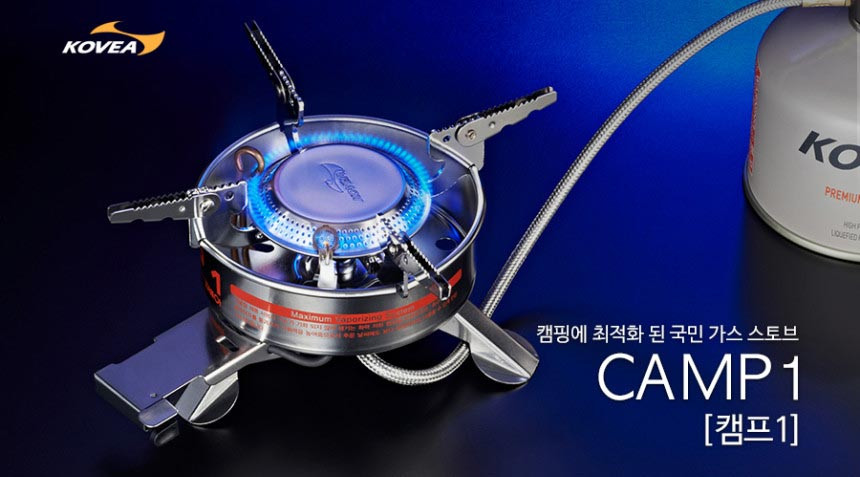
A small camping stove can become a major headache once you add a wide pan, uneven ground, or cold-weather gas pressure. The KOVEA Camp 1 takes a different approach: it keeps the burner low, moves the fuel canister away from the flame, and still folds into a compact case.
Known in Korea as the KOVEA Camp 1 Hose Stove, this single-burner model has been used by Korean campers for years. Its appeal is not based on new technology or ultralight specifications. It comes from a practical combination of strong heat, a wide burner head, low-profile stability, and manageable packing size.
I’m K-papa, a Korea-based creator who introduces useful Korean products to international readers. For this review, I examined and photographed the KOVEA Camp 1 in person, paying particular attention to its compact body, metal frame, folding pot supports, and fuel hose. I also checked KOVEA’s official product information and longer-term feedback from Korean campers.
Affiliate disclosure: This article contains affiliate links. If you buy through one of these links, The Korea Picks may earn a commission at no extra cost to you. This does not affect the independence of this review.
What This KOVEA Camp 1 Hose Stove Review Reveals About Its Low-Profile Design
Compact canister stoves are easy to pack, but placing the burner directly on top of the fuel canister raises the center of gravity. That arrangement can feel less reassuring when you are using a larger pot or preparing a full campsite meal.
The Camp 1 separates the burner and fuel canister with a hose. The burner therefore sits close to the ground or table, while its three folding legs create a broader stance than many tiny backpacking stoves.
What I noticed when I examined the Camp 1

The Camp 1 I examined in person. Its wide burner, folding supports, and substantial metal construction were easy to see at close range.
When I examined the Camp 1 in person, its construction felt more substantial than I expected from such a compact stove. The metal frame appeared solid, and the fuel hose felt thick and firmly made rather than lightweight or fragile. That gave me a reassuring first impression, although I did not conduct a gas-leak test or evaluate the hose through long-term outdoor use.
The three folding legs and pot supports also appeared sturdy for the stove’s size. Their low, wide arrangement looked better suited to supporting ordinary campsite cookware than the narrow supports found on many minimalist canister-top stoves. However, I would still use a larger dedicated burner for oversized griddles or unusually heavy pots.
The Camp 1 also seems to strike a useful balance between compact packing and practical cooking capacity. At 397 grams, it is not an ultralight backpacking stove, but it could work well for a solo camper who values cooking stability more than minimum pack weight. Its broad burner and substantial supports also make it a reasonable option for simple meals on a two- or three-person family camping trip.
This layout also gives the fuel canister some distance from the hot cookware. That does not eliminate the need to follow gas-stove safety rules, but it is a useful structural advantage when compared with a burner mounted directly above its canister.
KOVEA’s official material describes the Camp 1 as a remote-canister stove optimized for camping. It also highlights stainless-steel construction around the burner, legs, supports, and hose components.
The supplied material identifies the standard model as KGB-9703 and lists the stove at 397 grams. One Korean review estimated its weight at approximately 450 grams, but the official figure is the more reliable reference for the standard stove.

The KOVEA Camp 1 balances compact storage, a low cooking position, and practical heat for everyday campsite meals.
If this low-profile design fits your campsite cooking needs, compare the current listings carefully. eBay sellers may offer the standard KGB-9703, regional model-number variations, limited editions, or the newer Camp 1 Plus under similar titles.
The wide flame is better suited to campsite meals than tiny cookware
The Camp 1 uses a broad circular burner head rather than concentrating its flame in one narrow spot. According to KOVEA, this helps spread heat more evenly across the bottom of a pan.
That matters when you are cooking something more ambitious than water for coffee. A concentrated flame can create a severe hot spot in the middle of a frying pan or griddle, leaving the outer area cooler. The Camp 1’s burner geometry is intended to distribute heat across a wider area.
Several Korean users described the output as sufficient for ramen, soup, boiling water, and grilling meat. One reviewer particularly liked the degree of flame control, while another said the controls were approachable for someone unfamiliar with hose-type stoves.
These reports support the Camp 1 as a general campsite cooker. They do not establish laboratory boil times, wind resistance ratings, or fuel-efficiency results, because none of those measurements were provided.

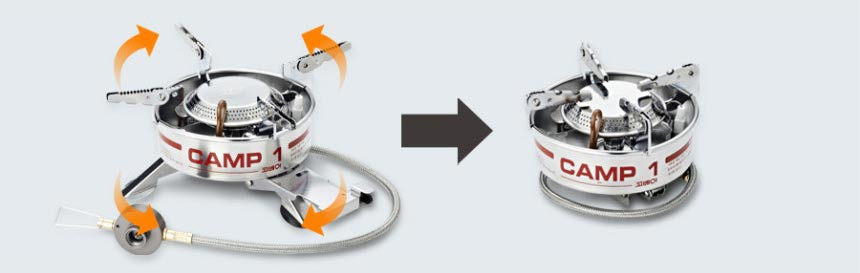

The heating pipe is one of the Camp 1’s most useful design details
A metal heating pipe runs close to the burner. KOVEA explains that this pipe preheats the fuel before it reaches the flame, helping the stove use gas more effectively in cold conditions.
One Korean owner of a Camp 1 plate edition also highlighted this feature as an advantage for winter camping, when low temperatures can weaken canister pressure and make fuel vaporization more difficult.
This feature should not be interpreted as a guarantee of unchanged output in every winter environment. Canister type, remaining fuel, wind, elevation, and temperature can all affect stove performance. The safer conclusion is that the heating pipe gives the Camp 1 a design advantage over a basic remote-canister stove without fuel preheating.
Fuel selection still requires attention. KOVEA’s supplied specification identifies a threaded butane-type camping canister, while several retailer-oriented Korean reviews mentioned adapters for other canisters. An adapter was associated with particular sales packages, not clearly listed as a universal component of every Camp 1 box.
Check the exact package and use only a compatible canister or manufacturer-approved connection. Do not assume an adapter will be included.
Practical strengths and limitations of the Camp 1
My in-person inspection, the official specifications, and longer-term user reports point to the same central trade-off: the Camp 1 offers more cooking stability than a minimalist stove while remaining much smaller than a full-size campsite burner.
Several reviewers thought the Camp 1 offered a useful middle ground between an ultracompact top-mounted stove and a much larger campsite burner. Its folding structure and included case make it easier to store, while the low burner position provides a more settled cooking platform.
Simple setup was also mentioned more than once. Users generally described the legs, pot supports, hose connection, ignition, and control arrangement as easy to understand.
The reviews were less consistent about wind. One user described the flame as remaining stable in breezy conditions, but two others recommended an additional windscreen when the wind became stronger. The available evidence therefore does not support calling the Camp 1 windproof.
| Practical Strengths | Limitations and Variables |
|---|---|
| Compact folding body and dedicated storage case | Wind performance ranged from satisfactory to needing a separate windscreen |
| Low hose-stove layout that feels more settled than a top-mounted burner | One user considered the hose short for flexible table placement |
| Easy ignition and understandable flame control | Stability may decrease on rough or uneven surfaces |
| Useful heat for water, ramen, soup, and everyday camp cooking | Large, heavy cookware may require more support than the stove alone provides |
| A practical balance between portability and cooking space | Adapter inclusion appears to depend on the seller or package |
One review was more generic and offered limited first-hand detail. Its broad claims about durability and value were therefore given less weight than reports describing specific cooking, storage, wind, or setup experiences.
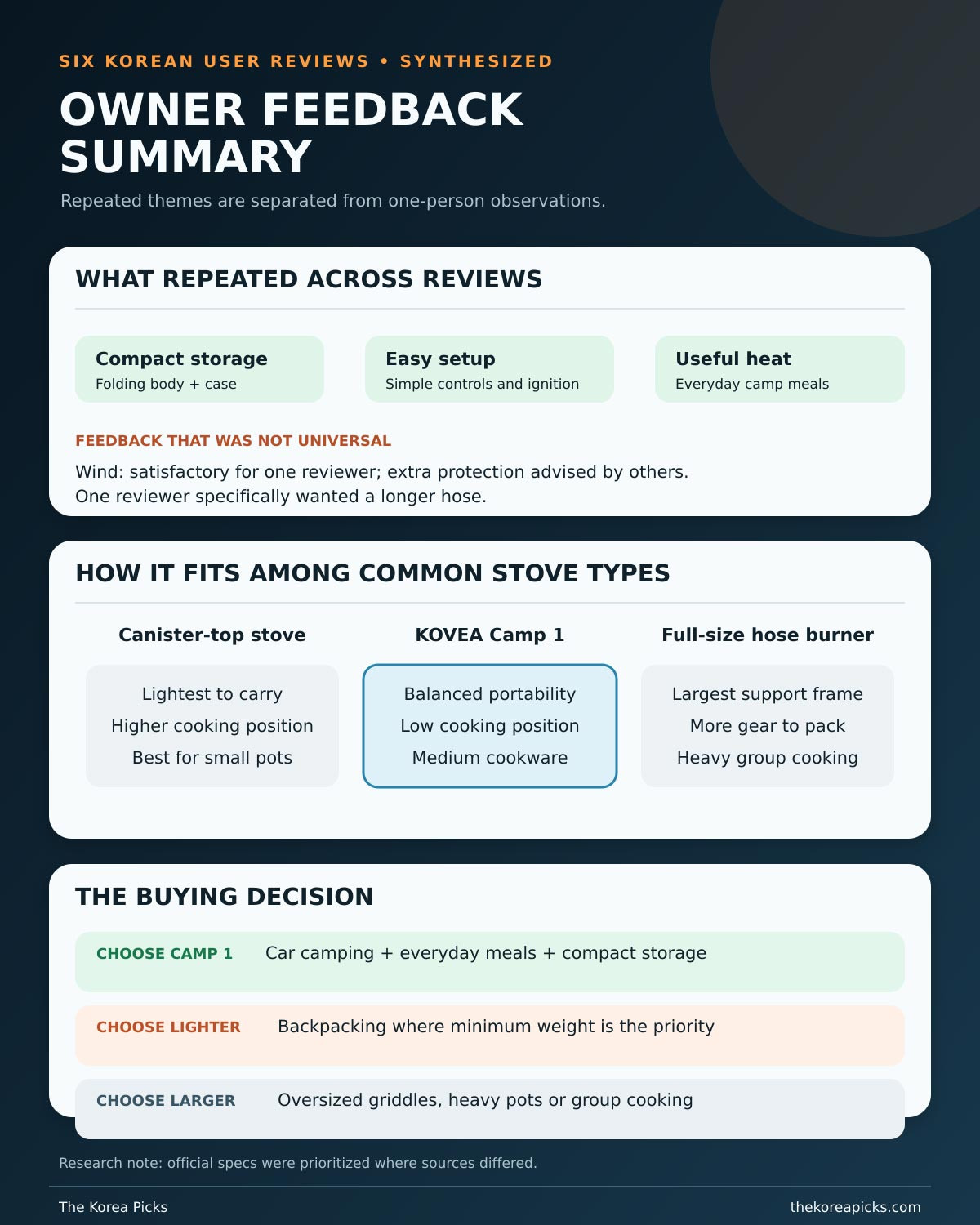
Six Korean user reviews suggest that the Camp 1 works best for campers who value cooking stability without carrying a full-size burner.
Folding supports help it pack small, but cookware choice still matters
The three legs and pot supports fold inward around the burner, reducing the Camp 1 to a compact cylindrical package. KOVEA includes a hard storage case with the standard product information supplied for this review.
That case is a worthwhile part of the design. Folding stove arms, an ignition electrode, and a hose connection can be damaged or bent if they are left loose inside a gear box.
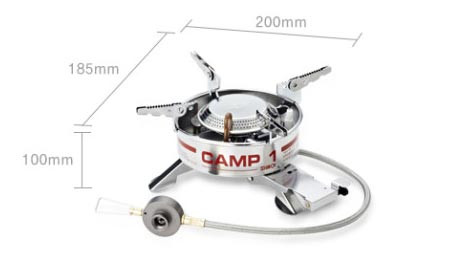
The official illustration shows a maximum span of approximately 200 mm across the extended upper supports. This measurement describes the stove’s physical support area, not a universal recommendation for every 200 mm pan. Cookware weight, shape, contents, and placement still influence stability.
One Korean reviewer preferred the Camp 1 for small cookware and medium pots rather than long sessions with heavy cooking equipment. Another used a Camp 1 plate bundle with larger cookware and valued the extra supporting structure.
Those experiences are not necessarily contradictory. The standard stove is compact, while the plate accessory changes how it integrates with a larger camp kitchen.
Product images courtesy of KOVEA : KOVEA Official Website
The Camp 1 plate bundle is not the same package as the standard stove
One of the six Korean reviews covered a Camp 1 Black Edition set with a surrounding plate rather than only the standard KGB-9703 stove.
That reviewer used the plate to support campsite cooking and liked how it caught spills before they reached the table. The set also included separate storage for the stove and plate. Its published total weight was 1.8 kg, including a 397-gram stove and the much heavier plate assembly and related components.
This distinction matters. A shopper seeing the 1.8 kg figure could incorrectly assume that the standard Camp 1 is a heavy stove. It is not. That number applies to the larger plate bundle described in the review.
The plate version may make sense for an organized IGT-style kitchen or frequent car camping. Campers interested in the Camp 1 primarily because of its compact size should compare the standard stove package instead.
The supplied reviews did not contain enough verified information to present a full old-versus-new Camp 1 comparison. They covered the standard model and a later plate-oriented bundle, but not a controlled comparison between two clearly documented stove generations.
The short hose and open flame deserve attention before buying
One Korean user specifically wished the hose were longer. A short hose can limit where the fuel canister sits relative to the burner, table edge, windscreen, and other cooking equipment.
The hose also needs more care during packing than the body of a simple top-mounted stove. Avoid forcing it into a sharp bend, and inspect the hose and connection points before use.
Wind protection is another limitation. The burner has a raised outer structure, but it remains exposed. A compatible windscreen may help in breezy weather, provided it does not trap heat around the fuel canister or hose. Never enclose or overheat the canister.
The official safety information also emphasizes outdoor use, adequate ventilation, correct assembly, and checking for gas leaks. Use the stove on a level, nonflammable surface and keep flammable materials away from the burner.
One user reported movement on uneven ground and recommended a flat table or mat. That is sensible advice for any low portable stove, especially when hot liquid is involved.
Who should buy the KOVEA Camp 1?
The Camp 1 is a strong match for car campers, picnic users, and recreational campers who want more cooking stability than a tiny canister-top stove without carrying a full two-burner kitchen.
It is especially relevant if your regular campsite menu includes:
- Ramen, soup, or stew
- Boiling water for coffee
- Frying or grilling with medium cookware
- Meals that benefit from a wider flame pattern
- Cold-weather trips where a fuel-preheating pipe may help
Beginners may also appreciate its clear folding mechanism and integrated piezoelectric ignition. Piezo ignition is convenient, but carrying a backup lighter remains sensible because ignition systems can become unreliable when dirty, wet, or damaged.
Who should skip it?
Ultralight backpackers should look elsewhere. At 397 grams before the canister and cookware, the Camp 1 is much heavier than minimalist canister-top stoves.
Campers who routinely use very heavy griddles or oversized stockpots may be better served by a larger high-output burner with a broader dedicated frame. The Camp 1 has extendable supports, but it should not be treated as an unrestricted heavy-cookware platform.
It is also less suitable for anyone wanting an all-in-one cooker with a built-in grill plate, lid, and drip system. A multi-purpose camping cooker such as the KOVEA Guibada occupies more space, but it provides a more complete tabletop cooking setup.
Finally, people who primarily cook indoors should not choose an outdoor camping stove as a substitute for a certified indoor appliance.
The Camp 1’s best alternatives depend on what you want to improve
A compact canister-top stove is the better alternative when pack weight and minimum volume matter more than pan stability. It will be easier to carry on foot, although the higher burner position and narrow supports may be less comfortable with larger cookware.
A full-size hose burner is more appropriate for heavy griddles and longer group meals. You gain support and cooking confidence but lose the Camp 1’s compact packing advantage.
An integrated grill system makes sense for car campers who want one appliance for grilling, frying, and hot-pot cooking. It is bulkier and takes more cleaning, but fewer separate cookware decisions are required.
The Camp 1 sits between these categories. That middle position explains much of its lasting appeal in Korea.
If you would rather carry one integrated cooker for grilling, frying, and hot-pot meals, read my KOVEA GUIBADA CERAMIC Review to see whether its all-in-one design better suits your camping style.
Since photos and text have their limits, here is a review video to give you a real sense of the product’s actual size and feel.
Is the KOVEA Camp 1 still worth considering?
After examining the Camp 1 in person, I was most impressed by how substantial its frame, folding supports, and fuel hose appeared for such a compact stove. Its low construction looked reassuring for ordinary campsite cookware, but I would not treat it as a substitute for a larger burner when using oversized or especially heavy cooking equipment.
The available evidence supports the KOVEA Camp 1 as a practical, established campsite stove rather than an ultralight or maximum-output specialist.
Its broad burner, low center of gravity, heating pipe, folding supports, integrated ignition, and hard case form a sensible package for ordinary campsite cooking. Korean feedback repeatedly points to portability, straightforward setup, and useful flame control as its main strengths.
The trade-offs are equally practical: a relatively short hose, mixed wind performance, added weight compared with backpacking burners, and limitations with very heavy cookware.
If you usually travel by car and want one compact burner for coffee, ramen, stew, and medium-pan cooking, the Camp 1 deserves a place on your shortlist. If every gram matters or your campsite meals depend on oversized griddles, choose a stove built specifically for that job.
If the standard Camp 1 matches your cooking setup, compare the available listings before ordering. Check the exact model number, included case, adapter status, seller location, shipping terms, and final delivered cost.
How I Checked and Researched This Review
I examined and photographed the KOVEA Camp 1 in person, checking its overall size, visible metal construction, folding legs, pot supports, burner head, and fuel hose. I did not operate it during cooking, conduct a gas-leak test, measure its heat output, or evaluate its long-term durability.
I also reviewed KOVEA’s official product information, including its listed weight, burner design, heating pipe, fuel connection, folding structure, and safety guidance. Longer-term Korean user reports were used as additional context for setup, wind performance, cookware use, and storage.
One source discussed a Camp 1 plate bundle rather than the standard stove alone, so its 1.8 kg total weight and plate-related benefits were not presented as specifications of the standard KGB-9703. When a user-provided weight differed from KOVEA’s material, the official 397-gram specification was used.
The reviews expressed different opinions about wind performance. Instead of combining them into one claim, this article reports that experiences varied and that stronger wind may require suitable protection.
Sources reviewed:
KOVEA Camp 1 Hose Stove FAQ
How much does the KOVEA Camp 1 weigh?
The standard KOVEA Camp 1 KGB-9703 weighs 397 grams according to the official material supplied for this review. A 1.8 kg figure found in one Korean review refers to a larger Camp 1 Black Edition package with a plate and related components, not the standard stove by itself.
Is the KOVEA Camp 1 good for beginners?
Yes, it appears suitable for beginners who understand outdoor gas-stove safety. Several Korean users described its folding structure, ignition, and flame control as easy to understand. New users should still read the manual, inspect the connection for leaks, cook on level ground, and carry a backup lighter.
Can the KOVEA Camp 1 handle large pans?
The folding supports can accommodate cookware wider than the burner body, but pan diameter alone does not determine safety. Weight distribution and the amount of food also matter. For very heavy griddles or stockpots, a larger framed burner or compatible support plate would be a more appropriate choice.
Does the KOVEA Camp 1 work well in cold weather?
Its heating pipe is designed to preheat the fuel and support more effective gas use in cold conditions. However, it cannot remove every winter limitation. Actual performance still depends on temperature, wind, canister type, fuel level, and correct operation.
Is the KOVEA Camp 1 windproof?
No, it should not be considered windproof. Korean users reported different results: one was satisfied with its performance in wind, while two others recommended additional protection in stronger conditions. Any windscreen must be positioned without trapping dangerous heat around the canister.
What fuel does the KOVEA Camp 1 use?
The supplied official information specifies a threaded camping gas canister. Some Korean sales packages were promoted with an adapter, but adapter inclusion may vary by retailer. Confirm the exact fuel connection and box contents before ordering, particularly when buying from outside Korea.
Is the KOVEA Camp 1 suitable for backpacking?
It can be carried on short trips, but it is not an ultralight backpacking stove. The 397-gram stove prioritizes a low cooking position, broad flame, and more substantial supports. Weight-focused hikers will usually prefer a much lighter canister-top model.
Can international buyers purchase the KOVEA Camp 1?
Yes. The standard KOVEA Camp 1 KGB-9703 is currently available from multiple eBay sellers, although shipping eligibility varies by country. Buyers should verify the exact version, fuel connection, included case, adapter status, shipping terms, import costs, and local outdoor-stove regulations before ordering.