
Neoflam FIKA Egg Roll Pan Review: Nonstick Performance, Size & Drawbacks
A neatly shaped Korean rolled omelet can be surprisingly difficult to make in a round skillet. The Neoflam FIKA Egg Roll Pan addresses that problem with a compact rectangular cooking surface, sloped sides, ceramic nonstick coating, and compatibility with induction cooktops.
I’m K-papa, a Korea-based creator who introduces useful Korean products to international readers. For this Neoflam FIKA Egg Roll Pan review, I compared Neoflam’s product information with four detailed Korean reviews. This is a research-based assessment, not a hands-on test.
The evidence suggests that the pan makes rolled omelets noticeably easier to shape and also works for small servings of fried eggs, sausage, bacon, meat, and Korean pancakes. Its biggest concern is not cooking performance. One owner reported that the metal section where the short wooden handle meets the pan became hot enough to cause repeated accidental contact.

Affiliate disclosure: This article contains affiliate links. If you buy through one of these links, The Korea Picks may earn a commission at no extra cost to you. This does not affect the independence of this review.
Neoflam FIKA Egg Roll Pan Review: Quick Buying Decision
The Neoflam FIKA Square Egg Roll Pan 15cm IH is a specialized mini pan that earns its place in kitchens where rolled omelets or small portions are prepared regularly.
Its strongest points:
- The rectangular shape helps produce straighter, more even omelet rolls.
- Korean owners found it useful for small portions beyond eggs.
- It works on induction, gas, and other commonly used stovetops.
- The warm beige finish and wooden handle give it a distinctive kitchen-friendly appearance.
- Its ceramic nonstick surface suits the moderate heat normally used for eggs.
The main reasons to hesitate:
- One owner reported a potentially serious hot-handle connection point.
- It requires hand-washing and should not be used in a dishwasher.
- Medium heat is recommended, limiting its appeal for high-heat cooking.
- Its small, specialized shape may be unnecessary if you rarely make rolled omelets.
- Opinions about its weight were mixed.
The best match is someone who frequently prepares Korean gyeran-mari, Japanese tamagoyaki, lunch-box sides, or single-person portions. A larger conventional skillet is more practical for high-volume cooking.
If that compact cooking style matches your routine, compare the current listings carefully. Some eBay sellers offer the 15 cm egg pan individually, while others include it as one option within a larger FIKA cookware listing.
If that compact cooking style matches your routine, compare the current listings carefully. Some eBay sellers offer the 15 cm egg pan individually, while others include it as one option within a larger FIKA cookware listing.
What the Neoflam FIKA Egg Roll Pan is designed to do
The pan is officially sold in Korea as the Neoflam FIKA Square Egg Roll Pan 15cm IH. Its core purpose is straightforward: it provides a small rectangular surface on which layers of egg can be rolled without the curved, unused edges found in a round skillet.
That geometry matters more than it may appear. In a round pan, the cook often has to trim, fold, or reshape the sides of an omelet. The FIKA pan allows the egg mixture to spread into a more uniform rectangle. As each cooked layer is rolled and fresh egg is added, the straight sides help maintain a compact shape.
Three of the Korean owner reports described the pan as making rolled omelets easier to form. One reviewer who considered herself an inexperienced cook was pleased that she could produce a well-defined roll rather than scrambled eggs. Another said the finished omelet came out straight and tidy even when the ingredient quantity changed.
Its usefulness is not limited to a single recipe. Owners also used it for:
- Fried eggs
- Small Korean pancakes
- Small portions of meat
- Ham, sausage, and Spam-style luncheon meat
- Simple side dishes for children
This does not turn it into a general-purpose family skillet. Its advantage is efficiency when the quantity is small.
Living in Korea, I do not think of gyeran-mari as a special-occasion recipe. It is the kind of side dish that can appear at breakfast, in a lunch box, or alongside an ordinary family meal. That frequency changes how I look at a specialized pan like this. A rectangular egg pan may seem unnecessary to someone who makes rolled omelets twice a year, but for a household that prepares them regularly, easier shaping can justify giving a dedicated pan some cabinet space. I would judge the FIKA mainly by how often you cook this kind of food, not by how many different recipes the pan can technically handle.
Ceramic nonstick performance at egg-friendly temperatures
The product uses a ceramic nonstick cooking surface. One owner specifically described its nonstick performance as good, while the cooking results shown across three reports support the conclusion that eggs can be rolled without excessive sticking when the pan is used appropriately.
Cooking temperature is important. The supplied use information recommends medium heat and warns against high heat or heating the pan while empty. Those restrictions are consistent with its intended role. Rolled eggs generally need controlled heat so the layers set without browning too quickly.
Buyers who prefer aggressive searing should view this as a separate low-to-medium-heat pan, not a substitute for stainless steel or cast iron.
Neoflam FIKA Egg Roll Pan specifications
The table below includes only details supported by the manufacturer’s product information and the supplied material.
| Specification | Details |
|---|---|
| Official product name | Neoflam FIKA Square Egg Roll Pan 15cm IH |
| Product type | Rectangular ceramic nonstick egg roll pan |
| Size classification | 15cm |
| Shape | Square/rectangular |
| Handle style | Wood-look handle |
| Induction compatible | Yes |
| Other supported heat sources | Gas, electric hot plate, and radiant cooktop |
| Recommended heat | Medium heat |
| Microwave safe | No |
| Oven safe | No |
| Dishwasher safe | No |
| Country of manufacture | South Korea |
An official weight was not clearly confirmed in the accessible product information, so it has not been estimated here. The complete exterior measurements should also be checked with the seller if storage space or cooktop-zone coverage is important.
What Korean users repeatedly appreciated
It makes rolled omelets easier to control
The most meaningful advantage was consistent across three owner reports: the pan’s geometry simplifies shaping.
One owner bought it because she wanted straighter omelets than she could make in a round skillet. She reported that the rectangular result remained tidy with both simple and ingredient-heavy mixtures. Another reviewer found it much easier to shape the omelet while rolling it, despite not considering herself a skilled cook.
A third owner also described the pan’s angles and construction as well suited to the task. That user was critical of other aspects of the product, making the positive assessment of its actual egg-cooking performance especially relevant.
The evidence therefore supports a focused conclusion: this is not merely a decorative pan shaped like an egg-roll pan. Its form provides a practical cooking benefit.
The design is consistently appealing
All four Korean reviews emphasized the appearance. The muted beige body, clean rectangular profile, subtle bottom logo, and natural-looking handle were repeatedly described as attractive.
Appearance does not improve cooking performance, but it may matter to buyers who keep cookware visible on open shelves or use it for serving breakfast at the table. The FIKA aesthetic is also more subdued than many dark, utilitarian nonstick pans.


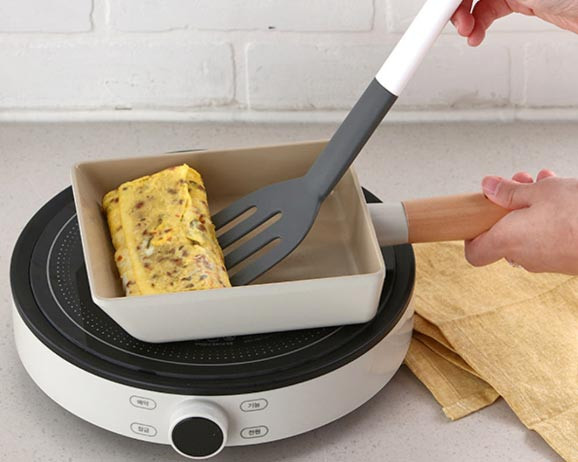

A small pan can be useful beyond omelets
Two owners described cooking foods other than rolled eggs. Their examples included pancakes, fried eggs, small portions of meat, ham, and sausage.
The compact surface can reduce the inconvenience of taking out and washing a full-size skillet for one egg or a child-size serving. The rectangular layout may also make it easier to arrange several narrow pieces in rows.
That versatility helps justify the purchase, but only within small-scale cooking. It does not provide the capacity of a conventional frying pan.
Performance in different kitchen situations
Korean rolled omelets and tamagoyaki
This is where the pan makes the most sense. Its straight walls help guide the sides of each layer, while the compact width produces a roll that can be sliced into lunch-box portions.
The user reports indicate that the pan accommodates both plain egg and mixtures containing vegetables, seaweed, or other additions. Adding many ingredients can still make rolling harder, but the shape provides more control than a round skillet.
Use low-to-medium heat and add each layer before the previous one becomes dry. A thin coating of oil may also help preserve release performance.
Breakfast for one
For a fried egg, a few strips of bacon, or a small serving of sausage, the pan can be more convenient than a large skillet. One Korean user specifically reached for it when using a larger pan felt unnecessary.
The limitation is space. Preparing multiple full breakfasts at once would likely require several batches, reducing the efficiency advantage.
Meals for children
One owner used the pan for a child’s dinner, including rolled egg and a small amount of meat. The size allowed her to prepare modest quantities and arrange the food neatly.
Parents who make frequent lunch-box sides may find this particularly useful. Families cooking large portions for several people will probably benefit more from a wider skillet paired with this pan only for omelets.
Induction kitchens
Induction compatibility is an important feature because many small egg pans are made without a magnetic base. The supplied reviews confirmed successful induction use, while other supported heat sources include gas and radiant electric cooktops.
The exact relationship between the pan’s base and an individual induction zone still matters. Some induction systems have minimum cookware-detection requirements, so buyers with unusually large or restrictive zones should check their cooktop manual.
Since photos and text have their limits, here is a review video to give you a real sense of the product’s actual size and feel.
Problems to consider before buying
One owner reported a hot metal section near the handle
The most important criticism came from one Korean owner who used the pan three times. According to that report, heat traveled into the metal connection between the pan and its short wooden handle. The user accidentally touched the heated section twice and considered it dangerous.
None of the other supplied reviews mentioned the same incident, so it cannot be presented as a universal experience. It is still too significant to ignore. The short handle and exposed connection point may place the user’s hand closer to hot metal than expected.
If you buy this pan, keep your grip toward the outer end of the handle and treat the metal connector as a hot surface. Using a dry oven mitt or handle cover would be prudent, especially on a gas burner where flame position can increase handle heat.
The handle joint may collect water
The same reviewer raised a second concern about the screw opening near the handle. Water reportedly entered that area during washing, creating worry about trapped moisture and possible internal corrosion.
The review did not document actual corrosion, so long-term damage cannot be claimed. Still, the construction may require more careful washing and drying than a pan with a sealed or removable handle joint.
Avoid immersing the handle unnecessarily. After hand-washing, dry the connector thoroughly and position the pan so retained water can drain.
It is not dishwasher safe
One owner who regularly used a dishwasher found the hand-wash requirement disappointing. This is an official care restriction rather than an isolated personal preference.
The small size should make manual cleaning manageable, particularly if the nonstick surface releases food easily. Even so, buyers who deliberately choose dishwasher-safe cookware should not overlook this limitation.
Avoid abrasive pads and harsh cleaners that could damage the ceramic surface.
Weight impressions were inconsistent
One reviewer described the pan as light and comfortable to lift with one hand. Another thought it felt unexpectedly heavy for such a small item.
These are subjective impressions rather than verified measurements. The difference may reflect expectations, grip, or experience with other pans. Buyers with limited hand strength should request the official packaged or net weight from the seller before ordering.
It is designed for moderate heat
The product information advises against high heat, empty heating, oven use, and microwave use. That makes it suitable for eggs and gentle frying but poorly suited to searing meat or recipes that begin on the stovetop and finish in the oven.
Ceramic nonstick surfaces also benefit from suitable utensils and careful temperature control. If you prefer unrestricted high-heat cooking, a small stainless-steel or cast-iron pan would be a better fit.
Korean user feedback at a glance
| What Korean Users Appreciated | What Buyers Should Consider |
|---|---|
| Rectangular sides made omelets easier to roll and shape | One owner reported that the metal handle connector became dangerously hot |
| Ceramic nonstick performance suited egg cooking | Water may enter the screw opening around the handle joint |
| Attractive beige body and natural-looking handle | Hand-washing is required |
| Compatible with induction and several other stovetops | High heat, empty heating, oven use, and microwave use are not supported |
| Useful for eggs, ham, sausage, pancakes, and small meat portions | Capacity is too limited for most family-size frying |
| Made in South Korea | Reviewers disagreed about whether it felt light or heavy |
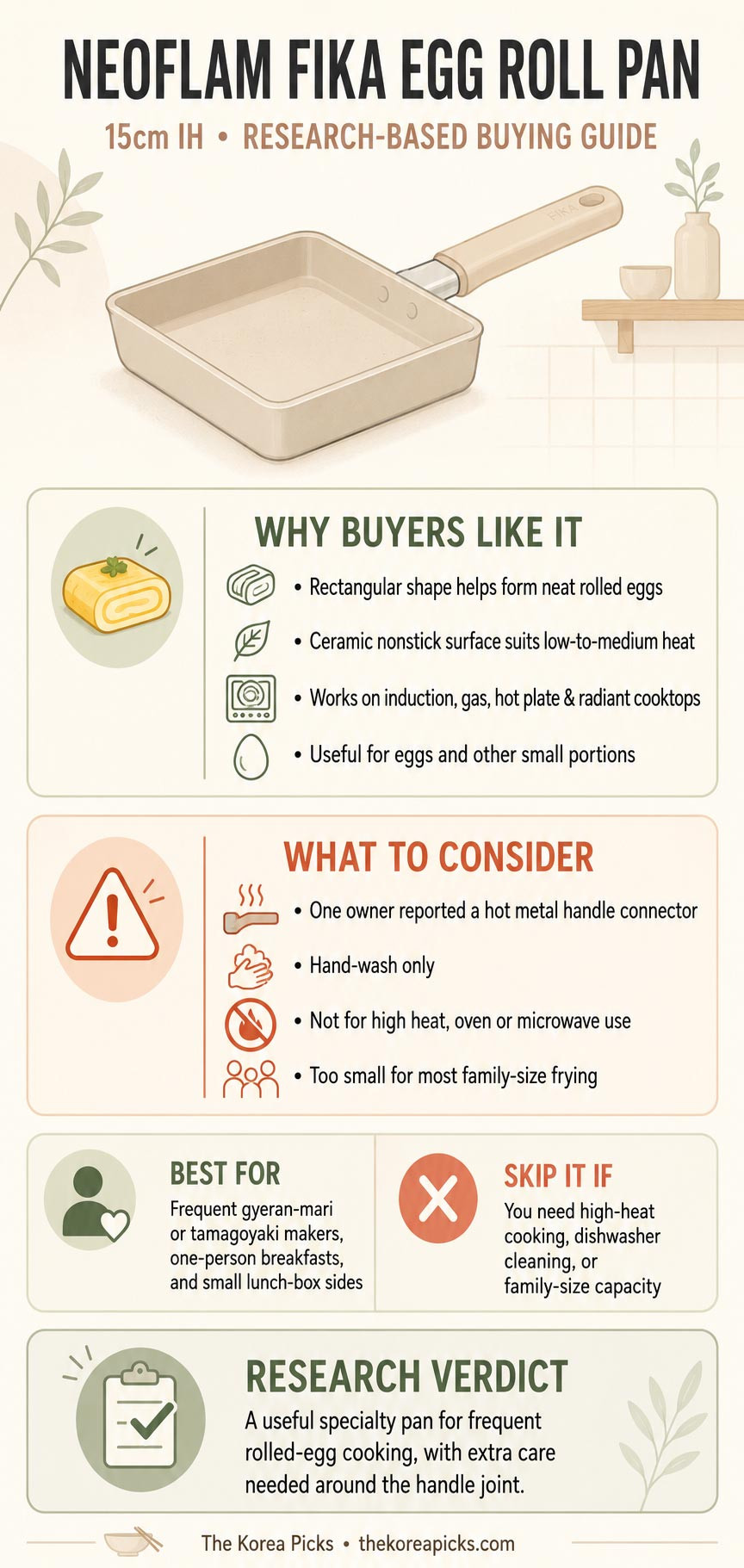
At a glance: The Neoflam FIKA Egg Roll Pan’s key benefits, limitations, and best uses based on official information and Korean user feedback.
How it compares with alternative pan types
No verified side-by-side comparison model was included in the supplied material, so a brand-specific performance ranking would be speculative. The practical alternatives can still be compared by category.
A regular round nonstick skillet
A round pan is more versatile and offers greater capacity. Most people can make a rolled omelet in one with enough technique, so occasional omelet makers may not need specialized cookware.
The FIKA pan has the advantage when straight sides and consistent width matter. It reduces the amount of manual shaping needed and uses less surface area for a small egg mixture.
A traditional tamagoyaki pan
Other rectangular tamagoyaki pans may offer similar shaping benefits, sometimes at a lower price or with a longer handle. Material, induction compatibility, coating type, and handle construction vary widely.
The FIKA’s distinguishing points are its ceramic nonstick surface, induction support, Korean manufacture, and carefully styled appearance. Buyers who care more about a cool, secure handle than design should compare connection structures closely.
A small stainless-steel or cast-iron pan
Uncoated metal cookware tolerates higher temperatures and avoids reliance on a ceramic nonstick layer. It can also last longer when maintained correctly.
The tradeoff is a steeper learning curve for eggs. Temperature control and oil technique become more important, and the pan may be heavier. These alternatives make more sense for shoppers who prioritize high-heat capability and long-term material durability.

Product images courtesy of Neoflam : Brand Official Website
Who should buy it—and who should skip it
Consider the Neoflam FIKA Egg Roll Pan if you:
- Make gyeran-mari or tamagoyaki frequently.
- Want straighter, more consistent omelet rolls.
- Regularly cook one egg or small portions.
- Need a rectangular pan that works on induction.
- Prefer ceramic nonstick cookware used at moderate heat.
- Value coordinated, neutral-colored kitchenware.
- Are comfortable hand-washing and drying the handle joint carefully.
Consider another pan if you:
- Make rolled omelets only a few times per year.
- Need enough capacity for several people.
- Depend on a dishwasher for cookware cleaning.
- Frequently cook over high heat.
- Want an oven-safe skillet.
- Have concerns about short handles or exposed metal connectors.
- Prefer cookware with a confirmed weight before importing it.
- Want one pan to handle most frying tasks.
Looking for practical containers to store the omelets and other side dishes you prepare? Read my Glasslock Classic White Edition 10-Piece Set Review: Practical Glass Storage for Everyday Korean Meals to see whether this Korean glass storage set fits your meal-prep routine.
Is the Neoflam FIKA Egg Roll Pan Worth Buying?
The Neoflam FIKA Square Egg Roll Pan succeeds at its primary job. Across the Korean owner reports, its rectangular shape repeatedly helped users produce cleaner rolled omelets, including users who did not consider themselves highly skilled cooks. Its ceramic surface, induction-compatible base, compact capacity, and refined appearance strengthen the case for it as a dedicated breakfast or lunch-box pan.
The most important reservation is the handle assembly. Although only one of the four supplied reviewers reported excessive heat at the metal connection, accidental contact with a hot component is a meaningful safety concern. Careful grip placement and heat protection are advisable. The opening around the handle screw also deserves thorough drying after washing.
This pan is worth considering for someone who makes rolled eggs often enough to benefit from the shape and will follow its moderate-heat, hand-wash care requirements. It is harder to justify as an imported specialty item for an occasional omelet maker, particularly if shipping raises the total cost.
My recommendation is therefore conditional: choose it as a dedicated pan for frequent rolled eggs and small portions, but choose a conventional round skillet if you need one pan for broader everyday cooking.
If the 15 cm FIKA pan fits your cooking routine, compare the current seller options before ordering. Check the exact model, individual-pan or set configuration, color, shipping origin, and final delivered cost.
How I Researched This Review
This review compares Neoflam’s product information with four Korean blog posts supplied for analysis. Three included firsthand owner accounts of cooking with the pan, while one focused primarily on its published features and design.
I separated details by evidence type: official product specifications, experiences repeated across multiple owner reports, and concerns raised by only one reviewer. Conflicting comments about weight were retained rather than converted into a single conclusion. No personal testing, independent measurements, or fixed international price has been assumed. Overseas marketplace availability was checked separately at the time of this update, but individual listings, prices, and shipping conditions can change.
The Korean product name and current model classification can be checked on the Neoflam official Korean store.
Frequently Asked Questions
Is the Neoflam FIKA Egg Roll Pan good for tamagoyaki and Korean rolled eggs?
Yes. Its 15cm rectangular cooking area helps keep egg layers straight while they are rolled. Three Korean owner reports indicated that the shape made forming neat omelets easier than using a conventional round skillet.
Can the Neoflam FIKA Egg Roll Pan be used on induction?
Yes, the 15cm IH version is designed for induction cooktops. It is also listed for use on gas, electric hot plates, and radiant cooktops. Check your induction unit’s minimum pan-detection requirement because the pan has a compact base.
Is the pan dishwasher safe?
No, the pan should be washed by hand. The supplied care information identifies it as unsuitable for dishwashers. Use a soft sponge, avoid abrasive cleaners, and dry the handle connection carefully so water does not remain around the screw opening.
Does the handle become hot?
The wooden portion is intended to provide a comfortable grip, but one Korean owner reported that the exposed metal connector became very hot. Keep your hand away from the connector and consider using a dry mitt or handle cover, particularly when cooking on gas.
What else can you cook in the FIKA egg pan?
It can cook fried eggs, small pancakes, ham, sausage, bacon, luncheon meat, and modest portions of other ingredients. Its limited capacity makes it useful for one-person breakfasts or children’s side dishes rather than full family meals.
Can it be used over high heat or placed in the oven?
No, the supplied instructions recommend medium heat and prohibit high heat, empty heating, oven use, and microwave use. Buyers who need high-temperature searing or stovetop-to-oven cooking should choose another type of pan.
Is the Neoflam FIKA Egg Roll Pan worth importing?
It may be worth importing for frequent rolled-omelet makers who want induction compatibility and a distinctive ceramic design. Occasional users should compare the delivered price with locally available rectangular pans because its specialized function and hand-wash requirement may not justify high shipping costs.