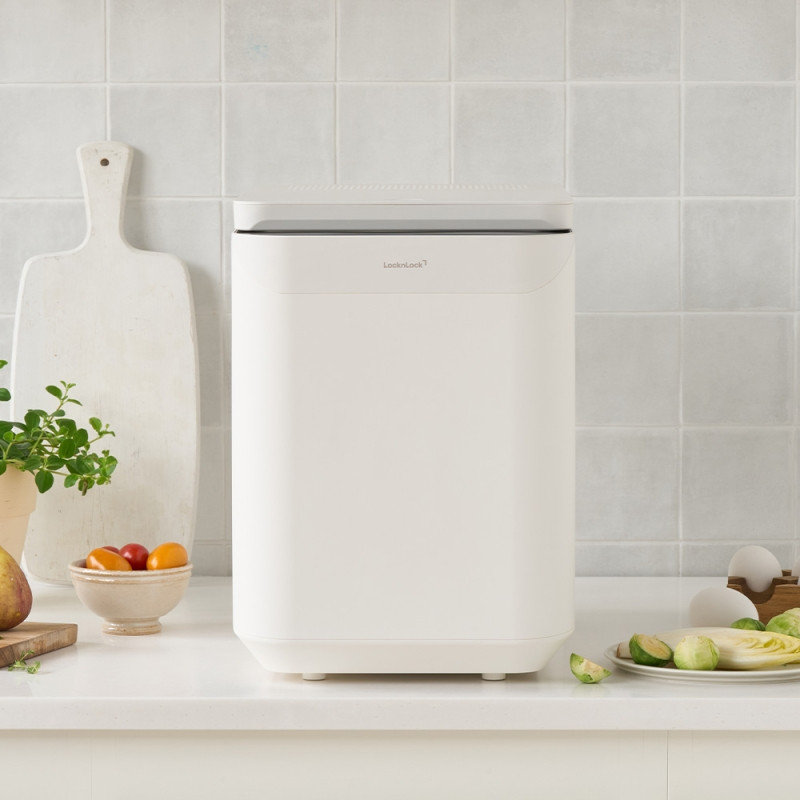
LocknLock Zero Waste Food Processor 3.5L Review: Less Food-Waste Odor, but Is It Practical Overseas?
Food scraps are easy to ignore for a few hours, right up until the kitchen starts to smell or fruit flies appear. If your kitchen bin starts smelling after just one day in summer, this is exactly the kind of problem this machine is designed to solve. A heated drying-and-grinding machine can make that daily chore less unpleasant, but a 3.5-liter appliance also takes up counter space, uses replaceable filters, and requires some care over what goes inside.
This LocknLock Zero Waste Food Processor 3.5L review looks at whether those trade-offs make sense. I’m K-papa, a creator living in Korea who introduces useful Korean products to international readers. This is a research-based review drawn from LocknLock’s product information and five Korean user reports, rather than my own hands-on test.
The Short Buying Answer
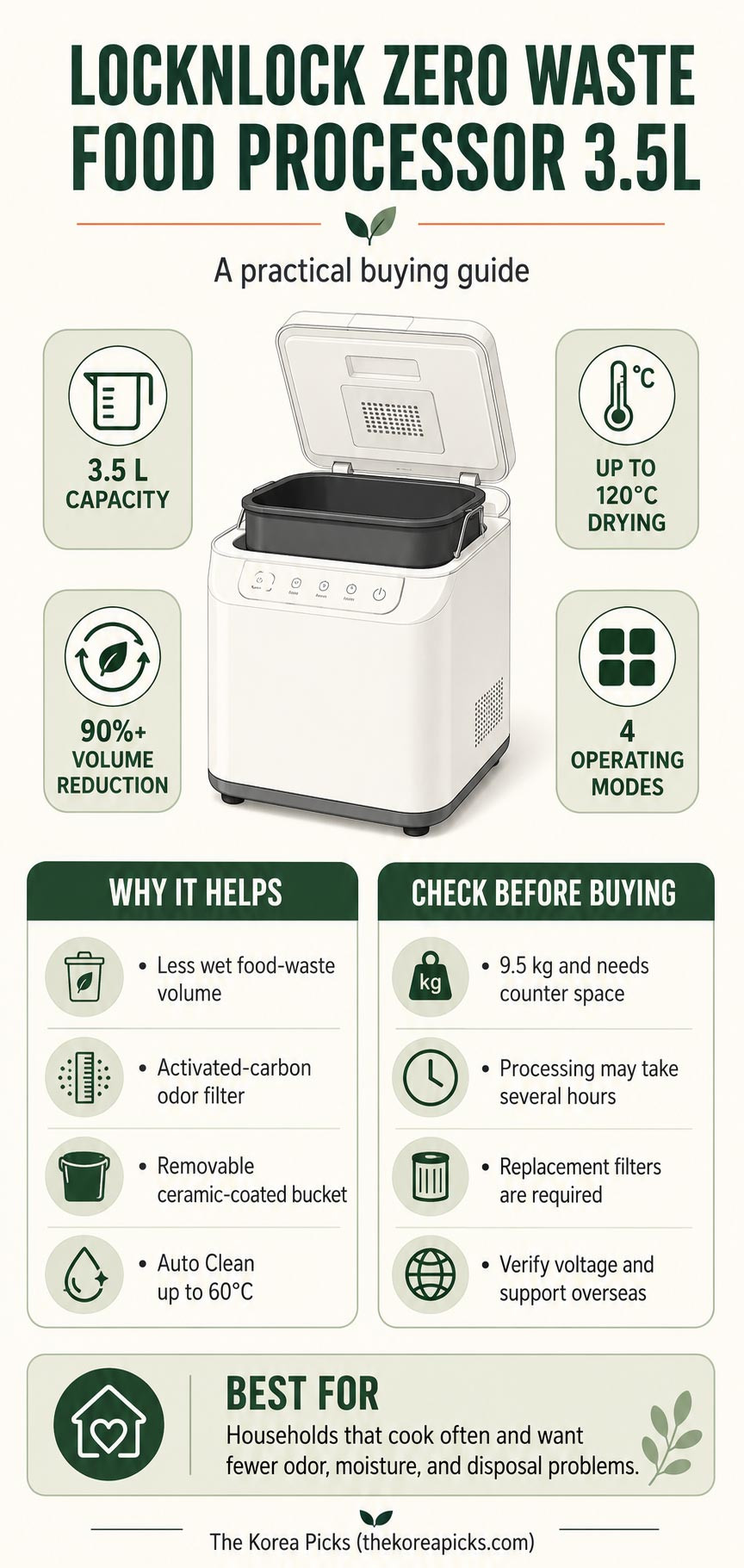
The LocknLock Zero Waste Food Processor 3.5L is most convincing for households that cook regularly and want to reduce the wet volume, odor, and disposal frequency of food scraps. Its official highlights include drying at up to 120°C, a three-blade grinding system, four operating modes, an activated-carbon deodorizing filter, and a removable ceramic-coated inner bucket.
The main reservations are equally practical. At a listed 9.5 kg, this is not an appliance you will want to move frequently. A full cycle may take several hours, starch-heavy scraps can stick or produce an unpleasant smell, and the filter is a recurring consumable. International buyers also need to verify voltage, plug type, replacement-filter supply, warranty coverage, and local waste rules before importing it.
LocknLock Zero Waste Food Processor 3.5L Review: What Problem Does It Solve?
This machine does not eliminate food waste. It changes its condition.
LocknLock says the appliance uses heat and grinding to reduce food scraps by at least 90% in volume. Moist leftovers become a much smaller quantity of dry, finely processed material. For a household that currently stores wet scraps in a kitchen bin, that can mean less leaking, less space occupied, and fewer trips to an outdoor collection point.
Odor control is the second major reason to consider it. The system combines high-temperature drying with an activated-carbon filter. Several of the Korean reviewers said kitchen odor became much less troublesome, especially during warmer weather. That feedback is encouraging, although it should not be interpreted as a promise of zero odor under every condition. One owner noticed a faint burnt smell after processing unsuitable or sticky food.
Capacity matters too. The 3.5-liter bucket was described as a comfortable size by reviewers from family households and by an owner processing a larger batch after holiday cooking. It offers more flexibility than a small processor that must be emptied after every modest meal, but the appliance itself needs a permanent place on the counter.
Official Specifications
| Specification | Official information |
|---|---|
| Product | LocknLock Zero Waste Food Processor 3.5L |
| Processing method | High-temperature drying and grinding |
| Inner-bucket capacity | 3.5 L |
| Maximum drying temperature | Up to 120°C |
| Claimed volume reduction | At least 90% |
| Grinding system | Three-blade structure |
| Operating modes | Standard, Slow, Storage, Auto Clean |
| Auto-cleaning | High-temperature cycle up to 60°C |
| Deodorizing system | Activated-carbon filter |
| Filter iodine adsorption value | 1,023 mg/g |
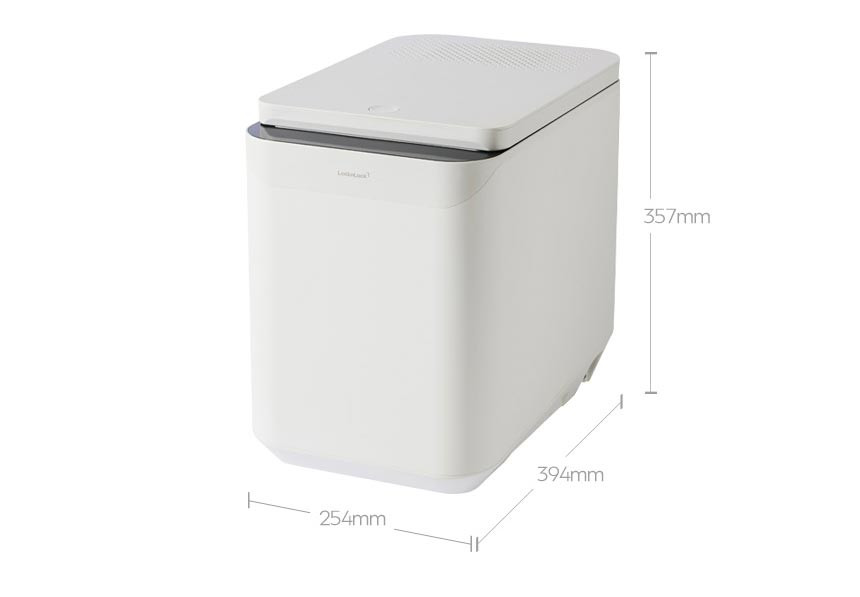
| Listed dimensions | 394 × 254 × 357 mm |
| Listed weight | 9.5 kg |
| Inner bucket | Removable, ceramic-coated |
| Inner lid cover | Removable stainless-steel cover |
| Certification shown | Q-Mark |
The manufacturer lists the dimensions as 394 × 254 × 357 mm. Its diagram indicates a narrow front and a deeper body, so buyers should compare the full footprint with their counter rather than relying on the sequence of the numbers alone. Leave enough clearance to open the top lid and lift out the inner bucket.
What Five Korean User Reports Repeatedly Mentioned
The reduction in wet waste is the clearest benefit
Four of the five reports specifically described a substantial drop in volume after processing. Reviewers used vegetables, tomatoes, fruit peels, and mixed leftovers, and described the result as dry crumbs or powder-like material. These are personal observations rather than controlled measurements, but they point in the same direction as LocknLock’s reduction claim.
That change has a simple household benefit: the unpleasant part of food-waste disposal becomes smaller and drier. If you cook often, this is likely to matter more than any individual display feature.
Odor control was positive, with one important exception
Four reviewers said food-waste odor became less noticeable or easier to manage. The activated-carbon filter and drying process appear to be central to that experience.
However, one owner reported a light burnt smell after apparently adding unsuitable food. The same reviewer warned about starch-heavy foods such as rice cakes and cooked rice sticking to the bottom. This does not contradict the generally positive odor feedback. It shows that results depend partly on the contents and on following the operating guidance.
Cleaning was widely viewed as manageable
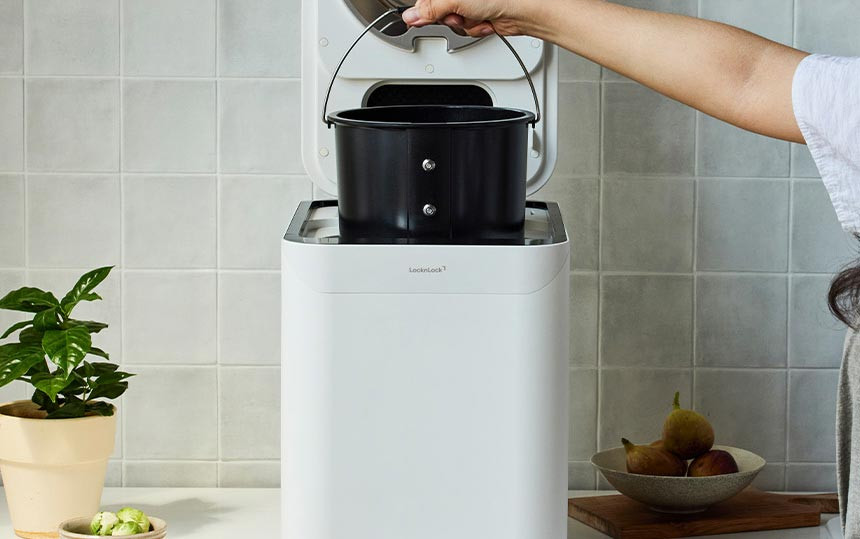
Three reports praised the removable bucket or the auto-cleaning function. LocknLock’s design allows the ceramic-coated inner bucket and stainless-steel inner cover to be removed, while the cleaning mode circulates heat with water in the bucket.
Auto Clean should be understood as maintenance assistance, not a guarantee that no manual washing will ever be needed. Sticky residue, oil, or material caught around removable parts may still need attention.
Noise feedback was consistently favorable
Three reviewers described the machine as quiet enough not to be distracting, including one who ran it overnight. LocknLock’s materials cite an average operating noise level of 29.3 dB.
Noise perception changes with room layout, background sound, load, and the stage of the cycle, so the published figure should not be treated as a guarantee for every kitchen. Still, none of the supplied reports identified operating noise as a major drawback.
Opinions on size depended on the kitchen
The feedback was mixed rather than contradictory. Two reviewers emphasized that the body is fairly large, while another said it fit a small kitchen more easily than expected. A 3.5-liter processor can feel compact beside larger waste appliances yet still consume valuable counter depth.
This is a case where measuring first is more useful than reading another subjective description.
How the Four Modes Affect Everyday Use
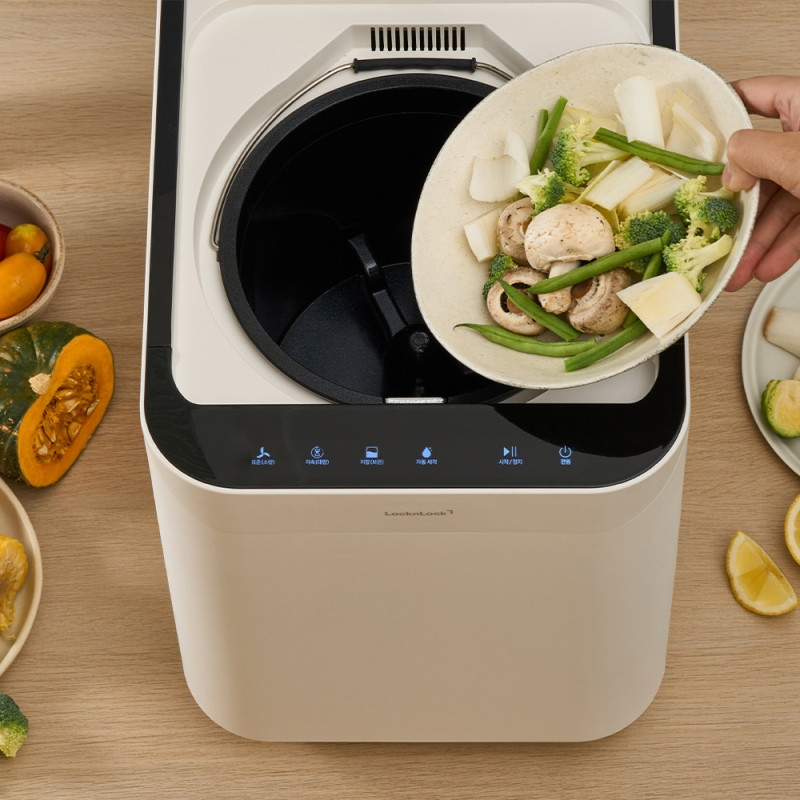
Standard mode is intended for smaller or routine loads. Slow mode is presented as the choice for larger quantities or oilier waste. Storage mode lets food scraps remain in the appliance until processing is more convenient, which may be useful for households that do not produce enough waste to justify starting a cycle after each meal.
Auto Clean is the maintenance mode. The supplied material describes adding water to the inner bucket before running the cleaning cycle, which uses heat up to 60°C. One Korean report described the cycle as taking 35 minutes.
The interface was repeatedly described as straightforward. That matters in a shared kitchen: an appliance is more likely to become part of the household routine when family members can select a clearly labeled mode without learning a complicated sequence.
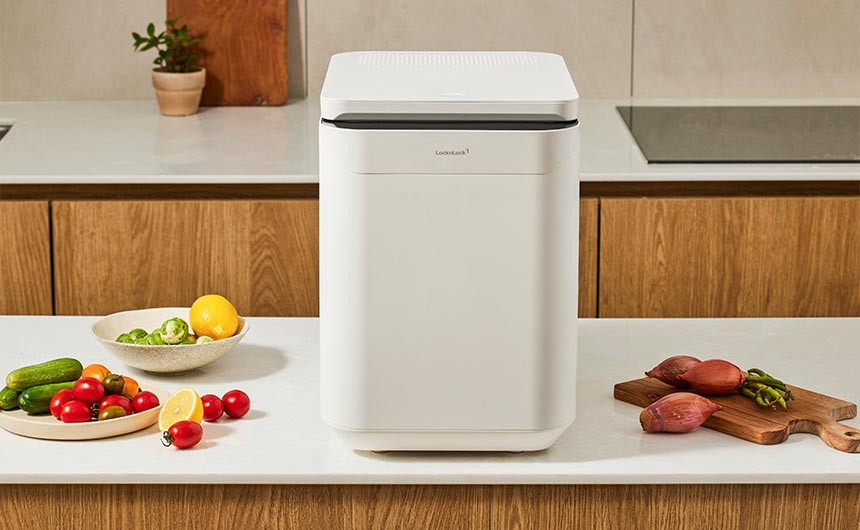
Image credit: LocknLock Official Website
Limits You Should Know Before Buying
Processing is not instant
One Korean owner estimated that a cycle took more than four to five hours. Another felt the process did not take excessively long, showing that expectations differ. The available official material does not establish one universal cycle time, and processing time may vary with the amount and moisture content.
Treat this as a set-and-wait appliance, not a rapid disposer.
Some scraps need preparation or should stay out
One reviewer warned against hard animal bones, shells, large fruit pits, and tough bulky vegetables, and recommended cutting difficult material smaller. The same report noted that starchy foods may stick and smell scorched.
International buyers should obtain and follow the manual for the exact model. A powerful-looking blade does not mean every kitchen scrap is safe to process.
Filters create an ongoing ownership cost
The activated-carbon filter is part of the odor-control system and will need replacement. The supplied sources do not confirm replacement intervals, current filter prices, or overseas availability. Those details matter because importing a machine is much less attractive if its consumables are difficult to obtain later.
Disposal rules are not universal
The Korean reports conflict on where the dried output should go: one says general waste, while another says it should remain food waste. Disposal classification can vary by local authority and by the way the waste has been processed. Check your municipality’s current rules instead of relying on either statement.
Buying Decision at a Glance
| What Makes It Worth Considering | What Could Make You Skip It |
| 3.5 L capacity suits regular household cooking | The body is deep and weighs 9.5 kg |
| Heat and grinding substantially reduce wet-waste volume | A cycle can take several hours |
| Recurring owner feedback supports meaningful odor reduction | Odor may still occur with unsuitable or sticky scraps |
| Removable bucket and Auto Clean simplify maintenance | The activated-carbon filter is a recurring consumable |
| Four modes cover processing, temporary storage, and cleaning | Not every bone, shell, pit, or starchy food is suitable |
| Reported noise was not a major complaint | Overseas voltage, service, and filter supply are unconfirmed |
Value for Money and International Buying
The provided material does not establish a current retail price, so a precise value judgment would be misleading. The best way to assess it is by frequency of use.
For a household that cooks most days, produces enough scraps to use the 3.5-liter capacity, and currently makes frequent disposal trips, the combination of drying, grinding, odor filtration, and assisted cleaning can justify paying more than for a sealed food-waste bin. If food waste is minimal, a smaller or simpler storage solution may solve the problem at lower cost.
Some Korean local governments offer subsidies for eligible food-waste reduction appliances, and the supplied LocknLock material highlights the product’s Q-Mark. Eligibility, reimbursement amounts, and application rules vary. Buyers in Korea should check their own municipality before purchase rather than assuming the model automatically qualifies everywhere.
For buyers outside Korea, confirm all of the following with the seller before ordering:
- Rated voltage and plug type for the exact unit
- Whether the seller ships to your country
- Total shipping cost, tax, and import charges
- Availability and price of genuine replacement filters
- Warranty service outside Korea
- Return arrangements for a 9.5 kg appliance
- Local rules for disposing of dried food-waste residue
No verified international retailer was included in the supplied material.
LocknLock Versus Other Food-Waste Solutions
The closest alternative depends on which part of food waste bothers you most.
A sealed food-waste refrigerator is better suited to someone who mainly wants to slow odor and decomposition while preserving scraps for normal collection. It does not aim to dry and grind them. A smaller drying processor may fit a one- or two-person household better, especially where counter space is limited. A larger processor may be more sensible for a household that routinely exceeds 3.5 liters.
At the premium end, buyers may also compare this LocknLock with processors offering larger capacity, more established international distribution, or easier access to filters and warranty service. Those factors can matter more overseas than a small difference in headline performance.
If you want to understand how a more established Korean drying-and-grinding model approaches the same problem, see the Smartcara 400 Pro X review. The useful comparison is not simply which machine is “better,” but which capacity, support network, and ownership routine fit your household.
Since photos and text have their limits, here is a review video to give you a real sense of the product’s actual size and feel.
Video source: This Korean-language owner review is included for additional visual context. The opinions expressed in the video belong to its creator and do not necessarily reflect the views of The Korea Picks.
Who Should Buy It – and Who Should Skip It
Consider the LocknLock Zero Waste Food Processor 3.5L if:
- Your household cooks frequently and generates regular food scraps.
- Odor, moisture, fruit flies, or repeated disposal trips are a recurring problem.
- A 3.5-liter bucket matches your typical batch size.
- You have permanent counter space and can access replacement filters.
- You are comfortable sorting out hard, fibrous, or unsuitable waste first.
Skip it or compare alternatives if:
- You produce only a small amount of food waste.
- You need instant processing.
- Counter depth is limited or you would need to move the 9.5 kg unit often.
- You want an appliance that accepts nearly every kind of scrap without preparation.
- You cannot confirm local voltage, service, filters, or disposal rules.
The Research-Based Verdict
The LocknLock Zero Waste Food Processor 3.5L addresses a real household nuisance: wet scraps that smell, attract insects, and require frequent disposal. Across the five Korean reports provided, the strongest recurring benefits were substantial volume reduction, less noticeable odor, manageable cleaning, and unobtrusive noise. Those points align reasonably well with the manufacturer’s stated design.
Its limitations are not minor details. You need enough space, patience for a multi-hour process, care over what enters the bucket, and continuing access to activated-carbon filters. Importing it also makes little sense until voltage, warranty, and consumable supply are confirmed.
For a Korean family household that cooks regularly, the 3.5-liter capacity and four-mode operation appear well matched to daily use. For an overseas buyer, it becomes a conditional recommendation: the processing concept is appealing, but local support and long-term filter access may decide whether it is genuinely worth the cost.
How I Researched This Review
This article compares LocknLock’s supplied product pages with five Korean blog reports. Official material was used for specifications and manufacturer claims, including capacity, dimensions, weight, operating modes, maximum temperatures, filtration, and stated reduction performance.
Owner reports were used only for subjective observations such as perceived odor, noise, cleaning effort, size, and processing time. An opinion was described as recurring only when it appeared in multiple reports. Conflicting statements, particularly the correct disposal category for processed residue, were retained as a point requiring local verification rather than forced into a single answer. I did not personally test this appliance.
Frequently Asked Questions
What does the LocknLock Zero Waste Food Processor 3.5L do?
It dries and grinds food scraps to create a much smaller quantity of dry residue. LocknLock claims at least a 90% reduction in volume, while several Korean reviewers also reported a visibly substantial reduction after processing vegetables, fruit peels, and mixed leftovers.
Is 3.5 liters enough for a family?
The 3.5-liter bucket appears suitable for many small-to-medium family households that cook regularly. Reviewers from family settings described the capacity positively, including during holiday meal preparation. Actual suitability depends on how much waste your household produces between cycles.
Is the LocknLock food-waste processor noisy?
The supplied evidence suggests noise is relatively low. LocknLock cites an average of 29.3 dB, and several reviewers said it was not disruptive, including during overnight operation. Actual sound can vary by load, processing stage, room acoustics, and placement.
Does it completely remove food-waste odor?
No odor-free result can be guaranteed, but most supplied reviewers reported a clear improvement. The machine combines high-temperature drying with an activated-carbon filter. One owner experienced a faint burnt smell after processing unsuitable or starch-heavy material, so correct sorting and cleaning still matter.
How easy is the inner bucket to clean?
Cleaning appears reasonably manageable because the ceramic-coated bucket and stainless-steel inner cover are removable, and an Auto Clean mode uses heated water. Sticky or oily residue may still require manual cleaning, so the function reduces maintenance rather than eliminating it.
What should not go into the processor?
Hard bones, shells, large fruit pits, and other very hard material should not be assumed safe. One Korean reviewer also advised caution with tough bulky vegetables and starchy foods such as rice and rice cakes. Follow the manual supplied with the exact model.
Can I buy and use it outside Korea?
Possibly, but the supplied sources do not confirm international distribution. Verify the unit’s voltage, plug, shipping, warranty, return policy, and replacement-filter availability before importing. A voltage mismatch or unavailable consumable can outweigh the appliance’s practical benefits.
Should the processed residue go into general waste or food waste?
Check your local authority’s rules because the provided Korean reports disagree. One owner described general-waste disposal, while another said the residue should still be classified as food waste. Municipal rules can differ, so neither statement should be applied universally.
About the Author
K-papa is a creator living in Korea who researches Korean camping gear and kitchen and living products for international readers. Learn more about K-papa and how The Korea Picks researches its reviews on the About page