A Foreigner’s Guide to Korean Campgrounds: What to Expect Before Your First Night
Camping in Korea can feel wonderfully easy once you understand how the campgrounds work. The difficult part is that many of the details visitors need are hidden inside Korean booking pages, campground notices, and rules that do not always translate cleanly.
A campground described as “auto camping,” for example, may let you park beside your tent—or it may provide a separate parking space nearby. A listing may show an electrical outlet without clearly stating its wattage limit. Even the word “deck” has a more specific meaning than many first-time visitors expect.
As a Korean camper, I have watched people arrive with beautiful equipment and still spend their first hour looking confused. The problem usually is not camping skill. It is simply that Korean campgrounds have their own rhythm.
This guide explains that rhythm: how to choose the right type of site, what the facilities are really like, what to bring, and which small details can save your first Korean camping trip from becoming unnecessarily stressful.
What Is Camping in Korea Actually Like?
The first thing to know is that most Korean campgrounds are not remote wilderness sites.
Many are organized facilities with assigned pitches, shared restrooms, sinks, showers, electrical connections, and clearly marked parking areas. Depending on the location, you may also find a convenience store, refrigerator, microwave, playground, swimming pool, or small café.
This makes Korean campgrounds approachable for families and newer campers. It also means that you will usually be sleeping closer to other groups than you might at a dispersed campsite in North America or Europe.
Space is carefully divided. Your reservation normally gives you the right to use one numbered site rather than a broad area in which you can choose any attractive place to pitch your tent.
Korean camping is therefore a mixture of outdoor living and shared-facility etiquette. You still have trees, mountains, rivers, and cold morning air, but you also have neighbors only a few meters away.
For international visitors, accepting that combination makes the experience much more enjoyable.
Learn the Main Korean Campground Types First
The word “campground” can refer to several noticeably different experiences in Korea. Choosing the wrong category may leave you carrying equipment much farther than expected—or arriving without gear that the campground assumes you already own.
Auto Camping Sites
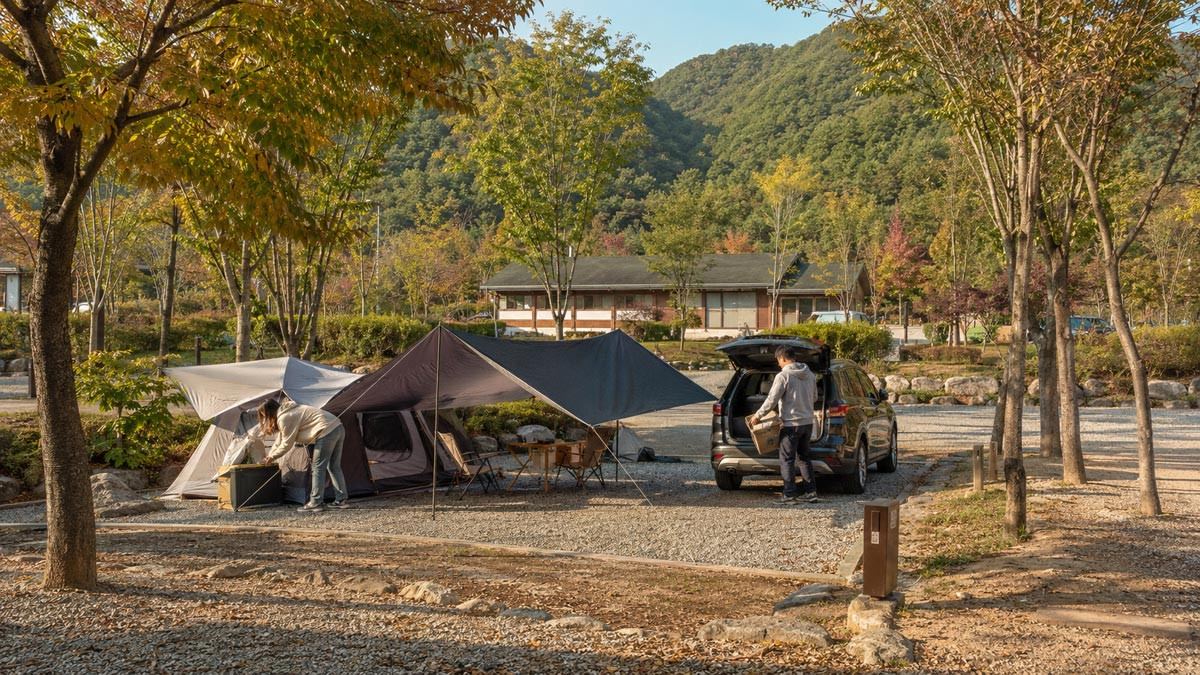
An auto camping site, called oto kaempingjang (오토캠핑장), is generally designed for people arriving by car.
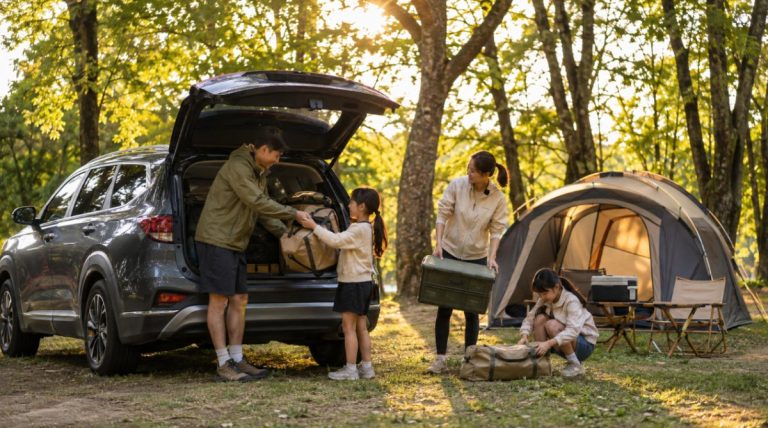
In the most convenient version, you park directly beside your assigned pitch. This makes it easy to unload a large tent, chairs, cooking equipment, coolers, and bedding. It is the style many Korean families prefer for a weekend trip.
However, “auto camping” does not guarantee that every vehicle remains beside every tent. Some locations allow unloading near the site but require cars to be moved to a designated parking lot afterward. Check the campground map and the individual site description rather than relying on the category name alone.
Regular Camping Sites
A regular camping area, often labeled ilban ya-yeongjang (일반야영장), may separate tents from vehicles.
The walk can be very short, but it matters when you are carrying heavy equipment. A campground on a slope can also involve stairs, narrow paths, or carts provided for transporting luggage.
Travelers without a car should pay special attention to this category. A campground may be reachable by bus, yet the final distance from the bus stop to reception can still be inconvenient with a suitcase and camping gear.
Wooden Deck Sites
Wooden platforms are extremely common in Korean recreational forests and mountain campgrounds.
A deck provides a level, relatively clean surface when the surrounding ground is rocky, damp, or sloped. That sounds ideal until your tent turns out to be wider than the platform.
Do not compare only the campground’s stated capacity with the number of people in your group. Find the exact dimensions of the deck and compare them with the full footprint of your tent, including vestibules when possible.
Ordinary tent pegs cannot be driven through wood. Korean campers frequently use deck pegs, deck anchors, or long straps attached to the platform’s edges. Bring a compatible anchoring system and avoid driving screws or nails into campground property.
Caravan and Glamping Facilities
Caravan and glamping reservations are the easiest options for travelers who do not own camping equipment.
A caravan usually provides permanent indoor sleeping space, while glamping accommodations may use large furnished tents or cabin-like structures. Bedding, cookware, toiletries, towels, air conditioning, and heating are not automatically included just because the accommodation is labeled “glamping.”
Read the included-items list carefully. If the information is only in Korean, translate the complete page and look for these terms:
- Chimgu (침구): bedding
- Chwisadogu (취사도구): cooking utensils
- Seyongpum (세면용품): toiletries
- Sugeon (수건): towels
- Naengnanbang (냉난방): cooling and heating
An attractive photo can show a perfectly prepared room even when guests are expected to bring several of those items themselves.
The Campsite Number Matters More Than It Seems
Choosing a campground is only half of the decision. Your particular site can change the whole trip.
When I select a pitch for my family, I spend more time studying the campground map than looking at promotional photos. Those photos show the view everyone wants. The map reveals the walk to the restroom at 2 a.m., the playground noise in the afternoon, and whether car headlights will sweep across the tent after dark.
A site near the restroom is convenient, especially with children, but it may receive more foot traffic. A pitch close to the washing area makes cooking cleanup easier, yet you may hear dishes and conversations late into the evening. Sites near an entrance are simple to access but usually have more passing vehicles.
Look for the following before selecting your number:
- Distance from the parking area
- Distance from restrooms and showers
- Location of communal sinks
- Nearby playgrounds or activity areas
- Trees that may provide shade
- Direction of the slope
- Riverbanks or low ground that may become damp
- Streetlights or bright facility lights
- The position of neighboring pitches
If no English map is available, save a screenshot of the Korean map and translate the important labels before you arrive.
Do Not Assume the Ground Will Be Soft
Korean campsites may use grass, bare soil, gravel, crushed stone, compacted earth, or wooden decks.
Gravel sites drain rainwater well, but pushing a thin peg into one can be frustrating. Hard ground may require sturdy forged pegs and a proper camping hammer. Lightweight pegs that work in soft soil can bend surprisingly quickly.
Grass can be more comfortable, although it may stay wet after rain. During Korea’s humid summer, moisture can remain beneath a tent even when the sky looks clear in the morning.
A footprint or groundsheet is worth bringing. It protects the bottom of the tent, makes packing easier, and reduces the amount of damp soil that travels home with you.
One of the least glamorous truths about camping in Korea is that the final morning often involves wiping mud, gravel dust, or condensation from equipment. The sunset gets photographed; that part usually does not.
Electricity Is Common, but It Is Not Unlimited
Many Korean campgrounds provide access to electricity, particularly auto camping facilities. That does not mean you can use any appliance you would use at home.
The supply may be shared, and campgrounds commonly impose a power limit for each site. High-wattage heaters, electric cooking appliances, hair dryers, and similar devices may be prohibited or may trip the electrical system.
Korea uses 220-volt electricity at 60 Hz and normally uses round-pin Type C or Type F plugs. Travelers from countries using different plugs or voltage standards should check every device before connecting it.
An ordinary plug adapter does not convert voltage.
Bring an outdoor-rated extension cable long enough to reach the power box safely. Some outlets are farther from the tent than the listing photos suggest. Waterproof connection protection is also helpful because dew and rain are normal outdoor conditions.
Before packing electrical equipment, check the campground’s current limit and prohibited-appliance list. The rules belong to the individual facility, so advice from another campground may not apply.
Restrooms, Showers, and Washing Areas
Most developed Korean campgrounds provide toilets and communal sinks. Showers are also common, but their operation varies considerably.
A shower room might be:
- Free throughout the day
- Available only during specified hours
- Operated with coins or prepaid tokens
- Closed during winter
- Temporarily unavailable for cleaning or maintenance
Hot water may be limited during busy periods. Bring your own towel, soap, shampoo, shower shoes, and a waterproof bag for clothing unless the campground explicitly says these are provided.
Communal washing sinks are generally intended for dishes, not personal bathing or food-waste disposal. Some campgrounds separate ordinary sinks from designated food-waste areas.
In my view, these shared facilities reveal the condition of a campground more accurately than its entrance sign does. A modest site with well-maintained sinks and restrooms is often more comfortable than a photogenic site with poorly managed common areas.
Recent reviews are useful here. Look beyond the overall star rating and search translated reviews for words related to cleanliness, hot water, drainage, and restroom distance.
Cooking Is Part of the Experience—But Fire Rules Vary
Outdoor cooking is a major part of Korean camping. Portable gas stoves and electric appliances are widely used, while charcoal and open fires are more restricted.
Never assume that a fire pit is included. Some facilities permit charcoal only in designated equipment. Others provide separate barbecue areas, prohibit firewood, or ban all flames during dry and windy conditions.
The rules may change temporarily because of wildfire risk.
Do not place a hot stove, brazier, or charcoal grill directly on grass or a wooden deck. Use a heat-resistant mat or an approved stand. Never operate a charcoal grill, gas stove, or fuel-burning heater inside a closed tent. Carbon monoxide has no smell, and opening a small vent is not a substitute for proper outdoor use.
If you want a campfire, confirm all of the following:
- Whether wood fires are allowed
- Whether a raised fire pit is mandatory
- Whether firewood can be purchased on-site
- Where ashes must be placed
- Whether seasonal restrictions are active
A Korean listing may use the expression bulmeong (불멍), a popular word describing the quiet pleasure of watching a fire. A campground promoting a bulmeong zone is indicating a designated fire experience—not permission to light a fire anywhere you choose.
Korean Weather Can Change the Character of a Campsite
Korea has four distinct seasons, and the same campground can feel completely different from one month to another.
Spring can bring pleasant days but cold nights. Fine dust and pollen may also affect people with respiratory sensitivities.
Summer is hot, humid, and rainy. The monsoon period can produce heavy rainfall, while heat and mosquitoes make ventilation especially important. Never camp beside a stream merely because the water level looks low when you arrive.
Autumn is one of the most popular seasons because of cooler air and colorful foliage. Reservations can become highly competitive, particularly at mountain and forest sites.
Winter camping requires appropriate insulation and careful heating practices. Some campground water facilities or showers may close to prevent frozen pipes.
Check the Korea Meteorological Administration forecast before departure and again on the day of travel. Mountain weather can differ sharply from the forecast for the nearest city. If authorities issue a heavy rain, strong wind, heat, or wildfire warning, contact the campground rather than assuming normal operations will continue.
Arrival and Check-In
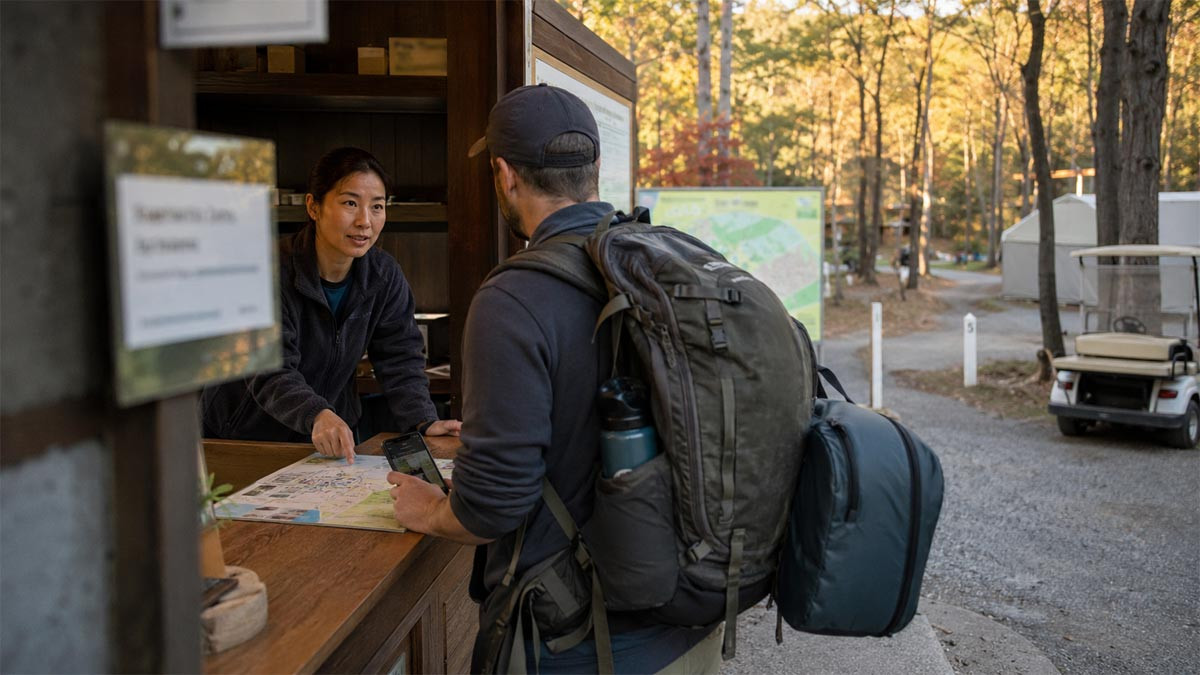
Campgrounds normally specify check-in and check-out times. Early arrival does not guarantee early access because staff may be inspecting or cleaning the site.
At reception, you may be asked for:
- The reservation holder’s name
- A reservation number or confirmation screen
- Identification
- Your vehicle number
- The number of adults and children
- A refundable deposit for a gate card, key, or waste container
Save the reservation details offline. Mobile reception can be unreliable in valleys and forested areas, and searching through email at the reception desk becomes difficult when other cars are waiting behind you.
If your reservation uses a Korean name or was made by a local friend, keep the exact spelling and phone number used for the booking. Staff may search their system using those details.
Try to arrive before sunset on your first trip. Finding the correct pitch, understanding the facility layout, and setting up on unfamiliar ground are all easier in daylight.
There is a particular kind of tension that appears when a family is assembling a tent in the dark while everyone is hungry. I know it well. Arriving even one hour earlier can make the evening feel like a holiday again.
Garbage Is Usually Sorted, Not Simply Thrown Away
Waste disposal at Korean campgrounds often follows the same basic separation system used elsewhere in the country.
You may need to divide waste into:
- General waste
- Recyclable plastic, cans, glass, and paper
- Food waste
- Used charcoal or ash
Some facilities require designated garbage bags. These may be included in the fee, sold at reception, or purchased from a nearby store. Other campgrounds expect visitors to take all waste home.
Food waste is treated separately from general trash in Korea. Do not place liquids, bones, shells, or disposable utensils into a food-waste container unless the campground’s instructions allow them.
The safest approach is to ask about disposal during check-in and photograph the sorting notice. Trying to decode five recycling bins while packing the car is not a satisfying way to end the weekend.
Quiet Does Not Mean Complete Silence
Korean campgrounds often have a designated quiet period, commonly called manner time (매너타임).
During this period, guests are generally expected to lower their voices, reduce lighting, stop loud music, and avoid noisy setup or vehicle movement. Exact hours vary by campground.
Sound travels easily between tents. A conversation that feels normal under your shelter can be very clear to a family trying to sleep nearby.
There is also a subtle cultural point here. Many Korean campers invest considerable effort in creating a welcoming outdoor space, but good camping manners are increasingly associated with knowing when that space should become quiet.
You do not have to whisper as soon as the sun goes down. Just notice how the campground changes. When lanterns dim and children disappear into tents, it is usually time for your group to lower its volume too.
For a fuller explanation of shared-site behavior, read our Korean Camping Etiquette: Do’s and Don’ts for Visitors guide.
Can You Camp in Korea Without Speaking Korean?
Yes, but preparation makes a significant difference.
Translation apps can handle most signs, reservation notices, and simple conversations. Image translation is especially helpful for maps and posted facility rules.
These Korean expressions can make check-in easier:
- Yeyakhaesseoyo (예약했어요): I have a reservation.
- Saituga eodiyeyo? (사이트가 어디예요?): Where is my site?
- Jeongi sayonghal su isseoyo? (전기 사용할 수 있어요?): Can I use electricity?
- Syaweosiri eodiyeyo? (샤워실이 어디예요?): Where is the shower room?
- Sseuregineun eodie beoryeoyo? (쓰레기는 어디에 버려요?): Where do I dispose of the garbage?
- Manner taim-i myeot siyeyo? (매너타임이 몇 시예요?): What time does quiet time begin?
You do not need perfect pronunciation. Showing the Korean sentence on your phone usually works.
For travel assistance, Korea’s 1330 Travel Helpline offers support to international visitors. Availability and supported services can change, so check the official Korea Tourism Organization information before your trip.
A Note From K-papa: Leave Some Empty Space in Your Plan
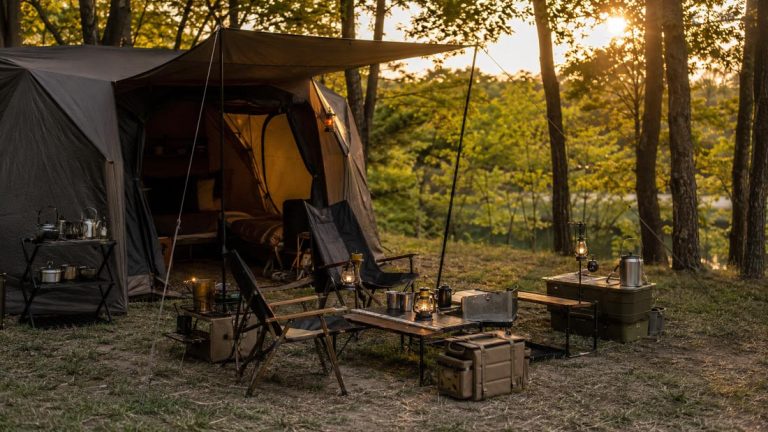
Korean campers can be extremely organized. It is common to see labeled storage boxes, matching furniture, carefully positioned lights, and meals that look as though they belong in a restaurant.
That can make a visitor feel underprepared.
You do not need to imitate the entire setup.
Some of my favorite moments at a campground have had nothing to do with equipment: the first quiet cup of coffee before my family wakes up, the sound of someone sweeping gravel from a neighboring site, or the strange sadness of folding a tent on Sunday morning.
A smaller setup also gives you time to notice where you are.
Bring equipment that handles the weather safely, food you can prepare without stress, and one comfortable chair. Once those needs are covered, an extra hour beside the trees is worth more than another hour arranging gear.
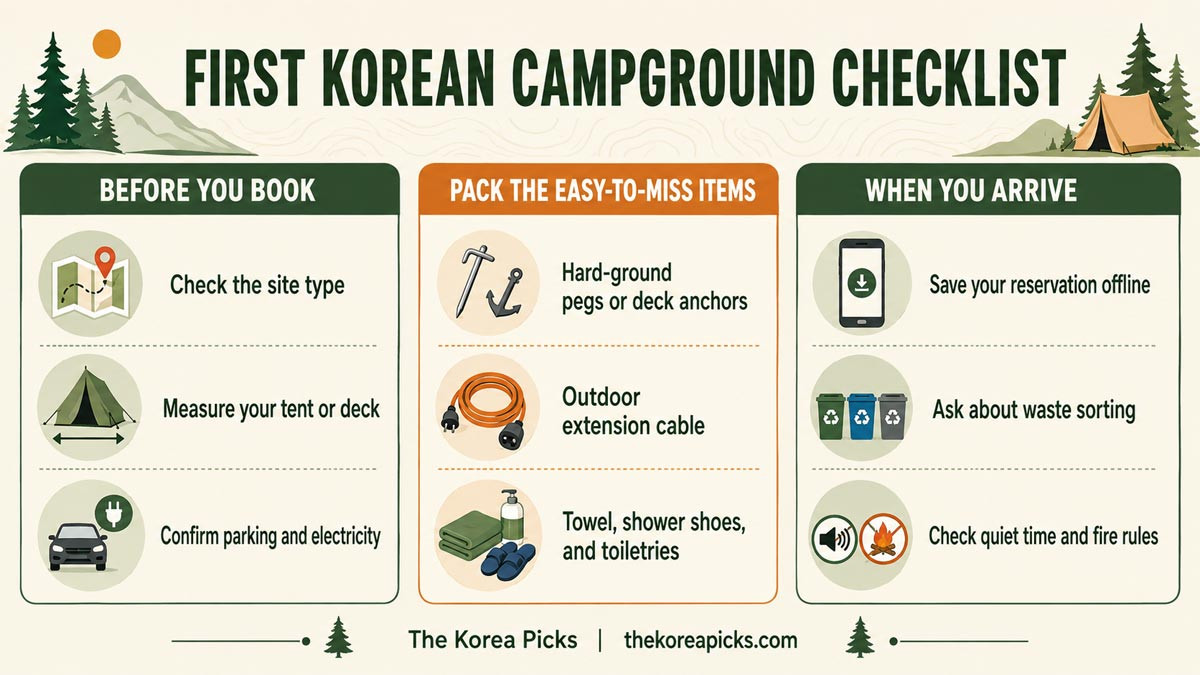
What to Pack for Your First Korean Campground
Your exact list will depend on the accommodation, but this compact checklist covers items that visitors commonly overlook:
- Passport or another accepted form of identification
- Offline reservation confirmation
- Screenshot of the campground map
- Tent footprint or groundsheet
- Pegs suitable for hard or gravelly soil
- Deck anchors if reserving a wooden platform
- Outdoor-rated extension cable
- Correct plug adapter and voltage-compatible devices
- Personal toiletries, towel, and shower shoes
- Toilet paper or tissues
- Food-waste and general-waste bags
- Rain gear and an extra tarp
- Insect repellent
- Flashlight or headlamp
- Portable battery
- Heat-resistant mat for approved cooking equipment
- Carbon monoxide alarm if using suitable fuel-burning equipment in an allowed, properly ventilated setup
- Warm clothing, even when the daytime forecast looks comfortable
Confirm rather than assume. A campground shop may sell ice and instant noodles but not the specialized tent peg or adapter you suddenly need.
Final Thoughts
A foreigner’s first Korean campground experience does not need to be complicated. The key is understanding that the system is organized around reserved spaces, shared facilities, careful waste separation, and consideration for nearby campers.
Choose the site number as thoughtfully as the campground itself. Verify what the accommodation includes. Measure your tent before booking a deck. Check electricity and fire restrictions directly with the facility. Most importantly, arrive with enough daylight to settle in without rushing.
Once the practical details are handled, Korean campgrounds offer something memorable: an outdoor experience that can be accessible, comfortable, and surprisingly close to everyday Korean life.
You may hear children riding bicycles between the tents, smell grilled pork from the next site, and wake to the sound of zippers opening as the campground slowly comes back to life.
It is not wilderness in the strictest sense. It is a temporary neighborhood under the trees—and learning how to join that neighborhood is the real beginning of camping in Korea.
About the Author
K-papa is a Korea-based creator, husband, and father of two daughters who writes about Korean camping culture, outdoor equipment, and everyday life. Through The Korea Picks, he helps international readers understand not only what Koreans use, but also how those products and customs fit into life in Korea.