15 Everyday Korean Home Products Foreigners Wish They Had
The first interesting product in a Korean home may appear before you even step inside.
There is often no key in anyone’s hand.
Someone taps a code into the front door, the lock clicks, the entry light comes on, shoes come off, and life moves indoors. Nothing about that little sequence feels remarkable when you’ve lived in Korea for a long time. But when I try to look at an ordinary Korean home through the eyes of someone visiting for the first time, I realize how many small conveniences are hiding in plain sight.
I’m K-papa, a Korean dad living in Korea, and this is one of my favorite things about writing for overseas readers. Big appliances are easy to notice. Everyday Korean home products are more interesting in a different way. They often solve tiny problems so quietly that the people using them stop thinking about the problem at all.
Not everything below was invented in Korea, and none of these products is used by every Korean household. Many are available in other countries too. What I find interesting is how naturally they fit Korean apartment life, seasonal weather, floor-level habits, and the constant challenge of getting more usefulness out of a limited amount of space.
So rather than walking through another shopping list, let’s walk through a home.
Before You Even Get Past the Front Door
The entrance to a Korean apartment tells you quite a lot about the way the rest of the home works.
The most obvious example is the digital door lock — the first product on my list. Keypad entry is a familiar feature in Korean apartment life, and the appeal becomes obvious once you stop thinking of it as technology. It is really about removing something from your day.
No house key to dig out from the bottom of a bag. No moment halfway to the elevator when you suddenly wonder whether you remembered it.
As a father, I have learned to appreciate anything that removes one item from the family’s mental checklist. There are already enough things to remember before leaving home.
Then there is the entryway motion-sensor light. That’s number two, although almost nobody would describe it as exciting. You arrive after dark with both hands full and the light simply comes on. You don’t stop. You don’t search for a switch. You barely notice it happened.
That, to me, is what a really good household convenience looks like.
The third product might be folded against a wall, hidden in a utility room, or waiting in the trunk of the car: a compact folding utility cart. Groceries, bottled drinks, parcels, recycling, camping equipment — all of these seem much heavier when the elevator is farther away than you remembered.
I probably would not have found a folding cart very interesting years ago. Now? Give me something with wheels and a small storage footprint and suddenly I am paying attention.
Maybe that is age. Maybe that is parenthood.
Probably both.

The Living Room That Changes Jobs During the Day
One of the things I like about Korean apartment living is that a room does not always have to perform one permanent job.
This is where the folding low floor table, product number four, makes sense. Bring it out for snacks, coffee, a game, a child’s activity, or a casual meal. Fold it away when the floor needs to become open space again.
I like that idea more than I like oversized furniture that wins a permanent argument with the room.
Next to that table you may find number five, a floor chair with back support. Sitting on the floor sounds wonderfully relaxed until your back decides it would like to participate in the discussion. A floor chair keeps the low seating position but adds support, making it easier to spend real time around a low table.
These products are not about recreating a traditional Korean home. Modern apartments are modern apartments. What is interesting is that floor-level habits haven’t completely disappeared; everyday products have simply adapted around them.
And somewhere nearby, often doing a lot more work than its appearance suggests, is number six: an individual-switch power strip.
Each outlet gets its own switch.
That’s it.
It sounds almost too small to include in an article about Korean home products, which is precisely why I wanted to include it. Chargers, a lamp, a computer, a television setup or a small appliance can remain plugged in while individual sockets are turned on or off as needed.
No dramatic innovation. No complicated app.
Just a tiny bit more control.
These are the products I tend to like most — the ones that don’t announce that they are making life easier.
Then You Reach the Bathroom, and the Rules Change
Open the bathroom door and the floor itself explains product number seven.
Many Korean bathrooms function as wet rooms, so waterproof bathroom slippers are an extremely straightforward solution. They live in or near the bathroom. They have one job. They do it.
Visitors sometimes find dedicated bathroom slippers amusing until the first time they nearly step onto a wet floor while wearing socks.
At that moment, no further cultural explanation is necessary.
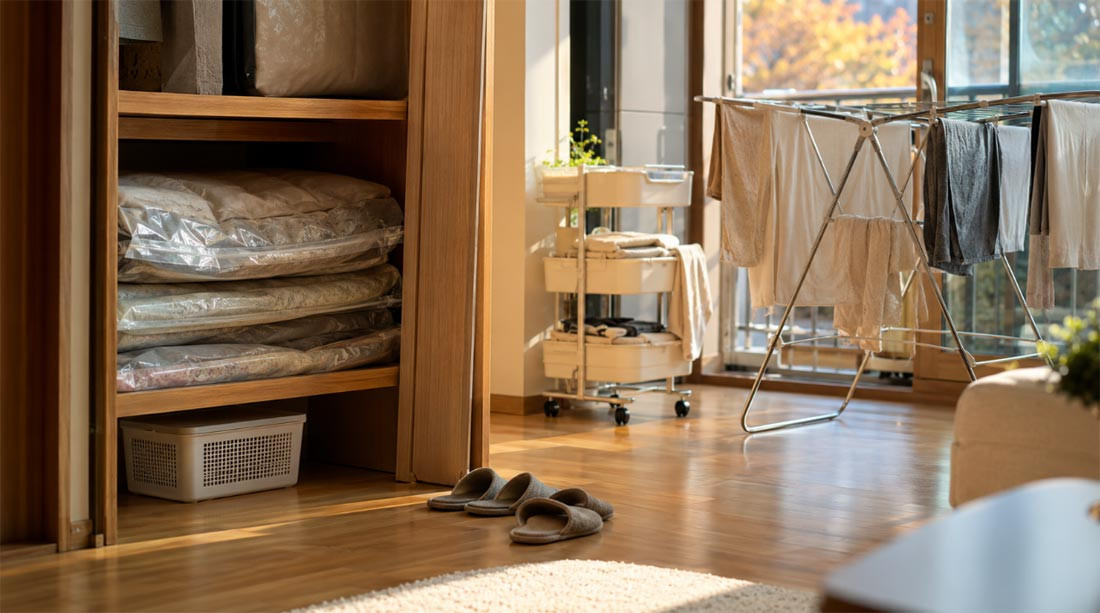
Laundry creates a different space problem. A family can generate an impressive amount of it without appearing to make any effort whatsoever. That brings us to number eight: space-saving laundry drying racks.
Some fold flat. Others take advantage of vertical space, doors, balconies, utility areas, or narrow corners. The basic idea isn’t uniquely Korean. The interesting part is how well it suits apartment living, where an empty square meter is not something you casually waste.
When you live with a family, a product that creates temporary drying space and then gets out of the way earns my respect very quickly.
The ninth product belongs to the same general part of home life but solves a different problem: a handheld bed or fabric-care device for mattresses, sofas, blankets, and other textile surfaces.
I don’t think everyone needs a specialized appliance for fabric. In fact, that’s exactly how I approach products like this. If the problem occurs often enough in your home, specialization can be convenient. If it doesn’t, you’ve simply bought another machine that now needs its own shelf.
Beds collect hair and fine debris. Sofas collect crumbs with almost professional efficiency. Families understand this without a long explanation.
The trick is deciding whether your household needs a dedicated solution.
Korean Storage Makes More Sense When You Experience Four Seasons
Summer and winter do not require the same home.
Thick blankets, padded clothing, lighter bedding and seasonal items have to trade places throughout the year. This is where product number ten — vacuum compression storage bags — becomes strangely satisfying.
You begin with a pile of bedding that appears to require its own apartment.
Then the air comes out.
Suddenly the closet has a shelf again.
There are very few moments in household organization that feel this much like winning.
Korean summers introduce the opposite problem: humidity. Closed wardrobes, cabinets, drawers, and shoe storage spaces can hold moisture, so number eleven is the humble closet moisture absorber or dehumidifying box.
This is another product that sits quietly in the background and asks for no attention.
Until you look at how much moisture it has collected.
Then your reaction may be less “What a clever little product” and more “Wait… all of that was in my closet?”
Near the entrance, number twelve tackles a related problem from another angle: shoe-drying or deodorizing products. These might be compact drying devices, moisture-control products, deodorizers, or other shoe-care solutions depending on the household.
Outdoor shoes remain near the entrance in Korean homes rather than traveling through the main living space. Add summer humidity, rainy days, and closed shoe cabinets, and you can see why this particular corner of the home attracts its own practical products.
Nobody invites a guest over to admire a shoe dryer.
That’s okay. Some of the best household products are successful precisely because they make an annoying problem disappear from the conversation.
Winter Is When the Quiet Products Become Heroes
If you visit Korea in spring, it is easy to underestimate winter.
Come back in January.
Product number thirteen will make much more emotional sense.
Portable electric heating mats fit naturally into a culture already familiar with warmth from below through ondol floor heating. Depending on the type, a heating mat can provide a warm floor area or sleeping surface without treating the whole room in the same way.
There is something deeply comforting about stretching out on a warm surface while the air outside is bitterly cold. On paper, it is just a heating product. On the right winter night, it feels much more important than that.
Of course, electrical heating products deserve more respect than a pair of slippers or a folding table. They should always be used according to the manufacturer’s instructions, particularly for temperature settings, storage, folding, and extended use.
Number fourteen is much lower-tech: seasonal window insulation film and draft-blocking products.
These can include removable window sheets, insulating film, or simple draft stoppers used around specific cold areas. They are not a substitute for proper building insulation, and I wouldn’t pretend they are. What I like is the modesty of the idea.
Sometimes you don’t need to reinvent the house.
You just need February to stop coming in under the door.
The Last Product Is Probably Already in a Drawer
After digital locks, heating mats, specialized fabric devices, and clever storage products, number fifteen is almost embarrassingly simple.
A good pair of multipurpose household scissors.
Depending on the design, sturdy household scissors may be used for opening packaging, handling food-related tasks, cutting tougher materials, or separating for easier washing. The exact features vary by model, so the important thing isn’t one particular pair.
It’s the philosophy behind it.
Many useful home products do not invent a new problem to solve. They take something you already do and make it less irritating.
And if you’ve ever fought with a plastic package using a pair of scissors that couldn’t cut warm butter, you know how satisfying a genuinely sharp pair can be.
What I Notice Now That I Didn’t Notice Before
Writing The Korea Picks has changed the way I look around Korean homes.
I used to think the interesting products were automatically the big ones — a new appliance, an unusual piece of furniture, something with enough specifications to fill a table. Those products are still fun to explore, of course.
But I’m increasingly interested in the small things.
A light that turns on because your hands are full. A table that disappears when you need the floor back. A pair of slippers that keeps wet feet from becoming a small household disaster. A storage bag that somehow gives your closet its dignity back.
None of these things proves that Korean homes are more advanced than homes elsewhere. That’s not the point, and it would be a silly claim to make. Every country has clever everyday products shaped by its own housing, climate, habits, and annoyances.
What makes these Korean home products worth noticing is how closely many of them are tied to the way people actually live here.
Small apartments reward furniture that folds. Four distinct seasons reward storage that adapts. Humid summers create moisture problems. Cold winters make warmth from below feel less like a luxury. Floor-level living habits create demand for furniture that works closer to the ground.
Put all of those details together and the products begin to tell a story about the home around them.
That story is more interesting to me than simply saying, “Here are 15 cool things from Korea.”
Would I Actually Tell an Overseas Reader to Buy Them?
Some of them, maybe. All of them? Definitely not.
I wouldn’t import a product simply because it is common in Korea or looks clever in a Korean apartment. Start with the inconvenience in your own home.
Do you have very little storage? Vacuum bags or folding furniture might genuinely help. Live somewhere humid? Moisture-control products suddenly become relevant. Constantly carrying boxes between the car and home? A folding cart doesn’t need to be Korean to be a very good idea.
Electrical products require extra care. Voltage, frequency, plug type, local certification requirements, warranty coverage, and access to replacement parts or consumables all matter. A plug adapter does not automatically make an electrical appliance appropriate to use in another country.
And that brings me to the part of this list I like most.
The best Korean home product isn’t necessarily the one that looks the most unusual to a foreign visitor.
It is the one that solves a small, repetitive problem so neatly that a month later you no longer remember being annoyed by it.
That’s not a very glamorous definition of good design.
But in a real home, I think it’s a pretty honest one.