Modori Kkalkkeum Cutting Board Set Review: A Smarter Way to Separate, Prep, and Store Ingredients
This Modori Kkalkkeum Cutting Board Set Review examines whether its four lightweight TPU boards and ventilated storage stand make everyday food preparation cleaner and more organized.
I’m K-papa, a Korea-based creator who introduces useful Korean products to international readers. For this guide, I compared Modori’s official product information with detailed feedback from four Korean users to help you make a more informed buying decision.
Quick Verdict
This verdict is based on Modori’s official product information and a cross-analysis of four Korean owner reviews, not direct testing by K-papa.
- Best for: Home cooks who want separate boards for meat, fish, vegetables, and fruit without cluttering the countertop.
- Biggest advantage: Four lightweight TPU boards fit into a ventilated vertical stand, making ingredient separation and storage unusually simple.
- Main drawback: TPU can develop knife marks, absorb strong food colors, or warp when exposed to high heat.
- Not ideal for: People who want one permanent cutting surface, regularly sanitize boards at 80°C or above, or prefer the solid feel of a thick wooden board.
- Research-based verdict: A practical, visually tidy set for everyday meal preparation, provided you accept that the TPU boards are replaceable kitchen tools rather than lifetime products.

Modori Kkalkkeum Cutting Board Set Review: Why it makes sense in a busy kitchen
Dinner preparation often starts with a crowded countertop: vegetables waiting to be chopped, raw meat still in its package, fruit for the children, and one damp cutting board that somehow needs to handle everything.
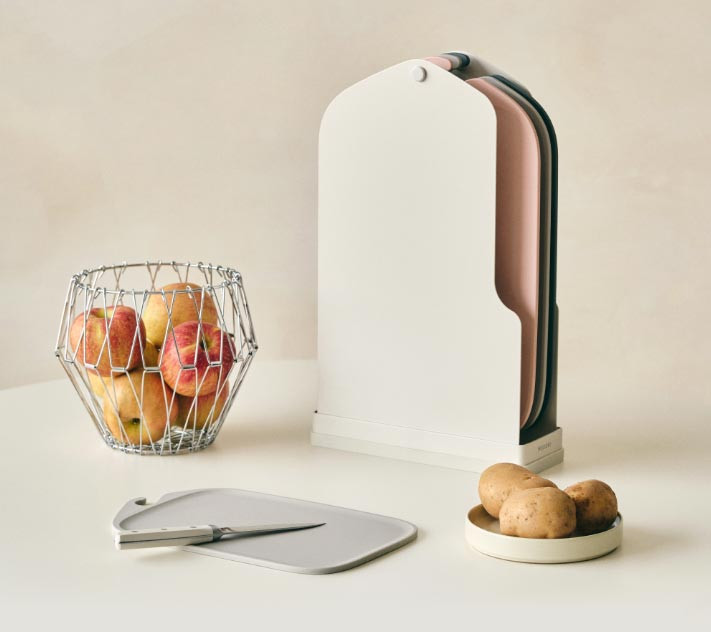
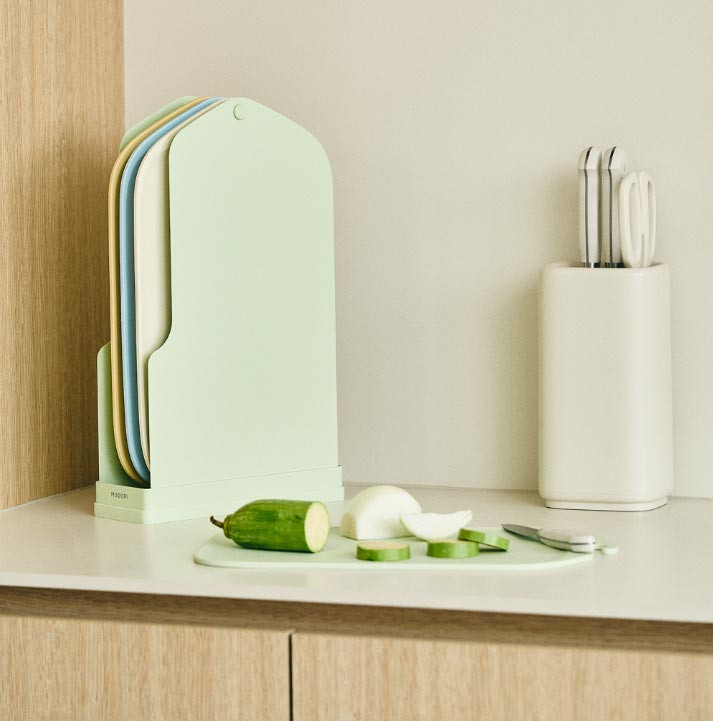
The Modori Kkalkkeum Cutting Board Set approaches this ordinary kitchen problem with four separate boards and a dedicated vertical stand. Instead of washing the same board between ingredients or stacking wet boards in a cabinet, the cook can assign a different color to each food category.
Several Korean owners described using the boards this way:
- One color for raw meat
- One for fish or seafood
- One for vegetables
- One for fruit or ready-to-eat food
Color coding does not automatically prevent contamination. The boards still require proper washing, drying, and handling. However, a consistent separation system can make it easier to avoid using a raw-meat board for food that will not be cooked.
What is included in the Modori Kkalkkeum Cutting Board 4-piece set?
The supplied manufacturer information identifies the product as the Kkalkkeum Cutting Board 4-piece Set. Its principal components are TPU cutting boards and a steel storage stand.
The official material description lists:
- Cutting boards: TPU, or thermoplastic polyurethane
- Stand: Steel
- Country of manufacture: South Korea for the TPU product; China for the stainless-steel board available in certain configurations
Modori lists two individual TPU board sizes within the wider product range:
- Medium: 385 × 240 mm
- Small: 280 × 170 mm
The stand measures 260 × 410 × 100 mm. The Best Set discussed by Reviews A and D used four medium boards measuring 385 × 240 mm each.
Modori also shows different package combinations, some of which include small TPU boards or a SUS 304 stainless-steel board. Buyers should therefore inspect the exact contents rather than assuming every Modori set has the same four-board configuration.

What the official Modori specifications mean during meal preparation
A medium board measuring 385 × 240 mm offers enough working room for most vegetables, boneless cuts of meat, and ordinary fruit preparation. Review D considered the size neither excessively large nor frustratingly small.
It may still feel restrictive when cutting a watermelon, preparing long leafy vegetables, or portioning a large fish. Review C used the larger boards for meat and bulky fruit while reserving smaller boards for simple snacks and smaller ingredients.
The official material weighs approximately 328 g for the TPU board, while the optional stainless-steel board weighs approximately 550 g. Review A described the TPU version as roughly 300 g, which is reasonably consistent with the official figure but less precise.
At 328 g, a TPU board is light enough to lift with one hand. Its flexible body can also be curved to guide chopped ingredients into a pot or frying pan. This was independently highlighted in Reviews A and B.
The board is officially listed as 5 mm thick. That is thick enough to avoid feeling like a disposable cutting mat, yet flexible enough to bend when transferring ingredients. By comparison, the optional stainless-steel board is listed at 1 mm thick.
How the TPU surface feels under a kitchen knife
All four Korean reviews described the TPU boards as relatively light, firm, and manageable. Reviews A, C, and D specifically noted that ingredients did not slide around excessively during cutting.
This should be understood as user feedback, not a laboratory measurement of slip resistance. Grip can vary with countertop material, moisture, ingredient shape, and cutting technique.
Review D offered the clearest description of the texture: the board felt neither excessively hard nor overly soft. The reviewer also found it stable during washing, without the loose, collapsing feel associated with very thin cutting mats.
Reviews A, B, and C reported that deep knife marks did not appear easily during their periods of use. Modori is more cautious. Its official FAQ explains that TPU has better resistance to knife marks than ordinary PP boards, but scratches can still form when sharp knives are used repeatedly. The manufacturer describes this as a natural consequence of the material.
That distinction matters. The surface may resist conspicuous cuts better than some inexpensive plastic boards, but it is not scratch-proof.
The raised edge is a small feature with practical value
Review D drew attention to a detail that can be overlooked in product photographs: the perimeter is slightly higher than the central cutting area.
This raised edge can help contain limited amounts of juice released by meat, fruit, or vegetables. It will not function like a deep carving-board channel, but it may reduce the chance of small quantities of liquid running directly onto the countertop.
For cooks who frequently prepare juicy tomatoes, marinated ingredients, or raw meat, this modest boundary may be more useful than another decorative feature.


Where the storage stand improves everyday hygiene and organization
The stand was one of the most consistently praised parts of the set.
Reviews A, C, and D noted that it keeps the boards separated rather than pressing them together while damp. Air can move between the boards, while the open lower section allows water to drain and makes residue around the base easier to see and clean.
This design does not sterilize the boards, and inserting them while heavily wet could still leave moisture around the stand. It does, however, create better drying conditions than stacking freshly washed boards flat on top of one another.
Review A found the stand reassuringly weighted and stable. The same reviewer also noted that connecting its hook-and-button components during initial assembly required considerable force.
The steel outer panel is magnetic, allowing small magnets, notes, or recipes to be attached. This is primarily a convenience and design feature rather than a performance benefit, but it helps the set look more like a deliberate kitchen organizer.
With dimensions of 260 × 410 × 100 mm, the stand occupies relatively little counter depth. Its height is more important: buyers should check the space below wall cabinets before ordering.
If you are improving food organization beyond the preparation area, our LocknLock Fresh Maestro Vacuum Container Review explains how its three-level storage system can help organize ingredients and extend freshness after cutting.
Can the Modori cutting boards go in a dishwasher?
The supplied Korean reviews indicate that the TPU boards can be cleaned in a dishwasher, but this comes with an important temperature restriction.
Modori states that TPU can develop slight bending when exposed to high heat or strong external pressure for extended periods. The manufacturer specifically advises avoiding:
- Heat sterilization at 80°C or above
- High-temperature dishwasher cycles
- Prolonged exposure to heat
- Boiling-water sterilization
Reviews A and D repeated the 80°C limit. Review D’s product instructions recommended pouring suitably hot water over the surface rather than boiling the board.
The practical lesson is straightforward: dishwasher compatibility should not be interpreted as unlimited high-heat compatibility. Check the temperature of the selected cycle, position the boards so they are not compressed, and avoid extended sanitizing programs.
If you routinely use very hot commercial-style dishwasher settings or boiling-water sterilization, this TPU set is not the most suitable choice.
Strongly colored foods can still leave stains
The owner reports were not entirely consistent about staining.
Review C used the board with kimchi and did not observe severe discoloration. In contrast, Review A warned that meat, seafood, and kimchi could cause staining, while Modori’s official FAQ says beetroot, chili powder, and kimchi may temporarily discolor the TPU surface.
These observations are not necessarily contradictory. Staining can depend on the food, pigment concentration, contact time, board color, age of the surface, and how quickly it is washed.
Modori recommends cleaning the board immediately after preparing strongly colored ingredients. Choosing a darker board for kimchi, chili-seasoned food, or raw meat may also make cosmetic discoloration less conspicuous.
The optional stainless-steel board may be preferable for ingredients that produce persistent odors or strong pigments, although stainless steel changes the cutting feel and may produce more noticeable metallic noise.
Why This System Feels Practical in a Korean Family Kitchen
In a Korean home, one meal can involve several ingredients that are better kept apart: raw meat for the main dish, vegetables for side dishes, kimchi, and fruit for the children afterward. What stands out to me about this set is not simply that it includes four boards. It gives each board a clear role, so there is less hesitation about which surface was just used for raw food.
As a father, I also think the lightweight design matters more than it may appear in product photos. A cutting board that is easy to lift, rinse, and return to its own slot is more likely to be cleaned immediately instead of being left beside the sink. I have not personally tested this Modori set, but its combination of color separation and vertical storage fits the way many Korean families prepare several dishes within a limited kitchen space.
Since photos and text have their limits, here is a review video to give you a real sense of the product’s actual size and feel.
What Korean owners repeatedly noticed
Across the four supplied reviews, the most consistent observations were:
- The TPU boards are easy to lift and wash.
Reviews A, B, C, and D all described them as light or easy to handle. - The surface provides a reassuring cutting feel.
Three reviewers explicitly mentioned limited ingredient movement or stable knife work. - The four-board system makes ingredient separation easier.
All four reviews discussed assigning boards by food type, size, or both. - The stand keeps the kitchen visually organized.
Reviews A, C, and D regarded the holder as a major advantage rather than incidental packaging. - The muted colors suit modern kitchens.
Reviews A, C, and D praised the neutral or toned-down palette, although color preference is subjective. - The boards dry more cleanly when stored vertically.
Multiple reviewers appreciated the gaps between boards and the stand’s open lower structure.
These are repeated owner impressions, not independently verified performance results. Nevertheless, their consistency across different reviews gives them more weight than an isolated comment.
Five limitations worth knowing before buying the Modori cutting board set
1. It is not a lifetime cutting surface
Knife marks are possible, and a board used intensively for raw ingredients will eventually need replacement. Modori sells individual boards, which makes gradual replacement more practical than discarding the entire set.
Review A referred to manufacturer replacement guidance but recorded the interval ambiguously as “6–2 months.” Because that figure is unclear in the supplied material, a precise replacement period should not be presented as confirmed.
Inspect the boards regularly and replace one when it develops deep cuts, permanent deformation, persistent odor, or damage that can no longer be cleaned confidently.
2. High heat can cause deformation
The manufacturer warns against temperatures of 80°C or above and prolonged high-temperature dishwasher use. This limits aggressive heat sanitation.
3. Pigmented ingredients may leave cosmetic marks
Kimchi, chili powder, beetroot, and similarly colored foods can stain the TPU, especially when residue is not removed promptly.
4. Packaging quality may vary
Review A received a stand with scratches and believed the absence of sufficient cushioning contributed to the damage. The reviewer also saw similar complaints from other buyers, but the supplied data does not establish how widespread the issue is.
This should be treated as a possible fulfillment problem rather than an inherent defect in every set. Inspect the stand and coating as soon as the package arrives.
5. The coated steel stand can show wear
Modori explains that the stand has a powder-coated finish. Small coating scratches or marks may be more noticeable on dark colors, especially black. The manufacturer treats minor wear as a normal effect of use unless it amounts to a functional defect.
Is the stainless-steel version a better choice?
Some Modori configurations combine TPU and SUS 304 stainless-steel boards. Review B preferred this arrangement for separating food categories:
- TPU for vegetables and fruit
- Stainless steel for meat, seafood, and kimchi
The official information describes SUS 304 as corrosion-resistant stainless steel and lists the board at approximately 550 g and 1 mm thick.
Stainless steel is less likely to retain food color or odor, but it involves trade-offs. Review D avoided it because of concerns about weight and the potential effect on knife sharpness. Modori also acknowledges that metallic cutting noise may occur and advises cutting slowly on a stable surface if the sound feels uncomfortable.
It is therefore not automatically superior. A mixed TPU-and-steel set makes sense for cooks who prioritize odor and stain resistance, while four TPU boards offer a lighter and more consistent cutting experience.
Product images courtesy of Modori: Modori Official Website
Who should buy the Modori Kkalkkeum Cutting Board Set?
The set is best suited to:
- Families that prepare several ingredient categories in one cooking session
- Parents who want clearly separated boards for baby-food preparation
- Apartment kitchens where counter depth and storage organization matter
- People who find heavy wooden or stone-style boards difficult to wash
- Buyers who value coordinated colors and a tidy countertop
- Cooks who want to replace individual boards instead of an entire storage system
The product may be less suitable for:
- People who want a thick, heavy cutting surface that remains completely flat
- Cooks who regularly prepare oversized ingredients
- Households that rely on dishwasher cycles reaching 80°C or above
- Anyone expecting complete resistance to knife marks and staining
- Buyers who dislike periodically inspecting and replacing cutting boards
- Minimalists who need only one general-purpose board
The research-based verdict on the Modori Kkalkkeum Cutting Board Set
The Modori Kkalkkeum Cutting Board Set solves three ordinary problems at once: separating ingredients, handling chopped food, and storing wet boards without creating a messy stack.
Its real appeal is not a single advanced material claim. It is the way four light TPU boards, muted color coding, flexible handling, raised edges, and a ventilated stand work together during normal meal preparation.
The limitations are equally clear. TPU is not immune to knife marks, staining, or heat deformation. The boards should not be exposed to temperatures of 80°C or above, and they should be regarded as replaceable food-preparation surfaces.
For a household that cooks frequently and values orderly ingredient separation, the set is a well-considered purchase. For someone who wants one permanent board that tolerates aggressive heat sanitation, it is the wrong tool.
Frequently asked questions about the Modori Kkalkkeum Cutting Board Set
What is the Modori Kkalkkeum Cutting Board made from?
The cutting boards are made from TPU, or thermoplastic polyurethane. The storage stand is steel. Certain alternative sets also include a SUS 304 stainless-steel cutting board.
How large is a Modori TPU cutting board?
Modori lists a medium board at 385 × 240 mm and a small board at 280 × 170 mm. The four-board Best Set covered in Reviews A and D used medium boards.
How much does each board weigh?
The official product material lists the TPU board at approximately 328 g. The optional stainless-steel board weighs approximately 550 g.
Is the Modori cutting board dishwasher-safe?
It can be used in a dishwasher within the manufacturer’s temperature restrictions. Avoid high-temperature cycles, prolonged heat exposure, and any sanitizing program reaching 80°C or above.
Does the TPU board develop knife marks?
It can. Korean owners generally found that conspicuous marks did not form quickly, but Modori confirms that repeated contact with sharp knives will eventually leave scratches.
Can kimchi stain the cutting board?
Yes. Modori says kimchi, chili powder, beetroot, and other strongly pigmented ingredients can cause temporary discoloration. Immediate cleaning can help reduce staining.
Is the Modori cutting board set suitable for raw meat?
It can be used for meat when washed and dried correctly. Assigning a dedicated color to raw meat may reduce accidental cross-use, but color coding does not replace standard food-safety practices.
Is the TPU or stainless-steel board better?
TPU is lighter, quieter, and flexible enough to funnel chopped ingredients into cookware. Stainless steel is more resistant to odor and staining but may feel noisier and harder under a knife. The better option depends on what you prepare most often.