LG Styler SC5GMR80H vs Samsung Bespoke AI AirDresser DF24CB9900CR: Which Clothing Care System Fits Your Home?
The LG Styler SC5GMR80H vs Samsung Bespoke AI AirDresser DF24CB9900CR decision is not simply about which machine removes more dust or odors. The more useful question is this: do you need a premium five-garment system with a built-in steamer and dedicated pants care, or a higher-capacity cabinet designed for family-size loads and more filter-based dust management?
I’m K-papa, a creator living in South Korea. This is a research-based comparison built from the manufacturers’ Korean product information, Korean owner reviews, and a direct comparison account. I have not personally tested these exact two units side by side. Several family members and friends around me use LG Stylers, however, and their satisfaction with the clothing-care performance and design has generally been high. In my own social circle, LG Styler is also the name people mention more often when discussing this category. That is useful local context, but it should not be mistaken for national sales data or proof that LG will suit every household better.
The short version: LG makes more sense if you value its built-in handheld steamer, pants-crease system, and furniture-like mirror design. Samsung offers the stronger practical case for households that regularly need to refresh more garments in one cycle.
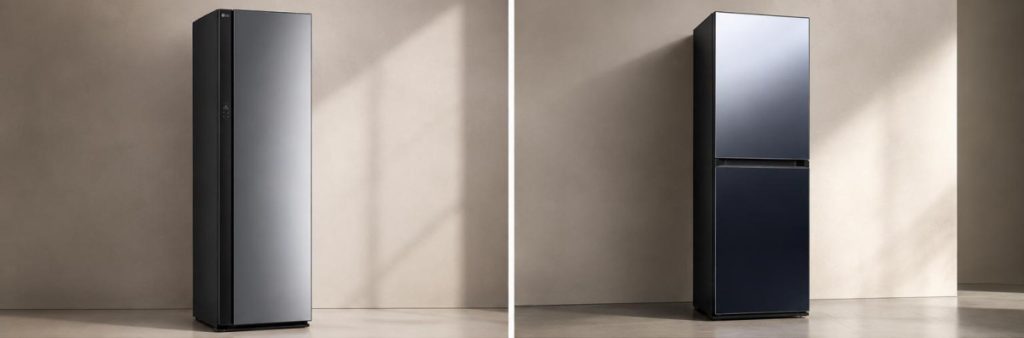
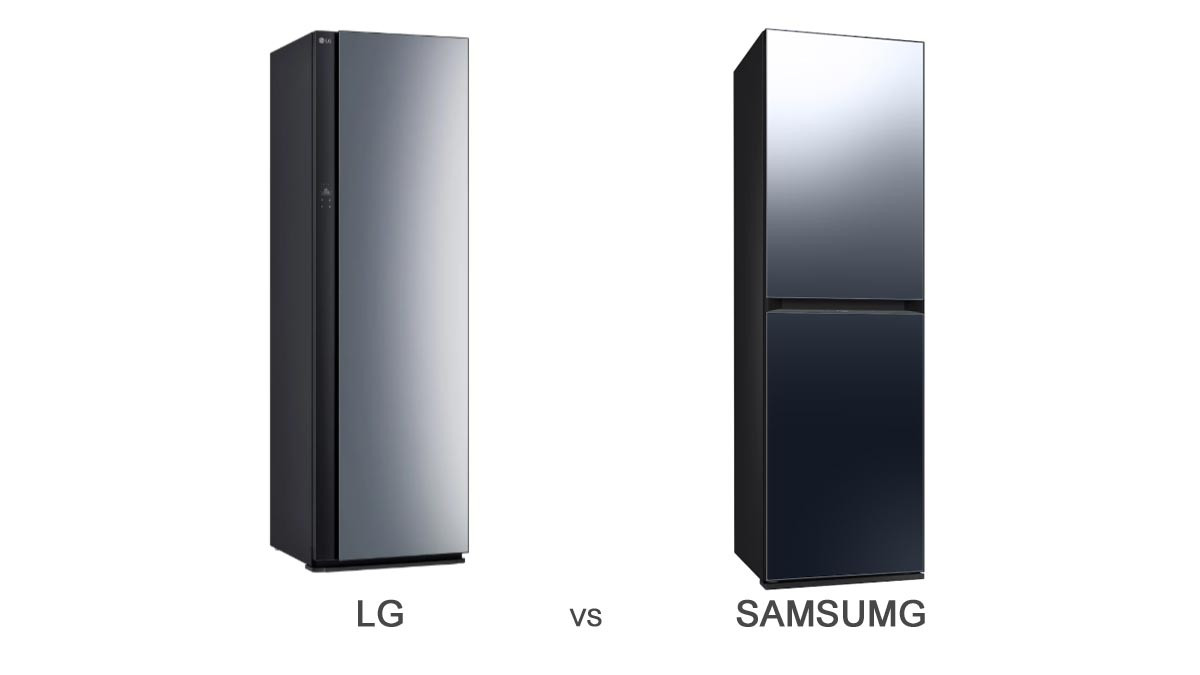
LG Styler vs Samsung AirDresser
The First Difference That Actually Matters: Five Garments or a Family-Size Load?
LG lists the SC5GMR80H for five upper garments plus one pair of pants. Samsung describes the DF24CB9900CR as a five-to-nine-garment model, with five Inside Care Hangers supplied and space for four additional compatible regular hangers.
That makes Samsung look like the obvious capacity winner, but the “nine garments” figure needs context. Samsung specifies that nine-garment care applies to its 113-minute Large Capacity Care course and assumes garments approximately as thin as T-shirts or shirts. Delicate materials such as wool, cashmere, fur, leather, rayon, silk, chiffon, and linen are excluded from that particular nine-item claim.
A winter wardrobe changes the calculation. Five thin shirts and five bulky coats are not comparable loads. Thick padding, long coats, and wide-shouldered jackets consume interior space quickly, regardless of the advertised hanger count.
Korean LG owners make a similar point about the five-garment rating: it represents the number of garments the machine is designed to manage properly, not permission to overlap six or seven pieces on the hangers. Overcrowding can limit movement and reduce the exposure each garment receives.
For a couple refreshing two office outfits after work, LG’s capacity may be entirely sufficient. A household that wants to process several shirts, school uniforms, or lightweight family garments together will find Samsung’s flexible five-to-nine-garment arrangement more useful.
Better fit for smaller, deliberate loads: LG Styler SC5GMR80H
Better fit for larger lightweight loads: Samsung DF24CB9900CR
Moving Hangers vs Directed Air: Two Different Cleaning Strategies
These machines approach garment care differently.
LG’s Dynamic Moving Hanger physically moves clothing in a twisting motion, reaching up to 350 movements per minute in applicable courses. LG combines that mechanical action with Dual Heating TrueSteam. The company says its fine-dust course removed an average of 99% of test dust from designated areas of a test shirt, including the sleeves.
Samsung relies on Dual AirWash from the upper section and hangers, with Dual JetSteam introduced from below. Dust released from garments is then managed through what Samsung calls Triple Dust Collection Care: one fine-dust filter and two lint filters.
Samsung reports 99% fine-dust removal from a defined area on a test shirt under laboratory conditions. It also claims that its fine-dust course can remove 90% of certain airborne test particles inside the appliance. These figures are manufacturer test results, not proof that Samsung and LG were tested under identical conditions.
That distinction matters. A 99% claim from each company does not produce a tie because the garment placement, course settings, test dust, measurement area, and calculation methods may differ. There is no reliable head-to-head test in the supplied material that establishes which exact model removes more real-world dust.
The practical difference is easier to understand than the percentages:
- LG emphasizes physically shaking dust from the garment, including areas that may be difficult to reach using airflow alone.
- Samsung emphasizes directed airflow through and around clothing, followed by a three-filter collection system intended to reduce dust remaining inside the cabinet.
Samsung’s airflow method may appeal to buyers who prefer less garment movement and a clearly defined filter system. LG’s moving-hanger approach is more compelling if you specifically want mechanical action on jackets, coats, and sleeves.
Korean comments about sound are mixed and model-dependent. Moving-hanger systems have historically attracted more concern about vibration, but one comparison shopper reported that the current LG system sounded very quiet when demonstrated with the door closed. Owners of both brands in the supplied reviews generally described operating noise as manageable. None of these observations came from a controlled sound measurement, so a bedroom or studio-apartment buyer should hear the exact unit in operation before purchasing.
Wrinkles and Pants: LG Has the More Distinctive Tool
Both appliances are designed to reduce everyday wrinkles, but neither should be treated as a complete replacement for traditional ironing.
LG has two advantages for wrinkle-focused buyers. The first is its Easy-Fit Pants Press, which manages one pair of pants on the inside of the door and is intended to help maintain a crease. The second is the built-in high-pressure steamer included with the SC5GMR80H.
That handheld steamer fills a gap that cabinet-style cycles cannot always address. If you notice a wrinkled collar or sleeve ten minutes before leaving home, waiting for a complete cabinet cycle may be inconvenient. The LG steamer can be used directly while the garment is hanging.
This was a particularly important point in one six-month owner review of a closely related SC5GMR80A variant. That owner ended up reaching for the bundled steamer more frequently than expected. Another owner of the SC5GMR80S also regarded the integrated steamer as a meaningful part of the package. Those are not reviews of the exact SC5GMR80H, but they illustrate why this shared accessory concept can affect daily use.
Samsung uses airflow, steam, and drying programs to reduce ordinary wrinkles. Its humidity sensor also adjusts drying operation according to moisture conditions. That is useful when refreshing damp garments, but it does not provide the same immediate, handheld finishing option as LG’s built-in steamer.
Samsung can accommodate several pairs of pants through its interior arrangement, while LG’s dedicated door-mounted pants system is limited to one pair per cycle. Therefore, “better for pants” depends on what you mean:
- For maintaining a defined crease on one pair of dress pants, LG has the more purpose-built feature.
- For loading multiple casual pants or jeans, Samsung’s larger interior may be more practical.
- For sharp dress-shirt results, either machine may still leave areas that need manual ironing or steaming.
Better fit for last-minute wrinkle touch-ups and a trouser crease: LG Styler SC5GMR80H
Better fit for refreshing several casual garments together: Samsung DF24CB9900CR
Delicate Clothing, Drying, and Items That Cannot Hang Normally
LG uses Dual Heating TrueSteam to vary the steam output for different courses. Its official material lists care options for suits, coats, wool, knitwear, silk, and cashmere. The cabinet also includes a shelf for knitwear and items that should not be suspended from a conventional hanger.
Samsung offers nine drying courses and uses a humidity sensor to determine an appropriate drying time. Its AI Customized Drying feature is more relevant to moisture-sensitive drying than to the exaggerated idea that the machine can independently identify every fabric placed inside it. Users still need to select suitable courses and follow garment-care labels.
The Samsung Multi Hanger creates another useful distinction. It folds out to hold items that are inconvenient to place on a standard hanger, including hats, bags, soft accessories, and certain small items. Samsung gives it a total maximum load of 3,600 grams, or 600 grams per hanger position.
This makes Samsung particularly versatile for a family with mixed daily items. LG’s shelf covers some of the same situations, but the two solutions organize the cabinet differently: LG provides a flat surface, while Samsung’s folding Multi Hanger offers multiple suspended positions.
Neither product should be used as a universal solution for every luxury material. Some high-capacity and intensive courses exclude delicate fabrics, and manufacturer care instructions can vary by material. A “delicate” or “AI” label does not override the care label attached to a garment.
For owners of expensive leather, fur, silk, or structurally delicate pieces, the correct conclusion may be neither. Professional cleaning or specialist storage can be safer when the manufacturer does not explicitly approve the material and course combination.
Installation, Mirror Design, and Daily Interaction
The two cabinets occupy nearly the same vertical footprint.
| Ownership detail | LG Styler SC5GMR80H | Samsung DF24CB9900CR |
|---|---|---|
| Listed capacity | 5 upper garments + 1 pair of pants | 5–9 upper garments; five supplied care hangers |
| Dimensions (W × H × D) | 600 × 1,965 × 620 mm | 595 × 1,960 × 595 mm |
| Garment-care method | Dynamic Moving Hanger + TrueSteam | Dual AirWash + Dual JetSteam |
| Fast manual wrinkle tool | Built-in high-pressure steamer | No comparable built-in handheld steamer listed |
| Accessory support | Shelf and dedicated pants press | Folding Multi Hanger and pants arrangement |
| App ecosystem | LG ThinQ | Samsung SmartThings |
| Front finish | Black Tint Mirror | Crystal Mirror |
Samsung is 5 mm narrower, 5 mm shorter, and 25 mm shallower according to the listed dimensions. The difference is modest, but the reduced depth could matter in a narrow dressing room or beside built-in cabinetry.
Measurements alone are not enough. Buyers also need to check the door swing, clearance in front of the cabinet, floor level, power outlet location, elevator dimensions, hallways, and tight turns on the delivery route. One LG owner warned that a cabinet can technically fit against a wall yet remain frustrating to use if a bed or shoe cabinet blocks the open door.
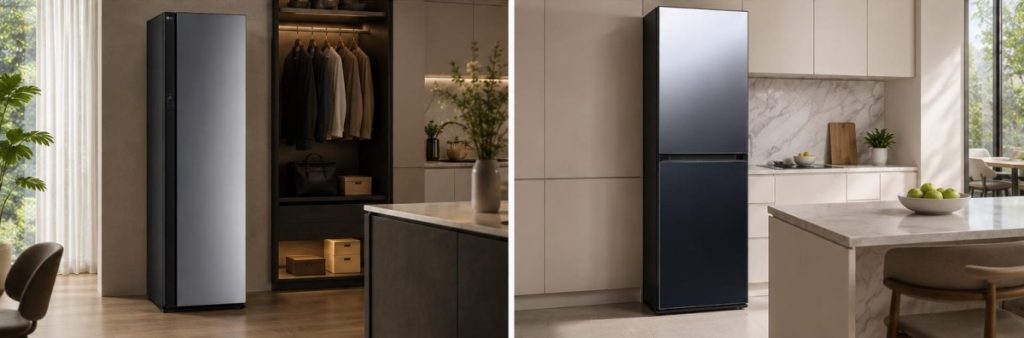
The mirror finish is a genuine part of the buying decision because these appliances often stand in a dressing room, bedroom, or visible hallway. LG’s Black Tint Mirror creates a dark, relatively continuous full-length appearance. Samsung’s Crystal Mirror can also function as a dressing mirror, although one Korean comparison shopper disliked the visible horizontal division in the Samsung door design and chose LG largely for that reason.
That is personal taste, not an objective performance advantage. See both doors in person if the reflection and panel lines matter to you. Product photographs can hide seams, reflections, and the amount of surrounding clutter a mirror surface will reveal.
Smart Controls and Maintenance Are Not Completely Hands-Off
LG connects through ThinQ, while Samsung uses SmartThings. Both ecosystems can support remote monitoring and connected functions, but Samsung owners should understand an important safety behavior.
One DF24CB9900CR owner initially thought remote operation was broken. The issue was that Smart Control had to be enabled again after opening the door or switching off the appliance. This is a safety-related behavior rather than evidence of a defective connection. Buyers expecting permanent, unrestricted remote startup may find that extra confirmation step less seamless than the marketing language suggests.
Both appliances also require ordinary maintenance. Water must be supplied, wastewater must be emptied, and interior components need periodic cleaning. Samsung adds a more visible filter-management routine through its fine-dust and lint filters. One owner was told that the filter associated with the aroma-sheet area would require periodic replacement, but replacement intervals and part numbers should be confirmed in the current manual rather than generalized from a single installation explanation.
LG’s moving system can leave loosened material in the lower area, making routine interior and filter cleaning important. The built-in steamer is convenient, but it is also another tool and water pathway that the owner needs to keep clean.
A clothing-care cabinet is easiest to justify when it becomes part of a routine: hang garments after coming home, start an appropriate course, and manage the water tanks and filters when prompted. If those repeated tasks already sound irritating, neither premium model is likely to deliver good value.
For another look at how a Korean appliance can be convenient at home yet complicated to own abroad, read the LocknLock Zero Waste Food Processor 3.5L review.
The Overseas Ownership Problem Is Bigger Than the Brand Difference
Both exact model numbers reviewed here are Korean-market products. Samsung lists the DF24CB9900CR for 220 V and 60 Hz operation. Buyers should confirm the LG unit’s electrical label and destination requirements directly before ordering, even if a reseller claims that it will work overseas.
A plug adapter does not change voltage or frequency. More importantly, importing a cabinet almost two meters tall introduces costs and risks that do not appear on a normal product page:
- International freight and final-room delivery
- Damage risk to the mirror door
- Customs duties and local taxes
- Installation responsibility
- App, account, or region restrictions
- Replacement filters and accessories
- Warranty coverage outside South Korea
- Access to authorized repairs and large replacement parts
Current overseas price, stock, affiliate availability, and international warranty coverage were not confirmed for either model. A marketplace listing alone does not prove that the seller provides authorized installation or usable after-sales support.
This can turn the correct answer into neither, even if one product appears superior on features. For many readers outside Korea, a locally supported clothing-care cabinet may be a safer purchase than importing either exact model.
The same ownership-versus-design trade-off appears in other Korean premium appliances. The LG PuriCare AS305DWWA vs Coway Noble AP-2023K comparison explores a similar choice between performance priorities and living-space design.
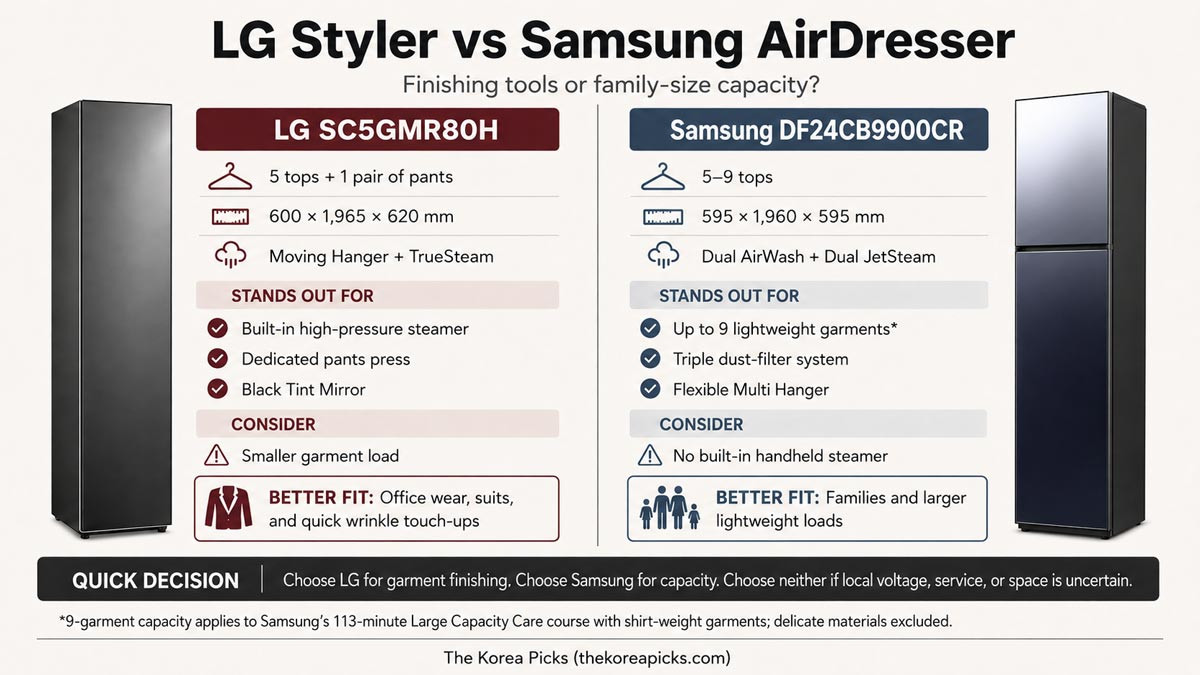
Which One Should You Buy?
Choose the LG Styler SC5GMR80H if your typical load is five garments or fewer and you care more about finishing details than maximum capacity. Its built-in high-pressure steamer, dedicated pants press, moving-hanger system, and continuous-looking Black Tint Mirror give it a clear identity. It is especially attractive for an office worker managing suits, shirts, coats, and one pair of dress pants at a time.
Choose the Samsung Bespoke AI AirDresser DF24CB9900CR if several people will share the appliance or you regularly want to refresh a larger group of lightweight garments. Its five supplied care hangers, potential nine-garment Large Capacity Care mode, Dual AirWash system, Triple Dust Collection Care, flexible Multi Hanger, and SmartThings integration make it the more practical family-load option.
Choose neither if most of your wardrobe consists of washable T-shirts and hoodies, you rarely rewear formal or delicate garments, or the cabinet would occupy space you cannot comfortably spare. Neither appliance removes stains, replaces a washing machine, or guarantees dry-cleaning results.
My editorial preference leans toward LG for a couple or an individual who values garment finishing and interior design. The favorable experiences of people around me also make LG feel like the more familiar choice in a Korean home. But for a family consistently filling the cabinet, I would not sacrifice Samsung’s usable capacity simply because LG has stronger recognition in my personal circle.
This recommendation would change if Samsung’s installed price were substantially lower, if your home already relies heavily on SmartThings, or if nine-item family loads are common. It would shift toward LG if the integrated steamer would replace a separate handheld appliance or if maintaining dress-pants creases is part of your weekly routine. Outside Korea, verified local service and electrical compatibility should outweigh all of these feature differences.
How I Researched This Comparison
I reviewed LG’s official Korean product information for the SC5GMR80H and Samsung’s official specifications for the DF24CB9900CR before comparing their capacity, garment-care systems, and ownership requirements.
The user material included two Korean LG owner articles, two Samsung owner articles, and one comparison article. The Samsung reviews covered the exact DF24CB9900CR. The LG owner reports covered closely related SC5GMR80A and SC5GMR80S variants rather than the exact SC5GMR80H, so I used them only for limited context such as load behavior, routines, water-tank management, mirror use, and the usefulness of the steamer. Exact SC5GMR80H features came from LG’s official information.
The evidence is therefore asymmetric. Samsung has more exact-model owner feedback in the supplied material, while LG has stronger anecdotal familiarity within my family and social circle. I did not personally operate or measure these two exact units, and no independent controlled comparison was available for noise, odor reduction, wrinkle removal, or long-term durability.
FAQ
Can either appliance replace washing or dry cleaning?
No. Both are intended to refresh garments, reduce certain odors and dust, provide drying care, and soften ordinary wrinkles. They do not wash away stains, body oils, or heavily embedded dirt. They may extend the interval between some cleaning visits, but they do not eliminate the need for laundering or professional garment care.
Can the Samsung AirDresser really care for nine garments at once?
Yes, but only under specific conditions. Samsung’s nine-garment claim applies to the Large Capacity Care course, which lasts 113 minutes, and assumes T-shirt- or shirt-thickness garments. Several delicate materials are excluded. Thick coats will reduce practical capacity.
Is the LG built-in steamer worth choosing over Samsung?
It can be if you frequently need quick, localized wrinkle correction. The steamer gives LG a function that is meaningfully different from running a full cabinet cycle. If you already own a good handheld steamer or rarely iron clothing, Samsung’s additional cabinet capacity may be more valuable.
Which one is better for a small dressing room?
Samsung is slightly smaller at 595 × 1,960 × 595 mm, compared with LG at 600 × 1,965 × 620 mm. The 25 mm difference in depth may help, but door clearance and delivery access are more important than the small differences in width and height.
Which model is safer to buy outside South Korea?
Neither should be considered safe to import until the buyer confirms voltage and frequency compatibility, warranty coverage, installation, app-region support, parts, and authorized repair availability. Samsung officially lists the DF24CB9900CR as a 220 V/60 Hz product. Do not assume that a plug adapter solves electrical compatibility.
DID YOU KNOW? Korea
In South Korea, clothing-care cabinets are especially visible in newlywed appliance packages and premium apartment dressing rooms. Korean households often use them for business clothing, school uniforms, winter padding, and garments that have absorbed restaurant odors but are not ready for a full wash.
“Styler” is LG’s trademark, but the name became so familiar in Korea that some people casually use it when referring to the entire clothing-care cabinet category. That familiarity helps explain why LG may appear more prominent in everyday conversations even when Samsung offers a strong competing system.
K-papa’s Quick Korean Lesson!
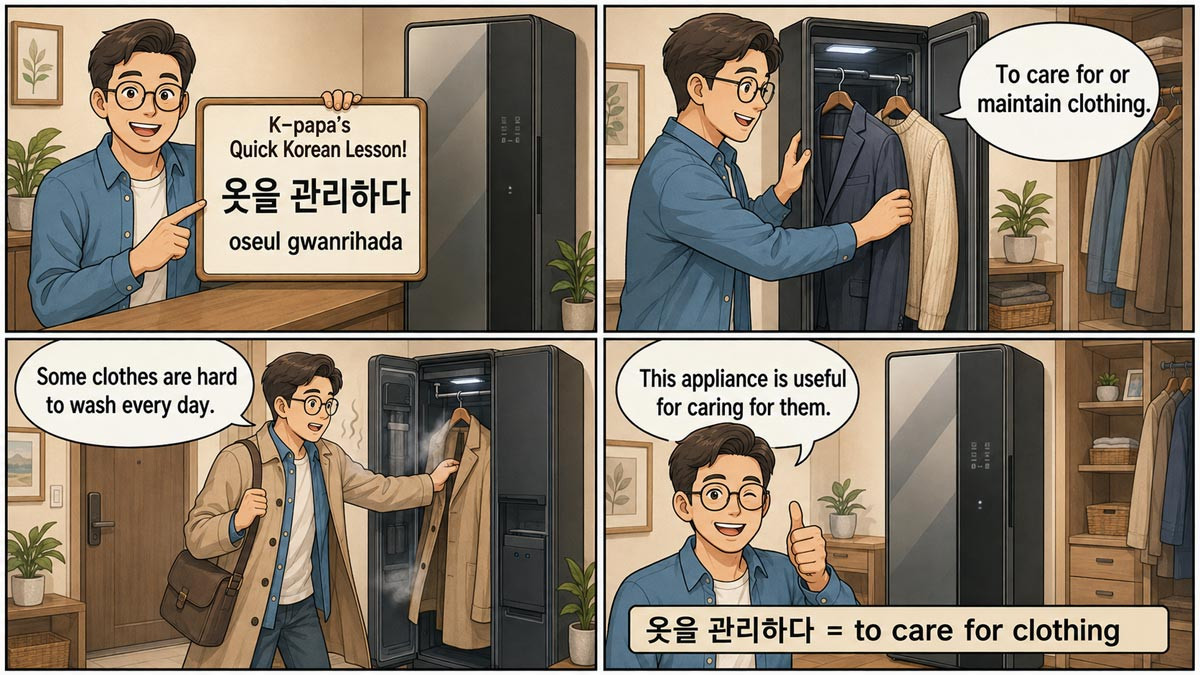
Korean phrase: 옷을 관리하다
Romanization: Oseul gwanrihada
Pronunciation: oh-seul gwan-ree-ha-da
Meaning: To care for or maintain clothing
Example:
이 제품은 매일 세탁하기 어려운 옷을 관리할 때 유용해요.
I jepumeun maeil setakhagi eoryeoun oseul gwanrihal ttae yuyonghaeyo.
This appliance is useful for caring for clothes that are difficult to wash every day.
About the Author
K-papa is a creator living in South Korea who examines Korean products and everyday culture for international readers. His reviews separate verified specifications, recurring user experiences, and editorial judgment so readers can make a practical buying decision. Learn more about K-papa and The Korea Picks.