Korean Apartment Utility Balcony: The Reason Behind This Separate Space
The first time a foreign visitor looks around a Korean apartment, the main balcony usually makes sense. It brings in sunlight, extends the living room visually, and sometimes holds plants or a small table.
Then there is another space—often behind the kitchen, beside a laundry area, or through an unassuming glass door.
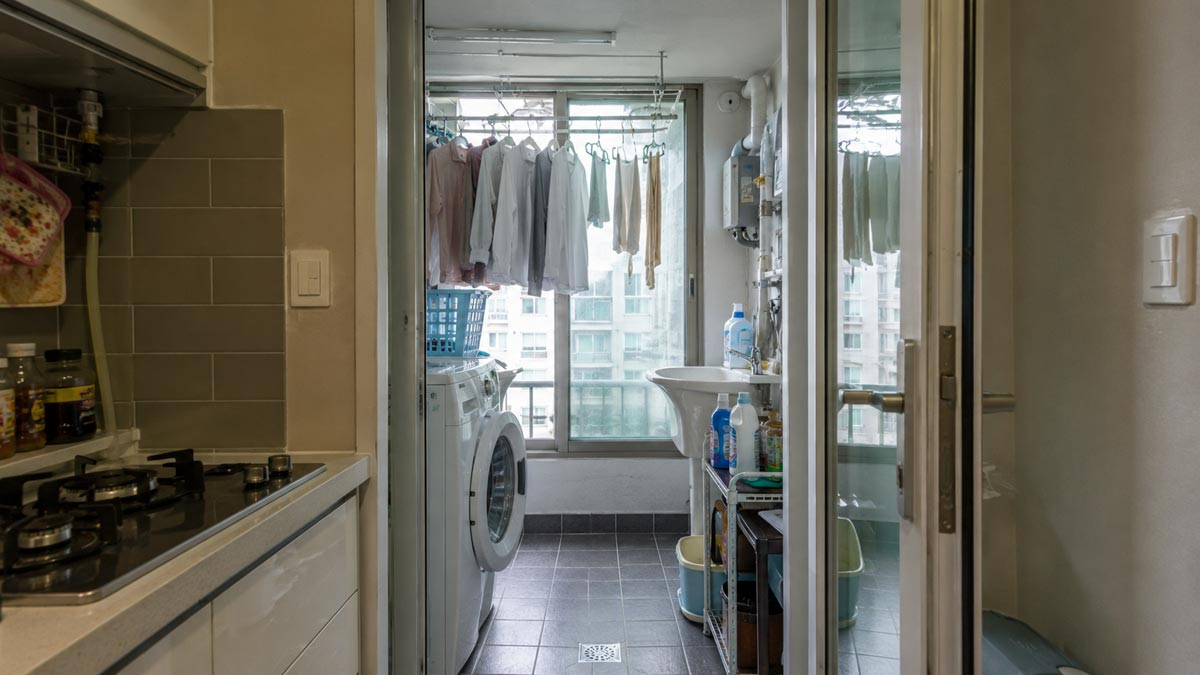
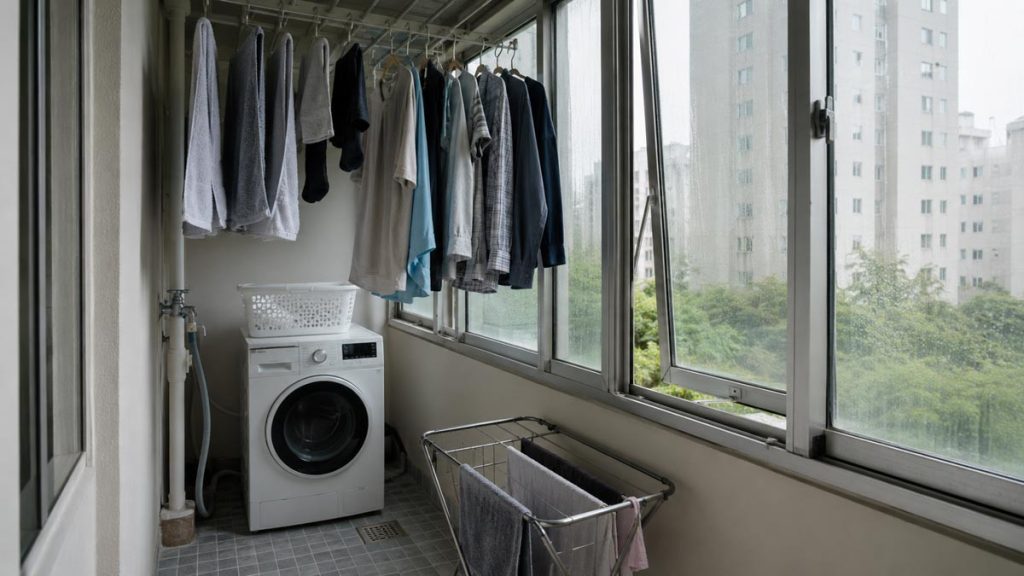
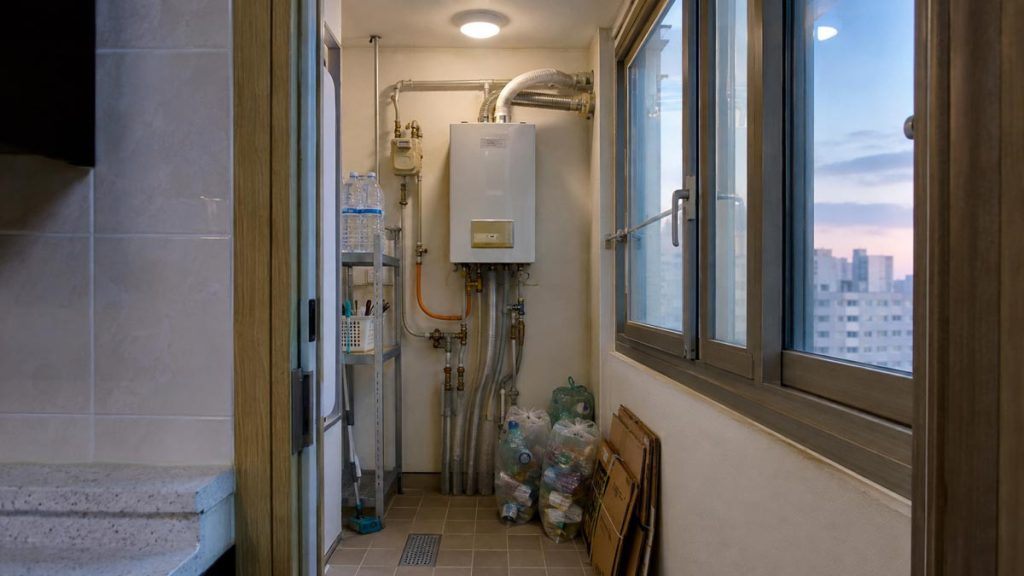
It may contain a washing machine, drying rack, recycling bins, shelves, a boiler, cleaning supplies, or boxes of vegetables. It is neither fully outdoors nor quite part of the living room. In Korean property listings, people may call it a balcony, veranda, utility room, or simply the place where the laundry goes.
A Korean apartment utility balcony exists because an apartment has to perform more jobs than its polished interior suggests. It gives noisy, wet, bulky, and temperature-sensitive household tasks somewhere to happen without taking over the kitchen or living room.
As K-papa, a creator living in South Korea, I have come to see this space as one of the quiet clues to understanding Korean homes. It rarely appears in glamorous apartment photographs, but daily life becomes noticeably harder when it is too small, poorly ventilated, or badly arranged.
It Is Not the Balcony Many Foreigners Expect
In some countries, the word balcony suggests an open platform with a railing, two outdoor chairs, and perhaps a view of the street. That image does not always match what Koreans mean when they say balcony or veranda.
Korean building regulations define a balcony as a buffer space connecting the inside and outside of a building. Depending on its structure and legal status, it may be used for different household purposes. That broad definition helps explain why the space can look more like a partially enclosed service room than an outdoor terrace.
Many Korean apartments originally had balconies along the exterior walls. Some homeowners later enclosed or incorporated part of the front balcony into the living room or bedroom to gain more indoor space. The rear or kitchen-side balcony, however, often remained separate because it still had practical work to do.
This is where terminology becomes confusing.
A real estate agent may describe the space in English as a utility balcony. A Korean resident may casually call it a veranda. An apartment floor plan might label it as a balcony, laundry room, or service area. These expressions do not always refer to identical structures, and apartments built in different periods can have very different layouts.
The safest way to understand the space is not by its English name but by asking what is installed there.
Does it have a water connection? A floor drain? A boiler? A window? Space for a washer? Shelving? An exterior wall? Those details reveal its actual role.
Laundry Needs More Than a Washing Machine
The washing machine is often the largest reason for keeping a separate utility area.
Placing it outside the main living space reduces noise and keeps water-related chores away from wood flooring, furniture, and cooking areas. A floor made for utility use is also more forgiving when a hose leaks, wet laundry drips, or someone cleans the area with water.
The usefulness does not stop when the wash cycle ends.
Many Korean households air-dry at least some of their clothes. A ceiling-mounted drying rack, folding rack, or retractable clothesline can turn the balcony into a temporary drying room. Closing the interior door keeps damp clothing from visually filling the living room.
That separation matters more than it first appears.
A drying rack covered with towels and children’s clothes can occupy a large amount of floor space. In a compact apartment, placing it in the living room affects how the entire home feels. When the rack can remain in a utility balcony, the household can continue eating, working, and relaxing without navigating around wet laundry.
Weather complicates the arrangement. Korea has humid summers, a rainy monsoon period, cold winters, and days when fine dust makes residents reluctant to leave windows open. A utility balcony does not magically solve these conditions. Clothes can still dry slowly, windows can collect condensation, and poor ventilation can create musty odors.
But it creates a controllable boundary. Residents can close a door, operate a dehumidifier, open a window when the air is suitable, or move delicate items indoors without surrendering the whole living room.
A Buffer Between the Kitchen and the Outside
The location behind the kitchen is not accidental.
Cooking produces heat, moisture, smells, food packaging, and a steady flow of things that need to be stored, washed, discarded, or recycled. A utility balcony gives these secondary tasks somewhere to go.
Depending on the apartment, residents may use it for:
- Sorting recyclable packaging
- Storing cleaning tools and detergents
- Keeping large pots or rarely used kitchen equipment
- Holding bottled water and bulk household supplies
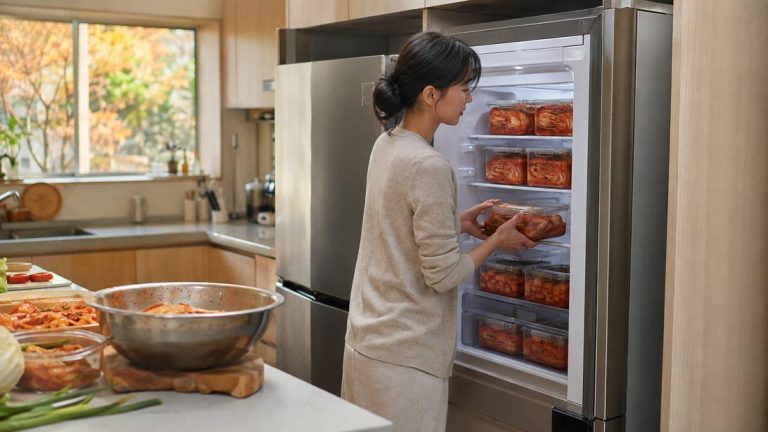
- Placing an extra freezer or kimchi refrigerator
- Storing onions, potatoes, or other ingredients temporarily
- Keeping food waste containers away from the dining area
Not every item is suitable for every balcony. Temperatures can vary considerably near exterior windows, and appliances require proper electrical capacity, ventilation, and clearance. Food can freeze in severe cold or spoil during summer heat. Building rules and appliance manuals should take priority over convenience.
Still, the pattern is easy to understand: Korean kitchens are expected to support frequent cooking, yet apartment interiors cannot endlessly expand. The utility balcony acts as a pressure-release zone.
It absorbs the objects and chores that would otherwise make a clean kitchen look crowded.
Why Two Balconies Can Be Better Than One Large Space
A separate utility balcony may look like an inefficient use of floor area. Why not create one larger room instead?
Because living space and working space benefit from different conditions.
The main living room should feel warm, dry, quiet, and visually calm. A laundry and storage area needs washable surfaces, ventilation, water access, and tolerance for clutter. Combining both functions may produce a larger-looking room, but it can make everyday maintenance more difficult.
Two smaller zones can therefore work better than one uninterrupted space.
The front side of an apartment can prioritize sunlight, views, and family activity. The rear side can handle washing, storage, recycling, and equipment. This division allows the apartment to appear orderly without pretending that household work has disappeared.
That logic suits Korea’s apartment-centered housing culture. According to the 2023 Population and Housing Census from Statistics Korea, 53.1% of general households lived in apartments. When a housing type accommodates such a large share of the population, small planning decisions become part of ordinary national life.
The utility balcony is one of those decisions. It is not luxurious, but it is repeated because it solves several practical problems at once.
Heating Equipment Also Shapes the Layout
In many Korean apartments, the boiler or related heating equipment is located in or near a utility area.
Korean homes are widely associated with ondol, the floor-heating tradition that evolved into modern hot-water systems installed beneath apartment floors. The contemporary equipment is not a traditional furnace under the house, but the cultural expectation remains: warm floors are central to winter comfort.
A boiler needs an appropriate installation location, exhaust arrangement, ventilation, maintenance access, and protection from severe temperatures. A separate service area can provide those conditions without placing mechanical equipment in the living room.
This partly explains why residents should not treat every utility balcony as unrestricted storage.
Boxes, drying racks, shelves, and appliances should not block boiler access, vents, pipes, meters, drains, or safety equipment. A crowded balcony may look harmless until maintenance is required.
Anyone renting a Korean apartment should ask the landlord or agent what equipment is located there and which areas must remain clear.
The Space Helps Korean Homes Look Less Cluttered
Visitors sometimes comment that Korean model homes and apartment interiors look unusually clean. Storage design plays a large role, but the utility balcony also contributes.
A home can appear minimalist when the less attractive parts of domestic life have a designated place.
Vacuum attachments, mop buckets, detergent refills, cardboard boxes, reusable shopping bags, recycling, and drying laundry do not vanish. They simply sit behind another door.
This is one reason I do not think the utility balcony should be judged by whether it looks beautiful. Its value lies in how much disorder it prevents elsewhere.
A carefully decorated living room can remain calm because the home has accepted that some spaces are allowed to be practical.
There is a lesson here that extends beyond Korean apartments. Minimalism is not always about owning very little. Sometimes it is about designing an honest place for the things a household genuinely uses.
Why Some Owners Enclose or Remodel Their Balconies
Space is valuable, particularly in urban apartments. It is therefore understandable that some owners want to convert balcony space into a larger living room, bedroom, or kitchen.
Enclosing a front balcony can make the interior feel wider and bring furniture closer to the windows. It can also create a cleaner, more continuous floor plan. However, expansion may change insulation, window performance, ventilation, condensation, heating demand, and the legal classification of the space.
The Korean Building Act framework treats balconies as defined architectural spaces rather than simply spare rooms. Legal remodeling requirements depend on the building, construction date, balcony type, structural conditions, and local rules.
This is not a project that should be approached by copying a neighbor’s renovation.
For renters, the issue is simpler: do not permanently change the space without written permission. Even drilling into walls, installing large shelving, or relocating appliances may create problems with waterproofing, pipes, or the lease.
Keeping at least one utility area separate often remains useful even after other balcony areas have been incorporated into the home. Extra living-room width is attractive, but losing the only practical location for laundry and equipment can create a different kind of inconvenience.
What Foreign Renters Should Check During a Viewing
A utility balcony deserves more than a quick glance during an apartment tour. It can reveal maintenance problems that are easy to miss in a freshly cleaned living room.
Start by checking ventilation. Does the window open properly? Is there a screen? Can moist air escape, or does the area smell damp?
Then look at the surfaces.
Dark marks around window frames or wall corners may indicate condensation or mold. Peeling paint, swollen materials, or stains near the floor can suggest past moisture problems. A floor drain should be visible and accessible rather than buried beneath storage.
If a washing machine will be installed, confirm:
- The available width, depth, and door clearance
- Water inlet and drain locations
- Electrical outlet position
- Whether a dryer can be stacked or installed separately
- Delivery access through doors and hallways
- Who is responsible for connecting the appliance
Also check the boiler and exposed pipes. Ask whether the space becomes cold enough in winter to require freeze-prevention measures. Do not assume that an enclosed balcony remains as warm as the living room.
Finally, stand there for a moment with the interior door closed.
Can you hear traffic, construction, mechanical noise, or neighboring equipment? Is the lighting adequate? Would you be comfortable sorting laundry there in January or during a humid July evening?
These questions may sound overly specific during a short apartment visit. After moving in, they become everyday questions.
The Drawbacks Are Real
A utility balcony is useful, but it is not a perfect room.
Because it sits near the exterior, it can experience wider temperature swings than the main interior. Condensation may collect on windows during winter. Humidity can slow drying in summer. Dust enters when windows are opened, while keeping them closed can reduce airflow.
The space can also become a clutter trap.
Once a household begins placing “temporary” objects there, walking space disappears quickly. Items block windows and drains, appliances become difficult to service, and nobody remembers what is behind the largest box.
Narrow utility balconies may be especially frustrating. A washing machine door can collide with shelves, a drying rack can prevent access to the boiler, or recycling bags can block the only path through the room.
Good organization helps, but the answer is not to fill every wall with storage. The most important equipment needs breathing room and access.
A Small Space That Explains a Lot
The separate utility balcony reveals something important about Korean apartment design.
Homes are not only places for sleeping, eating, and relaxing. They are systems for managing laundry, heat, moisture, food, recycling, equipment, and storage. When those functions are ignored, the attractive parts of a home become harder to enjoy.
The Korean apartment utility balcony gives those everyday tasks a boundary.
It may not be the part of the apartment that appears in a real estate advertisement. It may be cold in winter, humid in summer, and filled with objects no one wants in a photograph. Yet it protects the calm of the rooms on the other side of the door.
For a foreign resident, understanding this space can make apartment hunting easier. Do not ask only whether the home has a balcony. Ask which balcony it has, what is installed there, and what work the space is expected to perform.
That is where the real design becomes visible.
FAQ
What is a utility balcony called in Korean?
People commonly use terms such as dwi veranda (뒤 베란다, rear veranda), daseyongdosil (다용도실, utility room), or simply balcony depending on the apartment and location. The terms can overlap, so check the actual facilities rather than relying only on the name.
Are Korean utility balconies always outside?
No. Many are enclosed with windows but remain separated from the heated living area by a door. Their insulation, temperature, and legal classification can differ from those of an ordinary interior room.
Can I put a dryer in a Korean apartment utility balcony?
Sometimes, but confirm the available space, electrical requirements, ventilation, drainage, and building rules first. A dryer should not block boiler access, pipes, windows, drains, or safety equipment.
Why do Korean apartments put washing machines on balconies?
A utility balcony can provide water and drainage connections while separating appliance noise, moisture, and wet laundry from the main living space. Layouts vary, and some newer homes use dedicated interior laundry rooms instead.
Should I heat a utility balcony in winter?
Do not improvise permanent heating or modify pipes without professional advice. Ask the landlord, management office, or boiler technician about ventilation and freeze-prevention measures appropriate for the apartment.
About the Author
K-papa is a creator living in South Korea who examines Korean products and everyday culture for international readers. His articles separate verified information, recurring everyday patterns, and personal interpretation so international readers can understand how life in Korea works. Learn more about K-papa and The Korea Picks.