Why Korean Homes Stay So Clean Compared With Many Countries
The first thing many visitors notice when entering a Korean home isn’t the furniture or the size of the apartment.
It’s what happens before they take the second step.
“Shoes off, please.”
That simple habit explains more about Korean homes than you might expect.
I’m K-papa, a Korean creator living in Korea with my wife and two daughters. Our home is not spotless. Let me make that clear right away. With two daughters, laundry appears from nowhere, things mysteriously migrate from bedrooms to the living room, and sometimes I wonder how an object I put away yesterday is already back on the floor.
So no, Koreans don’t possess some magical cleaning gene.
And I’ve certainly seen messy Korean homes.
But there are everyday habits built into Korean life that make keeping a home clean a little easier. Some are so ordinary to us that we don’t even think of them as “cleaning.”
They’re simply how we live.
Here is why Korean homes often feel surprisingly clean to visitors—and what is really happening behind that tidy first impression.
1. The Outside World Usually Stops at the Front Door
Let’s begin with the most obvious difference: shoes.
In Korea, outdoor shoes generally don’t travel through the home.
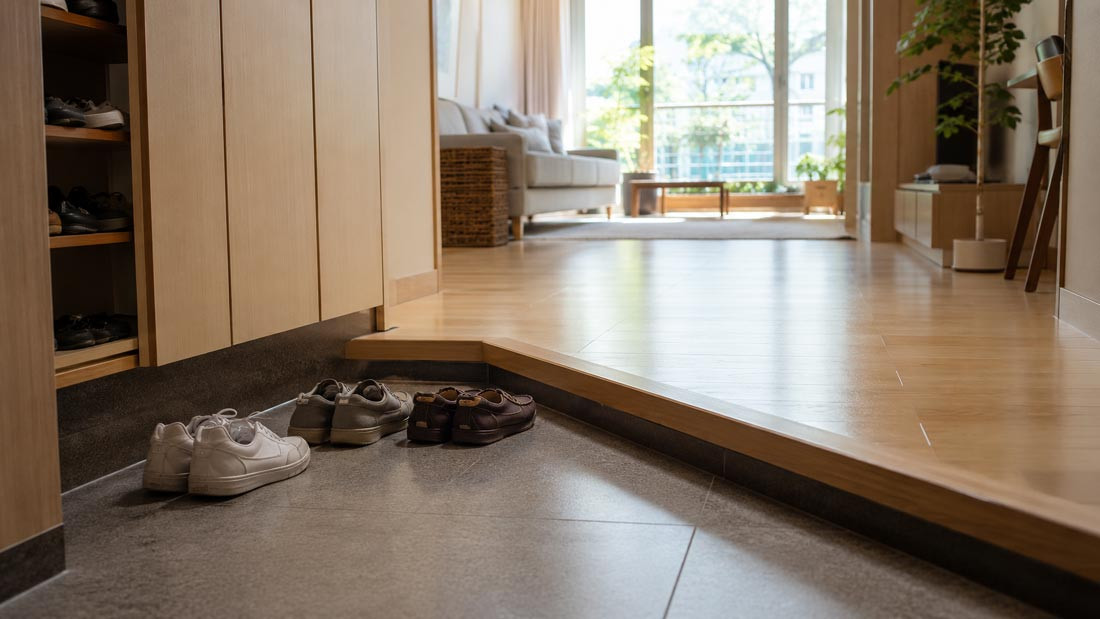
Most apartments have an entrance area called a hyeongwan (현관). You enter, take off your shoes, and step up into the main living space in socks or bare feet.
This creates a physical boundary between outside and inside.
Think about everything the bottom of a shoe touches during a normal day—sidewalks, parking lots, public bathrooms, subway stations, elevators and whatever that mysterious thing on the pavement was that you’d rather not investigate.
Most of it stays near the entrance.
As a Korean, walking through my living room wearing outdoor shoes would feel genuinely strange. Even if somebody told me, “Don’t worry, they’re clean,” my brain would still be saying, Nope. Those are shoes.
It isn’t really a house rule anymore.
It’s instinct.
2. Korean Life Happens Much Closer to the Floor
Keeping shoes outside matters even more because Koreans have historically lived very close to the floor.
Traditional Korean homes developed around ondol, the Korean floor-heating system. Modern apartments now use updated heating systems, but warm floors remain an important part of Korean home life.
And when the floor is warm, something interesting happens.
The floor becomes living space.
Children play there. Adults sometimes sit there. Families may fold laundry there. Someone might lie down on the living room floor while watching television even though a perfectly good sofa is two meters away.
I understand this one very well.
When the floor is warm on a freezing Korean winter day, it can be surprisingly difficult to convince yourself that a chair is somehow the better option.
Because people actually use the floor this way, a dirty floor feels much more personal.
You’re not just looking at it.
You’re living on it.
3. Socks Are Basically a Cleaning Inspector
There is an unofficial test for whether a Korean floor is clean.
Wear white socks.
Walk around.
Then look down.
I’m only half joking.
Because people commonly walk around Korean homes in socks or bare feet, you notice dirt on the floor quickly. A tiny crumb that might be invisible from standing height suddenly becomes very obvious when it sticks to your foot.
That changes how people respond to small messes.
See some hair?
Pick it up.
Feel crumbs?
Vacuum.
Something sticky?
Wipe it.
Cleaning doesn’t always wait for “cleaning day.” Often it happens in tiny bursts throughout the day.
Of course, this doesn’t mean every Korean follows their children around with a vacuum cleaner.
Although some days, as a parent, it certainly feels tempting.
4. Vacuums Are Never Far Away
In many Korean apartments, vacuuming is an easy everyday task rather than a major weekend event.
Cordless stick vacuums have become common, and robot vacuums are also popular in many households.
The important part isn’t really the technology.
It’s convenience.
If cleaning the floor means pulling a giant vacuum from the back of a closet, connecting tubes, finding an outlet, and dragging the machine through every room, you may postpone it.
If a cordless vacuum is standing nearby?
Three minutes.
Done.
Our family life has made me appreciate this kind of quick cleaning much more than I did when I was younger. When children are involved, waiting until the house is visibly dirty is not a particularly successful strategy.
Tiny messes have a strange talent for becoming large messes.
5. The Entrance Is Designed to Contain Mess
The Korean entrance isn’t simply where shoes happen to come off.
It is usually designed around that behavior.
Many modern apartments have dedicated shoe cabinets near the front door. Umbrellas, slippers, outdoor accessories and sometimes sports or children’s items can be stored there instead of moving deeper into the home.
That creates something like a small transition zone.
Outside life comes in.
Shoes stop.
Coats and bags may come off.
Then you enter the cleaner interior.
It’s such a normal part of Korean apartment design that I rarely notice it.
But remove that little entrance zone and I think many Korean families would suddenly realize how much work it has been doing for us all these years.
6. Korean Bathrooms Can Be Surprisingly Easy to Wash Down
Another thing that can surprise foreign visitors is the Korean bathroom.
Traditionally, many Korean bathrooms have been designed as relatively wet spaces, often with floor drains that make washing floors with water practical. Bathroom styles are changing, especially in newer apartments, so not every Korean bathroom works exactly the same way.
But the idea of using water to clean the bathroom floor is very familiar.
You don’t necessarily treat every drop of water on the floor like an emergency.
You wash.
You rinse.
The water goes toward the drain.
There is something satisfying about it.
A bathroom can go from “I really need to clean this” to fresh and washed surprisingly quickly.
Of course, water doesn’t magically make bathrooms clean. Ventilation and drying still matter.
Sadly, Korean bathrooms have not discovered a way to make cleaning completely disappear.
If they ever do, I will be first in line.
7. Fine Dust Changed the Way Many Koreans Think About Indoor Air
Here’s the less romantic side of living in Korea.
Fine dust can be a real concern.
On days when particulate pollution is high, many Koreans check air-quality information just as naturally as they check the weather. Windows may stay closed, and air purifiers are common in many homes.
That has made indoor air feel like another part of keeping a home “clean.”
Not just the floor.
Not just the bathroom.
The air too.
There is an irony here.
Opening every window used to be the obvious answer when you wanted fresh air. In Korea, there are days when you look outside, check the air-quality level, and think, Maybe not today.
When conditions are good, though, opening windows and airing out the home still feels wonderful.
Especially in spring or autumn, when Korea gives us those rare perfect days between “too cold” and “why is it this hot?”
8. Apartment Living Encourages Frequent, Small Cleaning
A large share of South Korea’s population lives in apartments, particularly in urban areas.
Apartment living changes how mess behaves.
Rooms are relatively close together. The kitchen flows into the dining or living space. Dirt in one area doesn’t feel very far away from everything else.
That can make clutter noticeable quickly.
But it also makes quick cleaning practical.
You can vacuum several rooms without traveling far. You can open windows across the apartment for ventilation. You can notice what needs attention simply by walking from the bedroom to the kitchen.
There is another side to this, of course.
In a smaller space, five things left in the wrong place can somehow look like fifty.
I have learned this lesson many times.
9. Cleaning Before Guests Arrive Is Almost a Ritual
Maybe this isn’t uniquely Korean at all.
But Korean parents will understand exactly what I’m talking about.
Someone is coming over.
Suddenly everyone sees the house differently.
That pile in the corner?
Why is that there?
Those things on the table?
Put them away.
The bathroom?
Check it again.
Growing up, I sometimes wondered whether guests believed Korean families simply lived in perfectly clean houses all the time.
They did not see what happened during the hour before the doorbell rang.
This is an important part of the “Korean homes are so clean” impression.
Visitors usually see a home after the residents know visitors are coming.
You are seeing the finished performance.
You missed rehearsal.
10. Cleaning and Organizing Are Often Two Different Jobs
One thing Korean homes have in common with homes everywhere is that being clean and being organized are not always the same thing.
The floor may be spotless.
The bathroom may be freshly cleaned.
And somewhere there is a drawer that nobody should open.
Every family has one.
At least, that’s what I choose to believe.
Modern Korean apartments often include significant built-in storage—shoe cabinets, closets, kitchen cabinets and other hidden spaces. That can help a home look visually calm even when everyday life is happening behind those doors.
Sometimes minimalism is a lifestyle.
Sometimes it is simply very good cabinet doors.
11. Recycling Creates Its Own Household Routine
Recycling is a very visible part of apartment life in Korea.
Residents commonly separate categories such as paper, plastic, glass, cans and other recyclable materials according to local rules and their building’s collection system.
At first glance, this sounds unrelated to keeping a home clean.
In practice, it creates a routine.
Packaging comes into the home. It gets separated. On designated days or according to the building’s system, it leaves again.
Cardboard delivery boxes don’t get to become permanent furniture.
Well, usually.
Online shopping has tested this system rather aggressively.
Sometimes I look at a pile of delivery boxes and wonder whether I ordered products or accidentally started constructing another room.
12. Korean Parents Teach “Inside” and “Outside” Very Early
Children learn the boundary between outside and inside quickly.
Take your shoes off.
Put them here.
Wash your hands.
Change clothes if necessary.
Don’t climb onto the bed wearing something dirty.
Naturally, children do not obey every instruction perfectly.
If they did, parenting books would be much shorter.
Still, these habits start early.
Over time, they stop feeling like cleaning rules and become normal behavior. That’s probably one reason some Korean homes can remain relatively clean without residents feeling as though they are constantly performing a giant cleaning operation.
The habits happen before the mess.
At least that’s the theory.
Parents know reality occasionally has different plans.
13. Bedding Gets Attention Too
For Koreans, cleanliness isn’t limited to surfaces people can see.
Bedding matters.
Blankets, mattress pads, pillow covers and other fabrics are washed or aired depending on the household, season and material. In Korea’s humid summer, keeping bedding fresh can feel particularly important.
There is a very specific pleasure in taking a shower and getting into clean bedding.
Maybe that isn’t Korean at all.
Maybe that’s universal human happiness.
Either way, I strongly recommend it.
14. Cleaning Is Often Woven Into Daily Life Rather Than Saved for One Big Event
This may be the biggest difference.
When I think about how homes stay clean, I don’t imagine somebody spending five heroic hours cleaning every Sunday.
I think about small actions.
Shoes come off at the entrance.
A spill gets wiped immediately.
Hair on the floor gets vacuumed.
Packaging gets separated for recycling.
The bathroom floor gets rinsed.
Things are put back before they spread into another room.
None of these actions is impressive.
That’s exactly why they work.
A clean home is often less about cleaning harder and more about preventing dirt and clutter from traveling.
So, Are Korean Homes Really Cleaner Than Homes in Other Countries?
Honestly?
There is no sensible way to say that an entire country’s homes are “cleaner” than everyone else’s.
Korea has immaculate homes and messy homes.
Some people genuinely enjoy cleaning. Others avoid it until avoidance is no longer an option.
I won’t tell you which category I occasionally belong to.
What makes Korean homes interesting isn’t that Koreans are somehow naturally cleaner.
It’s that several parts of Korean culture work together in a way that can make indoor spaces feel clean: removing outdoor shoes, living close to the floor, having a defined entrance area, cleaning floors frequently, separating recycling, and treating the inside of the home as distinctly different from the outside world.
Once you notice that pattern, the spotless-looking floors make more sense.
And perhaps the biggest secret is the simplest one.
Don’t bring as much dirt inside in the first place.
K-papa’s Take
As a father, my definition of a clean home has changed.
Years ago, I might have imagined a perfectly organized living room with nothing out of place.
Now?
If I can walk across the floor without stepping on something unexpected, we’re already having a good day.
Joking aside, I think the most Korean part of keeping a home clean isn’t constant scrubbing. It’s the invisible boundary at the front door.
Outdoor shoes stay there.
Inside is where we sit, lie down, play with the kids, rest and spend much of our family time.
Maybe that’s why taking your shoes off doesn’t feel like etiquette to me.
It feels like coming home.